
The Entry-Level Kawasaki Engine So Reliable It’s Still In Production After Decades
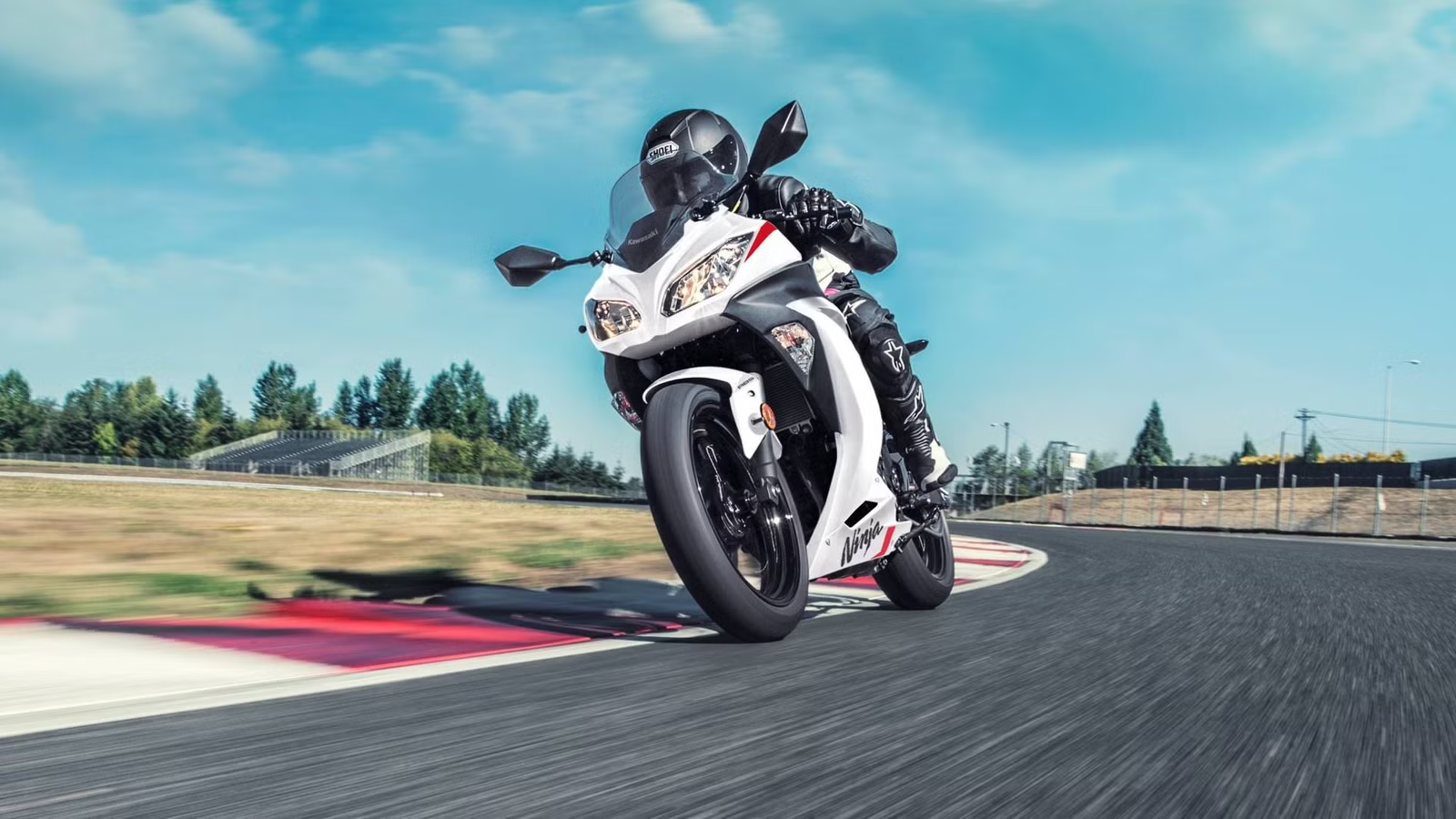
Today, the expectation with entry-level/beginner motorcycles is that beginners will drop them, practice figures of eight, bounce them off the rev limiter cold, learn about chain maintenance the hard way, and quickly trade up. Consequently, starter bikes are built cheap; mostly single-cylinder machines with optional liquid cooling and chassis hardware that rarely tests your skill. Their sole purpose is acting as a temporary stepping stone. Yet in one Japanese showroom sits an anomaly: a motorcycle whose engine has endured for decades, offering bulletproof reliability that embarrasses machines twice its size and triple its price.
Why Bulletproof Beginner Bikes Don’t Make Sense From A Business Point Of View

From a strictly business perspective, building an entry-level motorcycle that is indestructible does not make sense. The upgrade ladder needs to be predictable: beginner riders are supposed to outgrow their first motorcycle, trade it in for something larger, and repeat the process until they settle on the motorcycle that suits their skill and usage best.

If the very first motorcycle does not break, there is little incentive for a casual rider to trade up. There is also the matter of emission standards. While the US is relaxed about motorcycle emissions, the rest of the world is not, which means building beginner motorcycles must meet certain cost targets. Emissions restrictions have killed many icons, or manufacturers simply release another beginner motorcycle with slightly more displacement to ensure performance is not hit.
Yet, Kawasaki Takes Its Own Approach Here

Kawasaki might be more well known for its warp-speed superbikes, but it also applied the same philosophy to its budget commuters a long time ago. It gave one of its budget motorcycles a high-revving twin-cylinder engine, liquid cooling, and a ferociously high redline that could put a smile on the face of even a seasoned rider.

It was genuinely good to ride thanks to its racetrack pedigree, and over the years, it exhibited durability that was unheard of in the starter segment. In fact, it was so flexible that it went from powering a sports bike to then powering a beginner adventure-tourer motorcycle. We are very used to manufacturers redesigning engines every so often to keep up with the times, but this engine simply hasn’t needed it, and Kawasaki has let it carry on its legacy even 40 years later.
How The Legendary EX250 Architecture Evolved Into The Modern Ninja 300
The engine we’re talking about is the 180-degree parallel twin that has done duty in a number of beginner Kawasaki road bikes like the Ninja 250 and Ninja 300. It originated in the 1983 GPz250, and we know it more commonly as the 1986 EX250, known as the Ninja 250R here. It was the undisputed king of the beginner segment for well over two decades until emissions and competition forced it to evolve. Then, in 2013, Kawasaki increased its stroke, taking displacement to 296 cc; thus was born the Ninja 300. It got taken off sale when the Ninja 400 debuted, but the Ninja 300 ABS is back in showrooms this year with an aggressive price tag, carrying on the legacy of an entry-level Kawasaki engine so reliable it is still in production today.
The Versys-X 300 Harnesses Screaming Twin Reliability For Touring

The same engine serves duty in the baby Versys, too. You might scoff at the idea of a sub-300 cc tourer, but that is exactly what the Versys-X 300 is. This is the most beginner-friendly adventure motorcycle, and it utilizes the same engine as the Ninja in the same state of tune, but pairs it with a steel backbone chassis, beefier 41 mm forks with 5.1 inches of travel, and a rear shock that offers 5.8 inches of travel. The 17-inch alloy wheels are ditched in favor of a 19/17-inch combination of spoked steel rims.
It also has a longer wheelbase, more ground clearance, and a slightly higher seat height, although it is still very manageable at 32.1 inches. With the 4.5-gallon tank, it can easily offer over 200 miles of range even at highway speeds, and this engine sits pretty at high revs with not too many vibrations. It is untroubled by sitting in the higher parts of its rev range for extended periods of time. A $5,799 price rounds it all off.
Why 39 Horsepower At 11,000 RPM Refuses To Wear Out Its Internals

Since the larger 296 cc engine is on sale today in the newer Ninja 300, that’s where we’ll focus properly. This is a parallel-twin, short-stroke engine with a 180-degree firing order and a compression ratio of 10.6:1. It needs 2.4 quarts of oil, which is a lot for a small-displacement engine; in comparison, a 400 cc single will need less than 1.6 quarts.

It is the same with the cooling system: overkill for an engine that generates 39 horsepower at 11,000 RPM and 19.3 pound-feet at 10,000 RPM. A recent update has been an assist and slipper clutch for the six-speed gearbox, and fuel injection made its way to the 250 cc in 2008, although the North American market never saw anything but carburetion on the 250. FI only debuted with the 296 cc engine in 2013.
Simple 37 mm Telescopic Forks Deliver Low-Maintenance Chassis Durability

The Ninja 300 uses a steel tube diamond frame with the engine as a stressed member. This pairs up with a simple suspension setup, with 37 mm telescopic forks at the front with 4.7 inches of travel, and a Uni-Trak linkage shock with adjustable preload that offers 5.2 inches of travel. It is one of the few motorcycles that uses the exact same brake calipers at the front and the rear, two-piston floating units, but the front brake disc is larger at 290 mm, whereas the rear is a 220 mm one. 17-inch alloy wheels and tubeless tires round out the chassis package. Despite the simple underpinnings, this is a Ninja that first-time riders should not ignore.
Standard ABS And Forgiving Handlebar Geometry Offset Spartan Equipment

The Ninja 300’s supersport styling makes it appear a lot larger than its displacement; it is one of the best versions of the Ninja. There are clip-on handlebars that are mounted above the triple clamp, and the footpegs are moderately rearset, so it is quite easy for beginners to use. Another feature that helps is standard dual-channel ABS. The rest of the features are limited: an instrument cluster with a large analog tachometer that takes center stage is flanked by warning lamps.
At the bottom, there is an LCD that displays speed, fuel level, trip meters, odometer, a clock, and an economical riding indicator. The latest iteration of the Ninja 300 also makes the radiator fan blow hot air downward rather than onto the rider’s legs, which really helps on a hot day in traffic. Kawasaki has priced it at $4,999, making it the cheapest parallel-twin sportbike today.
Yamaha’s Decade-Old 321cc Platform Plays Catch-Up To Kawasaki’s 40-Year Run

The $5,499 Yamaha YZF-R3 is a budget bike that can do it all. It has a 321 cc engine that has been in continuous production since 2014. This was a clean-sheet design, but with 41.4 horsepower and 21.8 pound-feet of torque, Yamaha has not seen any need to update it. Like the Kawasaki engine, it powers a different Yamaha model, the naked MT-03, and with its 180-degree firing order, it is uncannily similar to the Ninja 300. The R3 offers a slightly better chassis setup with inverted forks and styling that is a little more aggressive than the Ninja.
Source: Kawasaki USA

Related posts

Latest Post



No Comments