
The Five-Door Family Hauler That Ran The Quarter Mile At 108 MPH
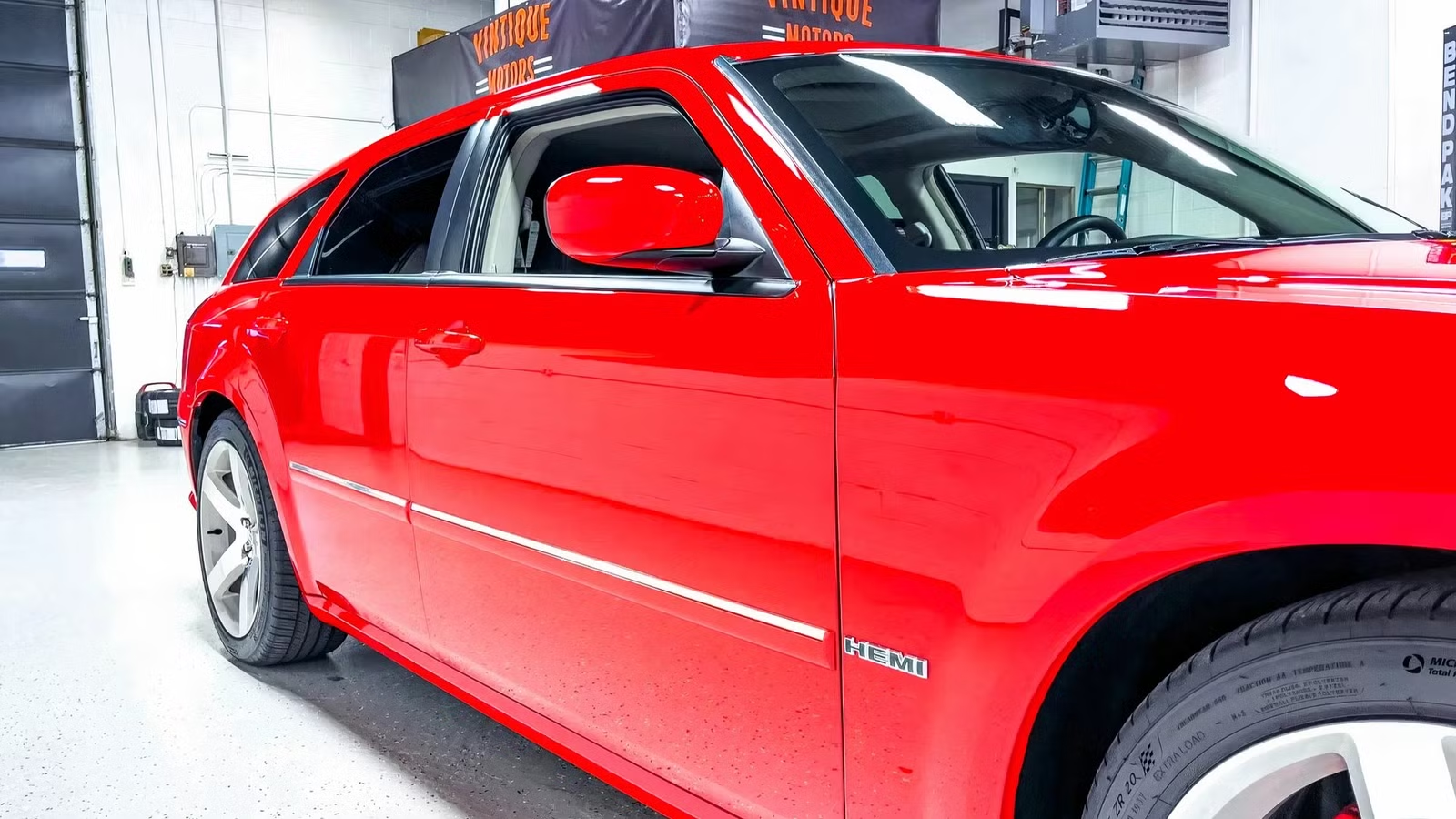
By the middle of the 2000s, a 13-second quarter mile still meant something serious. Sports cars chased those numbers, and muscle cars bragged about them. Family wagons usually watched from a safe distance while carrying soccer bags and bulk groceries. But one American five-door could cover the quarter in 13.1 seconds at 108.2 mph, carry five people, and still swallow a weekend’s worth of luggage. The wild part was how Detroit built it, what it cost, and how little time it got to make its case.
A 13-Second Quarter Mile Was Muscle-Car Territory

Of course, performance numbers need period context. A 13-second pass sounds less shocking today, when a powerful luxury SUV can launch hard enough to rearrange the groceries. In 2005, things looked very different. MotorTrend recorded 13.6 seconds at 99.9 mph from an automatic 2005 Ford Mustang GT. Another test put a Mustang GT at 13.5 seconds and 103.6 mph. Pontiac’s 400-hp GTO lived in the low-13s, while the Cadillac CTS-V could also crack roughly 13.1 seconds. A wagon running in that company had graduated far beyond the usual “quick for what it is” compliment.
Europe had already proved that a long roof and a fast engine could coexist. Mercedes-AMG built brutally quick E-Class wagons, and Audi had turned the practical estate into something capable of embarrassing sports cars. In fact, MotorTrend clocked a supercharged Mercedes-Benz E55 AMG wagon at 12.3 seconds in the quarter during a period comparison. The idea of a high-performance wagon therefore carried no great technical mystery. The Europeans had simply tied that idea mostly to expensive machines with premium badges.
That made the American approach much stranger and, for enthusiasts, far more interesting. Rather than build a polished six-figure autobahn missile, one Detroit company applied familiar muscle-car thinking to a body with a rear hatch. The recipe centered on displacement, rear-wheel drive, big brakes, wide rubber, and enough horsepower to make a stoplight feel like a starting tree. Its price sat within reach of buyers already considering serious V8 performance cars..

The Factory Engineered It Like A Muscle Car, Not A Grocery Getter

The engine was definitely the start here. Under the hood sat a naturally aspirated 6.1-liter V8 rated at 425 horsepower at 6,000 rpm and 420 lb-ft of torque at 4,800 rpm. A five-speed automatic handled the shifting, while the drivetrain sent power to the rear wheels. There was no turbocharger waiting for boost and no supercharger whining above the intake. The big V8 made its numbers the old-fashioned way—with cubic inches, airflow, compression, and engine speed. Factory specifications placed the electronic engine-speed limit at 6,400 rpm, unusually ambitious territory for such a large pushrod V8.
The rest of the hardware refused to play supporting actor. Four-piston Brembo calipers clamped 14.2-inch front and 13.8-inch rear vented rotors. Forged polished-aluminum wheels measured 20 by 9 inches, with Goodyear F1 Supercar tires fitted in staggered sizes. Engineers lowered and stiffened the suspension, revised the stabilizer-bar tuning, and sharpened the steering response. The 16.1:1 steering rack acted quicker than the ordinary version’s 18:1 setup. Yet the new base price came to about $37,995 – that figure put genuine SRT-grade hardware much closer to everyday performance-car money than European super-wagon money.
The Dodge Magnum SRT-8 Was America’s 425-HP Muscle Wagon

The mystery machine was the 2006–2008 Dodge Magnum SRT-8. Dodge had already taken a gamble with the standard Magnum, a low-roof wagon with rear-wheel-drive proportions and styling that looked more chopped custom than suburban appliance. Then the Street and Racing Technology team got involved. SRT dropped the 6.1-liter Hemi into the five-passenger, five-door body and created a 425-hp wagon with 420 lb-ft of torque. The finished product landed somewhere between a muscle car, a family hauler, and an engineering department’s particularly entertaining lapse in adult supervision.
Despite its weight of about 4,379 pounds, the car reached 60 mph in 5.1 seconds with a quarter-mile run in about 13.1 seconds at 108.2 mph. Those results mattered because mass should have worked against the wagon. The SRT-8 carried a long 120-inch wheelbase, room for five, and a genuinely usable cargo hold. Factory specifications listed 27.2 cubic feet behind the rear seats and 71.6 cubic feet with them folded. A machine capable of hauling home a flat-pack furniture purchase could also trap at 108 mph. Assembly instructions probably did not cover that part.

Calling it a sleeper requires some care, though. The Magnum SRT-8 never looked like the cheapest wagon in a rental lot. Its 20-inch wheels, lower ride height, big exhaust tips, SRT badges, deeper fascias, and visible red Brembos gave enthusiasts a decent set of clues. What made it sleeper-like was the mismatch between body type and capability – a five-door Dodge rolling through a school pickup lane simply did not fit the mental picture of a car that could challenge purpose-built performance machinery. MotorTrend later described the Magnum SRT8 as a “semi-sleeper,” which fits the car much better than pretending it hid every sign of trouble.
That disguise weakened further for 2008. Dodge refreshed the front end with slimmer headlights and revised the grille, while the SRT-8 gained a functional hood scoop. Anyone paying attention had less reason to mistake it for a normal grocery getter. By then, however, time had almost run out. The SRT-8 existed for only three model years, from 2006 through 2008, and the Magnum itself disappeared after the 2008 model year. Chrysler built only 4,130 Magnum SRT8s across those three years.
The 6.1-Liter Hemi Was Much More Than A Bored-Out 5.7

The usual shorthand says the 6.1-liter Hemi grew from Chrysler’s 5.7-liter Hemi architecture. That description works, but it leaves most of the interesting engineering on the floor. SRT engineers enlarged the cylinder bore by roughly 3.5 mm to gain displacement, then strengthened the deep-skirt iron block for the extra load. They fitted a forged-steel crankshaft and tougher powdered-metal connecting rods, while piston oil squirters helped control heat. Compression climbed to 10.3:1.
The top end received just as much attention. Higher-flow cylinder heads used larger valves and reshaped ports, while the intake employed larger, shorter runners aimed at high-rpm breathing. A performance-oriented billet-steel camshaft carried more aggressive timing, and hollow valve stems helped shed weight and heat; the exhaust valves also used sodium filling for better heat transfer. SRT pushed the useful operating range toward roughly 6,400 rpm, with peak horsepower arriving at 6,000. The result was 425 horsepower without forced induction.

SRT then built a chassis capable of using the engine instead of merely surviving it. The lowered suspension received its own spring, damper, bushing, and anti-roll-bar tuning. The big summer tires measured 245/45R20 up front and 255/45R20 at the rear. The faster steering made the 197.7-inch wagon respond with more urgency, and the four-piston Brembos gave it repeatable stopping power. MotorTrend measured a 112-foot stop from 60 mph and 0.90 g on the skidpad in its period wagon comparison. Even more surprisingly, the Magnum posted stronger slalom and skidpad numbers than the far more exotic Mercedes E55 AMG wagon tested beside it.
The transmission carried another piece of mid-2000s history. The W5A580 five-speed automatic offered AutoStick manual control and used a 3.06 final-drive ratio in the Magnum. This transmission family represented an early piece of hardware shared across the American and German sides of DaimlerChrysler after their merger. Mechanically related five-speeds appeared in both the Magnum SRT-8 and Mercedes E55 wagon, although software and gearing differed.
Dodge Killed The Wagon, But Its Formula Won

The Magnum SRT-8 lasted from 2006 through 2008, and the entire Magnum line vanished after that final model year. Dodge did not abandon rear-drive V8 performance, though – the company kept developing the same broad idea around the Charger and the newly revived Challenger. The 6.1-liter Hemi continued in the Challenger SRT8 through 2010, still making 425 horsepower and 420 lb-ft. For 2011, Dodge moved its SRT flagship toward the larger 6.4-liter 392 Hemi, which arrived with 470 horsepower and 470 lb-ft. The wagon missed that next step by only a few years.
What followed makes the Magnum’s timing sting more. The Charger and Challenger received larger and stronger Hemi packages, more aggressive SRT versions, and eventually the supercharged Hellcat treatment that turned Dodge horsepower into a cultural event. Those cars built enormous followings around an idea the Magnum had already demonstrated in a stranger package: take a roomy rear-drive Chrysler platform, install far more V8 than sensible transportation requires, give the chassis enough tire and brake to cope, and let practicality coexist with noise and speed.

That makes the Magnum SRT-8 more than an oddball from the first modern Hemi boom. It shows a road Dodge could have kept following. A later Magnum with a 392 would have been outrageous, and a Hellcat wagon would have turned the school run into a national emergency. Neither happened, and perhaps that unrealized potential explains why the original still matters. For three model years, Dodge sold a five-door family car with a naturally aspirated 425-hp V8, forged 20-inch wheels, Brembo brakes, rear-wheel drive, and enough speed to cross the quarter-mile line at 108 mph.
Source: Chrysler, Dodge, MotorTrend

Related posts




Latest Post


No Comments