
2026 Triumph Trident 660 First Look: Budget Bike, Premium Feel
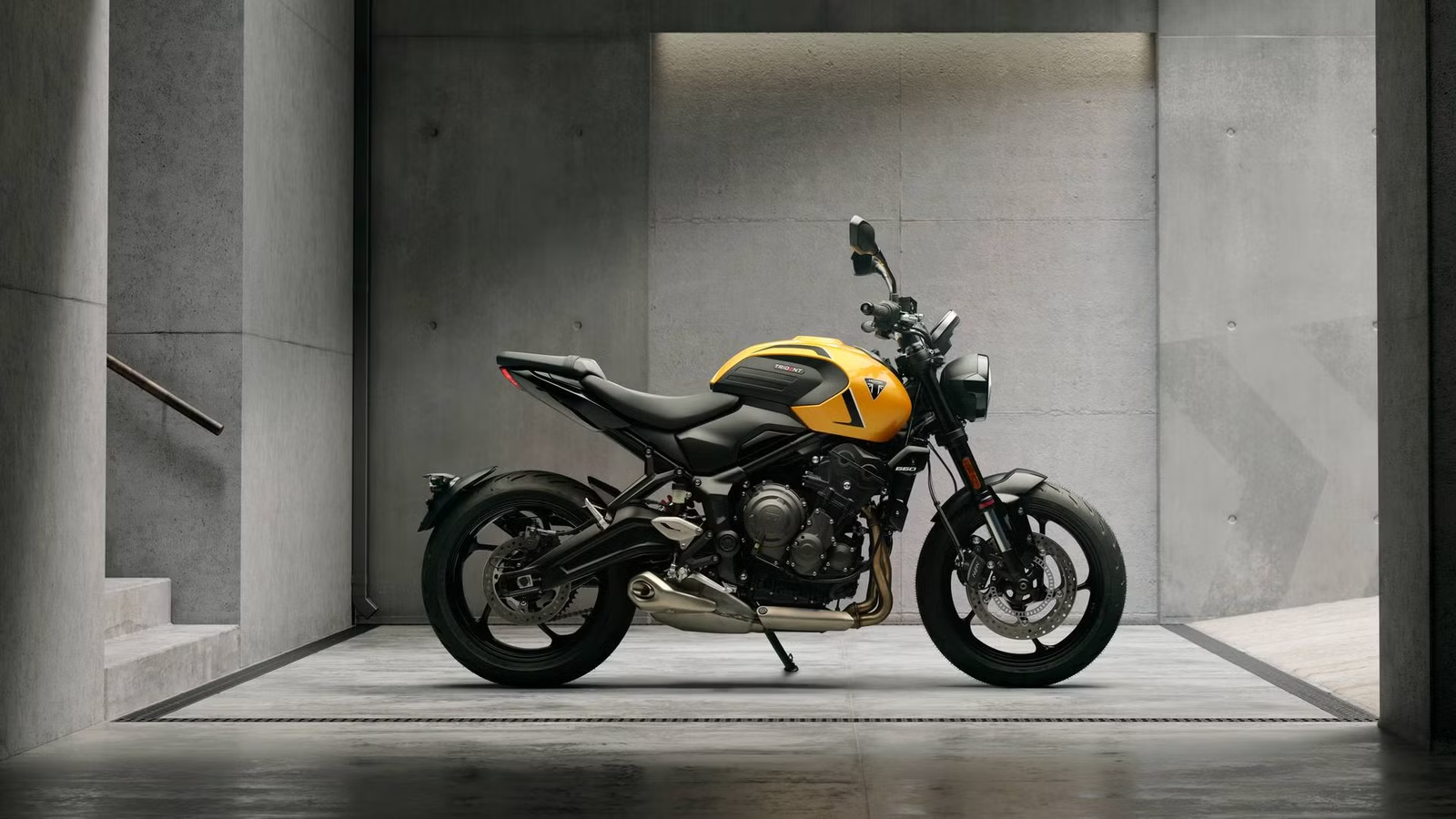
Triumph has given its entry-level roadster a substantial makeover for 2026. The Trident 660 remains the most accessible three-cylinder-equipped member of the British manufacturer’s roadster family, sitting below the larger Trident 800 and the more performance-focused Street Triple 765 range. This time, however, the update goes well beyond fresh paint and a few software tweaks. The engine, chassis, suspension, styling, and transmission have all received attention.

The result is a Trident that moves considerably closer to Triumph’s sportier middleweights without abandoning the straightforward formula that helped establish the model in the first place. US pricing starts at $8,745, putting the new Trident 660 only modestly above the previous version while bringing a sizable increase in output and revised mechanical hardware.
The 660cc Triple Gets A Much Bigger Set Of Lungs
The headline change sits between the frame rails. Triumph retains the familiar 660cc liquid-cooled, double overhead camshaft (DOHC) inline-three architecture, but substantially reworks how the engine breathes. Instead of the previous single throttle body, the 2026 Trident uses three individual 44mm throttle bodies, paired with a larger front-mounted airbox, revised cylinder head, larger exhaust valves, and a higher-lift cam profile.

Peak output rises from 81 horsepower to 94 horsepower at 11,250 rpm, while torque increases from 47 lb-ft to 50.2 lb-ft at 8,250 rpm. Triumph also increased the redline by 20 percent to 12,650 rpm and says at least 80 percent of peak torque remains available from 3,000 rpm until nearly 12,000 rpm. In other words, the extra output hasn’t simply been concentrated into one narrow section at the top of the tachometer.

The six-speed gearbox has been revised as part of the same update, receiving new input and output shafts, altered ratios, and revised final-drive gearing. A slip-and-assist clutch remains standard, as does clutchless up-and-down shifting. The exhaust also gets revised 3-into-1 headers, an updated catalyst, and a compact underslung silencer.
Triumph Had To Change The Chassis, Too
Three throttle bodies take up more room than one, so Triumph revised the tubular steel perimeter frame to accommodate the new intake arrangement. The basic chassis layout remains familiar, with a steel swingarm and 17-inch cast aluminum wheels wrapped in 120/70 front and 180/55 rear Michelin Road 5 tires. Wheelbase measures 55.2 inches, with 24.5 degrees of rake and 4.25 inches of trail.
Up front, the Trident retains its Showa 41mm upside-down separate-function big-piston fork with 4.72 inches of travel. The rear is more interesting, as a new Showa monoshock now adds rebound adjustment alongside preload, with 5.12 inches of travel. Braking comes from twin 310mm front discs with two-piston sliding calipers and a single 255mm rear disc. Braided brake lines are standard.

Wet weight is now 429.9 pounds, while the seat sits 31.89 inches from the ground. Triumph has also fitted wider handlebars to increase leverage and redesigned the bodywork around a reshaped 3.7-gallon fuel tank. A new split rider and passenger seat replaces the previous one-piece unit, while the round LED headlight keeps the visual link to the Trident that arrived at the start of the decade.
It Boasts Lots Of Electronics For A Middleweight Naked Bike

The Trident’s electronics package was already expanded significantly for the previous model year, and those features carry into the more powerful 2026 machine. A six-axis IMU supports lean-sensitive ABS and traction control, while the ride-by-wire throttle enables Sport, Road, and Rain riding modes. Traction control can also be switched off.
Would-be owners will also find cruise control and clutchless up-and-down shifting fitted as standard. The circular instrument cluster combines an LCD with an integrated color TFT screen, while Bluetooth connectivity adds turn-by-turn navigation, music control, and phone functionality. LED lighting and self-canceling turn signals round out the convenience features.

That equipment list matters because the Trident continues to occupy Triumph’s accessible end of the roadster market rather than presenting itself as a stripped-down budget special. There’s still no need to jump immediately to the Street Triple 765 just to get lean-sensitive rider aids, cruise control, connectivity, or a factory quickshifter, unless you’re hunting for a significant step up in overall performance.
The Trident 660 Is Getting More Grown-Up

The 2026 Trident 660 remains aimed at riders looking for a relatively compact naked bike that sits above the traditional beginner class without wandering into full-fledged supersport territory. Its 31.89-inch seat, upright roadster layout, 429.9-pound wet weight, and 660cc engine keep it approachable on paper, while the 94-horsepower output gives it considerably more headroom than the outgoing version.
At $8,745, the important part isn’t simply that Triumph has added more horsepower. The Trident now combines that stronger engine with an updated shock featuring rebound damping adjustment, a six-axis IMU, lean-sensitive ABS and traction control, three riding modes, cruise control, a quickshifter, Bluetooth connectivity, and a 10,000-mile service interval. That makes the 2026 update one of the Trident 660’s most substantial revisions since the model originally joined Triumph’s lineup.
2026 Triumph Trident 660 Photo Gallery
2026 Triumph Trident 660 Specifications
Engine:
|
Type |
Liquid-cooled inline-three; 240-degree firing order |
|
Displacement |
660cc |
|
Bore x stroke |
74.0mm x 51.1mm |
|
Maximum horsepower |
94 horsepower @ 11,250 rpm |
|
Maximum torque |
50.2 lb-ft @ 8,250 rpm |
|
Compression ratio |
12.0:1 |
|
Valvetrain |
DOHC; 12 valves, 4 valves per cylinder |
|
Fueling |
Multipoint sequential electronic fuel injection w/ electronic throttle control; three individual 44mm throttle bodies |
|
Exhaust |
Stainless-steel 3-into-1 header system w/ underslung stainless-steel silencer |
|
Cooling |
Liquid |
|
Transmission |
Six-speed manual w/ clutchless up-and-down shifting |
|
Clutch |
Wet multiplate slip/assist |
|
Final drive |
X-ring chain |
Chassis:
|
Frame |
Tubular steel perimeter frame; twin-sided fabricated steel swingarm |
|
Front suspension; travel |
Showa 41mm inverted Separate Function Big Piston fork; 4.7 inches |
|
Rear suspension; travel |
Showa monoshock w/ preload and rebound adjustment; 5.1 inches |
|
Wheels |
Five-spoke cast aluminum alloy |
|
Front wheel |
17 x 3.5 inches |
|
Rear wheel |
17 x 5.5 inches |
|
Tires |
Michelin Road 5 |
|
Front tire |
120/70R17 |
|
Rear tire |
180/55R17 |
|
Front brake |
Dual 310mm fixed discs w/ 2-piston sliding calipers |
|
Rear brake |
255mm fixed disc w/ single-piston sliding caliper |
|
ABS |
Standard lean-sensitive ABS, supported by a six-axis inertial measurement unit (IMU) |
|
Electronic rider aids |
Throttle-by-wire; Sport, Road and Rain ride modes; six-axis IMU; lean-sensitive ABS; lean-sensitive traction control, switchable off; cruise control; clutchless up-and-down shifting; LCD instruments w/ integrated color TFT display; Bluetooth smartphone connectivity w/ turn-by-turn navigation, music and call control; full LED lighting |
Dimensions & Capacities:
|
Wheelbase |
55.2 inches |
|
Rake |
24.5 degrees |
|
Trail |
4.25 inches (108mm) |
|
Seat height |
31.9 inches |
|
Ground clearance |
Not Provided By Manufacturer |
|
Lean angle |
Not Provided By Manufacturer |
|
Fuel capacity |
3.7 gallons |
|
Estimated fuel consumption |
57.6 mpg, claimed |
|
Curb weight |
430 pounds |
Price & Warranty:
|
Website |
triumphmotorcycles.com |
|
Price |
$8,745 MSRP |
|
Warranty |
Two-year unlimited-mileage warranty |
|
Service interval |
10,000 miles / 12 months, whichever comes first |
|
Color |
Cosmic Yellow, Snowdonia White, Stone Grey |
Source: Triumph Motorcycles

Related posts



Latest Post


No Comments