
The Used Affordable V8 Sports Car With A Manual Transmission
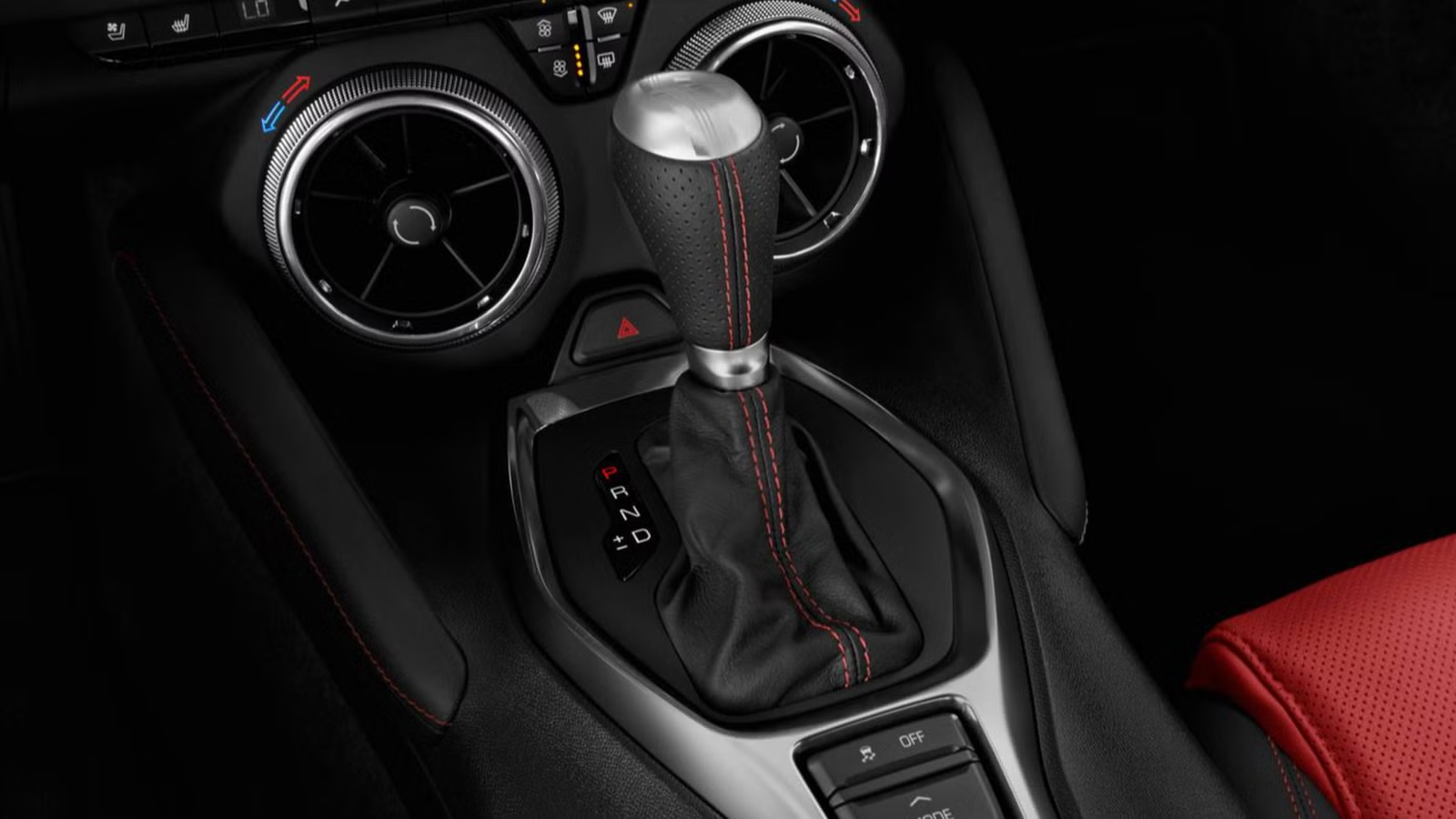
If you’ve spent any time in automotive circles lately, you already know the lament: the manual transmission is dying, and it’s taking the affordable V8 sports car with it. It’s not mere nostalgia talking — it’s math. Every model cycle seems to claim another exciting powertrain, another three-pedal option, another reason to actually want to drive to work. The enthusiast car market has never felt more squeezed, and the overlap between “V8,” “manual,” and “sports car” has shrunk to a near-vanishing point.

Apparently so, as only two are still sold today. The Mustang GT (and Dark Horse) and the Cadillac CT5-V Blackwing…that’s the entire list. While it’s true there still exists a decent selection of manual enthusiast cars, generally speaking, finding a V8 with three pedals is becoming as hard to find as an honest person in a multi-level marketing scheme. And it’s not as though the CT5-V Blackwing or Mustang are “affordable” per se, given that the Blackwing starts at nearly six figures and the base GT at nearly $50,000. Therefore, your only option for a truly affordable, manual V8 sports car is in the used market.
The Dual-Clutch Killed The Manual Sports Car
Is the manual the best transmission for pure performance? No. Does that mean manufacturers shouldn’t offer them? Also, no. In my humble opinion, not buying a manual because it’s not the “fastest” option is no different from spending $6k on a Fender Custom Shop Stratocaster despite only playing guitar twice a week in your bedroom. If you’re not tracking the car competitively, tenths of a second truly don’t matter. That said, we can all be swayed by the appealing nature of traditional performance statistics. A manual 911 GT3 can be more than half a second slower than the PDK version, and I can’t deny the allure of an impressively low 0-60 mph time. It’s also true that most people, especially those with a certain level of wealth, aren’t necessarily “true” enthusiasts — they simply want an exotic car to valet at their local steakhouse. And while there is nothing wrong with that, wealthy buyers do tend to have the greatest influence on the supercar market, which has pushed manufacturers toward “ease of use” and impressive acceleration figures over driver engagement.

Prior to the introduction and widespread adoption of dual-clutch transmissions, the automatic option often delivered worse performance and fuel economy. Today, the opposite is true, so most performance cars that offer a manual will also offer a DCT or a responsive torque-converter automatic, like the ZF8, alongside it. Even if you go back as recently as 2005, you’d find that nearly every supercar, sports car, and performance car was offered with a manual. That year proved to be the curtain call for the manual in the supercar segment — there hasn’t been a manual supercar since (excluding the manual Pagani and Koenigsegg models). The Gallardo, first-generation Audi R8, Murciélago, F430, Carrera GT, and Ford GT were all the last of their lineage to allow the driver full control. Thankfully, a few dedicated manufacturers who listen to their customers have kept the manual alive long enough that options still exist for those who want that experience.
Enthusiasts Want Fun Over Fast

Experience is everything for today’s car enthusiast. While speed is exhilarating, it’s not the only metric by which we judge an automobile. If speed were the end-all, be-all, I suspect the GR86, Miata, Civic Si, and GTI would all be as dead as the manual supercar, but they’re not. In fact, the GR86 and Miata remain perennial favorites with loyal followings, and Honda continues to offer the Civic Si (and Type R) with a 6-speed as the only transmission option. While for years a large part of the enthusiast community closely followed ever-increasing power and performance numbers, the world has changed since the introduction of mainstream EVs. Not to say that the barrage of sub-2 and 3-second EVs isn’t impressive, but it has caused some exposure fatigue. To paraphrase Syndrome from The Incredibles, when everything is fast, nothing is.

As speed has become democratized to the point that a base Model 3 is as quick as a C5 Z06, straight-line performance is no longer the exclusive calling card of dedicated sports cars. It’s similar to the sudden boom in popularity of anything with more than four cylinders: once everything became a 2.0-liter turbo, the idea of a more musical-sounding engine grew extra appealing. What enthusiasts want more than anything is a special, exciting, or giggle-inducing experience. Despite what some may tell you, finding an automotive experience that makes you smile might come from a “bad” car. Whether the “bad” comes from a lack of reliability, performance, or modern features doesn’t matter. I like everything from air-cooled Beetles, Willys CJ-2As, SN-95 Mustangs, manual Nissan Maximas, Miatas, 911s, and all the way up through a gated Murci. Performance and capability just aren’t the primary drivers of car enthusiasm anymore, so finding the experience that brings you joy is all that really matters.
The 6th Generation Camaro SS Is A Powerhouse

While the massive appreciation of the 911 R could be largely responsible for the uptick in manual enthusiast offerings since 2016, Chevrolet never ditched the Camaro’s 6-speed. In fact, the Camaro may be coming back from the dead a second time and may even offer a manual transmission, unlike the Corvette. It only feels natural, as the Camaro has offered the opportunity to pair big, powerful V8 engines with three pedals since its initial introduction back in 1967. The Camaro and its Pontiac twin, the Firebird, began life as an answer to the Mustang. First-gen Camaros were fast and fun, but primarily muscle/pony cars that certainly weren’t designed with the Nürburgring in mind. First-gen and early second-gen Camaros have always been the darlings of muscle car enthusiasts and collectors alike. Due to the 1973 fuel crisis, the later second-gen and most third-gens — “plastic fantastic mobiles,” as my dad calls them — were as underperforming as anything from that era.
|
Horsepower |
455 |
|
Torque |
455 lb-ft |
|
0-60 MPH (6-Speed) |
4.3 |
|
Engine |
6.2L V8 (LT1) |
|
Curb Weight (6-Speed) |
3,718 |
While the “catfish” fourth-generation Camaro did have some powerful versions, it still wasn’t the proper sports car that the Camaro would become following its resurrection in 2010. In a moment of déjà vu, the fifth-gen arrived with a retro design, a few years after the S197 Mustang debuted in 2005. The 2010–2014 models are genuinely great sports cars, but it’s the sixth-gen that we’re highlighting here. The 2016–2023 Camaro SS comes with a 6.2-liter naturally aspirated pushrod V8 (LT1) producing 455 horsepower and 455 lb-ft of torque. That kind of power translates to a 0–60 mph time of just over four seconds when paired with the excellent Tremec TR-6060 six-speed manual. Speed aside, these are proper sports cars. Thomas from Throttle House, along with many other respected journalists, has praised the Alpha platform, the chassis, and especially the steering. Even without the optional 1LE track package, the sixth-generation is an absolute beast on track and a joy down a canyon or mountain road.
The Camaro SS Will Burn Rubber, Not Money

Surely, given how recent the sixth-gen is, you’re wondering what our justification is for sneaking “affordable” into the title of this article. While we’re not talking sub-$15k fun cars here, we are talking about a price range commensurate with a mid-trim Honda Accord Hybrid. And because these are relatively recent, they benefit from modern safety features, efficiency, and reliability far more than older V8 alternatives — which means, assuming you can get past the notorious blind spots, you could easily daily drive one.
Naturally, we are highlighting the six-speed manual version, which commands a small premium. While automatic SS trims can be found in the mid-$20,000 range, if you’re looking to row your own, expect to spend closer to $35,000. If you don’t mind a 1LT or 1SS trim, it’s not at all rare to find examples for just under $30,000, but assuming you want lower mileage and an accident-free history, you’ll need to stretch just a little beyond that.

$35k for a clean Camaro SS is truly a bargain given the car’s sheer capabilities. All SS models come equipped with a mechanical limited-slip differential, and it’s possible to find examples fitted with the brilliant MagneRide suspension as well. Astoundingly, while the most difficult to track down, SS 1LEs can occasionally be found in the $35,000 range, and if you’re looking for a track toy, the 1LE is definitely the one to get. As if you needed more reason to start searching, reliability isn’t bad either. The Tremec TR-6060 is exceptionally durable, and the 6.2-liter isn’t known for any major issues. Aside from some electronic gremlins typical of General Motors products and potential concerns with cylinder deactivation, these are about as dependable as it gets for a car this capable, this powerful, and this modern.
The Best Sports Car For The Money

I can hear your voices now, crying out into the night, “but I got a clean manual C5 for $15,000!” And as a huge fan of the C5, you’re not wrong to bring that up. There are many, often older, options that offer great V8 performance for $10,000–$20,000 less than a sixth-generation SS. Within this price range, you could opt for a C5 or C6, an S550 Mustang, or even a manual Challenger Scat Pack (although it’s much harder to find). These are all great options, but each has its pros and cons. The C5 and C6 are older, and as a caretaker of a 2001 C5, I can tell you that while the powertrain and driving experience are absolutely fantastic, the interior is complete garbage. While not a problem for a weekend toy, they aren’t the best for daily use. The S550 is much easier to see out of than a sixth-gen Camaro, but the steering isn’t as communicative, and the Getrag MT-82 is not known for its durability — and is nowhere near as satisfying to use as a TR-6060. Not to mention, if you are looking to go on track, the SS 1LE offers superior performance to the GT PP2.

Now obviously, in the spirit of finding the car that personally brings you joy, the Camaro SS might not be your cup of tea. That said, it seems altogether foolish not to highlight a car with this level of capability that can be purchased for the same money as a Honda CR-V with cloth seats. Plus, with the manual V8 becoming such a rarity, finding a car that can handle daily-driver duty and track duty — and is modern enough that you can put a car seat in the back and use Apple CarPlay to navigate — is few and far between. While a new manual Camaro may be on the horizon, for now, this is all we have. It may not be the best sports car ever made, but it’s certainly one of the best modern sports cars money can buy.
Sources: classic.com

Related posts


Latest Post


No Comments