
The Biggest American V-Twin Ain’t Got Nothing On This Massive Triple Engine
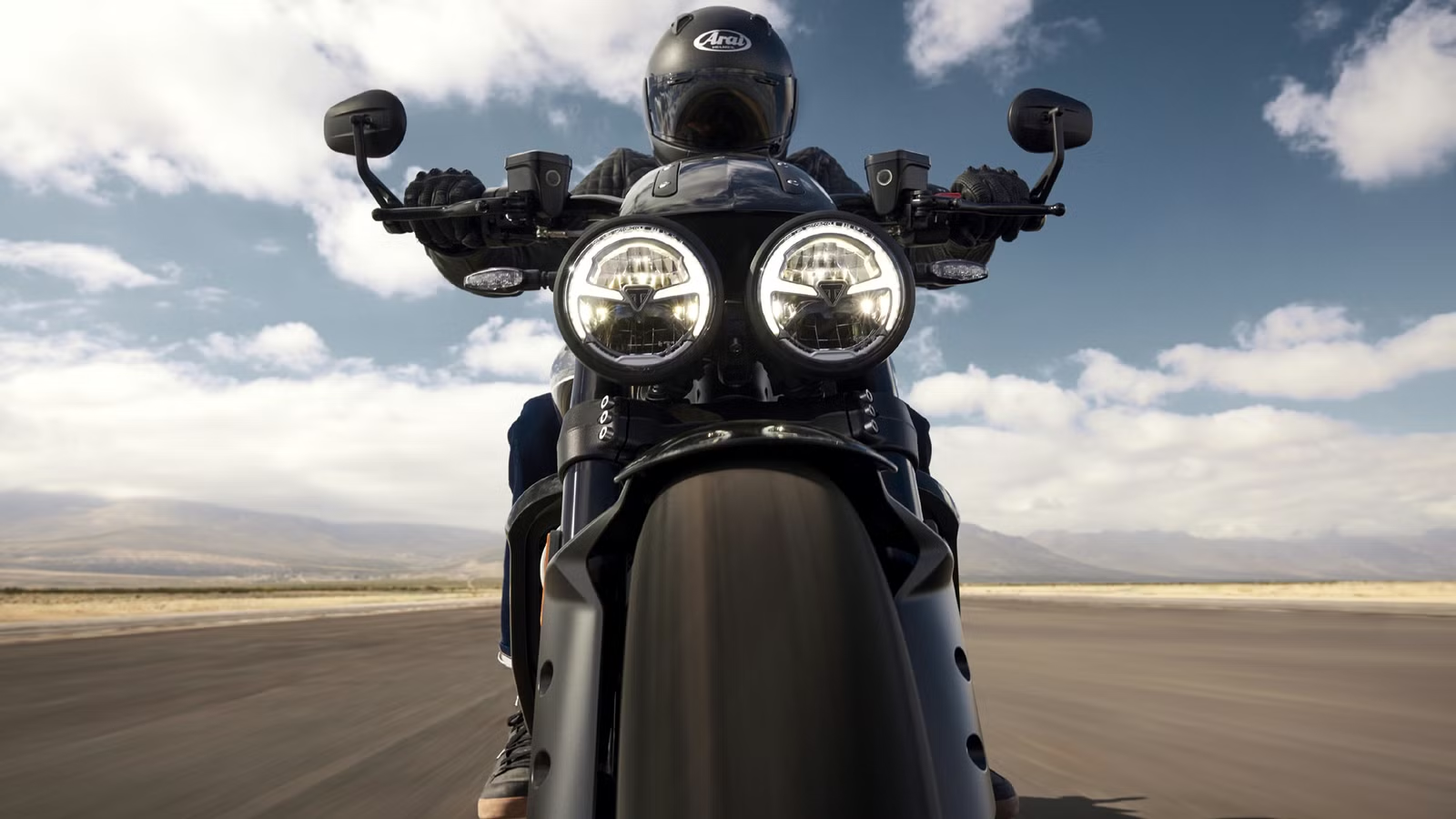
Harley-Davidson has spent decades making the big V-twin part of its identity, and today its largest street-compliant crate engine displaces 135 cubic inches. That works out to 2,212cc, which would be an enormous engine by almost any motorcycle standard. Yet there is a production motorcycle with another 246cc on top of that, and it does it with 3 cylinders.

The current version takes the idea further than ever. Its engine measures 2,458cc, produces 180 horsepower, and reaches peak torque at just 4,000 rpm. Those numbers are impressive, but the interesting part is how the motorcycle gets there and what had to be built around such a large powerplant.
Harley-Davidson’s Biggest V-Twins Are Already Enormous
There is nothing small about the upper end of Harley-Davidson’s Milwaukee-Eight family. The Screamin’ Eagle 135ci Stage IV crate engine is the company’s largest street-compliant crate performance engine, and the testing of one of these models came back at 144 horsepower and 149 lb-ft of torque at the rear wheel. It uses a 4.31-inch bore and a 4.625-inch stroke, along with an 11.6:1 compression ratio. Harley also fits CNC-ported cylinder heads, a high-lift cam, forged pistons, a 68mm throttle body, and larger fuel injectors.

This is not the engine that comes standard in a regular Harley touring model. It is a factory-built performance crate engine intended to replace the existing Milwaukee-Eight in compatible Touring motorcycles. At $8,349.95 for the engine alone, it also gives some idea of how serious Harley is about the upper end of its traditional V-twin formula. For most manufacturers, 135 cubic inches would be more than enough.
Even The Screamin’ Eagle 135ci Crate Engine Comes Up Short

The 135 is interesting because Harley did not reach its displacement by completely changing the basic big-twin formula. Its 4.31-inch bore works with a much longer 4.625-inch stroke. That long stroke is one of the reasons the engine can make so much torque at relatively low engine speeds.
Other manufacturers take different routes to achieve higher displacement. The Honda Gold Wing, though small in comparison, uses 6 cylinders to achieve its 1,833cc, or approximately 111.9 cubic inches. While typically known for their thumping inline twins, Triumph, in typical oddball fashion, decided to go with a three-cylinder to go bigger than all their competitors.
The Triumph Rocket 3 Took Motorcycle Displacement Even Further

Triumph had already crossed into unusual territory when the first-gen Rocket III arrived in 2004. Its inline 3-cylinder engine displaced roughly 2.3 liters at a time when many large cruisers were still well below the 2-liter mark. Rather than copying the American V-twin layout, Triumph placed its 3 cylinders in a line running lengthwise through the motorcycle. The engine naturally became the centerpiece of the entire design as it is truly a sight to behold.
That original Rocket established the basic formula Triumph has continued to develop. It paired large displacement with shaft drive, a long wheelbase, and a rear tire wide enough to look more at home on a custom build. The motorcycle was never intended to be a lightweight sportbike or a conventional cruiser. Triumph had effectively created its own category and spent the following 2 decades refining it.
From The Original 2.3-Liter Rocket III To The 2,458cc Rocket 3 Storm

The major change came in 2019, when Triumph increased Rocket displacement from 2,300cc to 2,458cc. The latest Rocket 3 Storm keeps that capacity but extracts more from it, with Triumph rating the engine at 180 horsepower at 7,000 rpm and 166 lb-ft of torque at 4,000 rpm. That represents a substantial increase over the previous Rocket 3, which produced 165 horsepower and 163 lb-ft. The extra output comes without increasing the engine beyond its already considerable 2,458cc.
The Storm still uses a liquid-cooled, double-overhead-cam inline triple with 4 valves per cylinder. Fuel arrives through multipoint sequential electronic injection, while electronic throttle control handles the connection between the rider’s right hand and the engine. A 6-speed transmission sends power through a shaft final drive rather than a chain or belt. None of this is especially exotic on its own, but packaging it around an engine this large makes the Rocket different from nearly every other production motorcycle.
The Rocket 3 Storm Gets 2.5 Liters From Three Cylinders

Breaking 2.4 liters across only 3 cylinders means each cylinder displaces more than 800cc. For perspective, an entire Triumph Trident 660 engine is smaller in capacity than one cylinder’s share of the Rocket’s total displacement. The pistons have a 110.2mm bore to work with, while the relatively shorter 85.9mm stroke keeps the engine from relying entirely on the long-stroke approach used by large American V-twins. Triumph can therefore combine huge cylinder capacity with an engine that still reaches its 180-horsepower peak at 7,000 rpm.
The layout also helps explain why the Rocket looks the way it does. Its 3 cylinders run longitudinally, and the engine occupies a substantial portion of the space between the wheels. Triumph does not try to disguise that size with covers or oversized bodywork. The exhaust headers leaving the side of the engine and the large intake hardware on the opposite side make the powertrain one of the most visible parts of the motorcycle.
A 110.2mm Bore Helps Explain Its Enormous Displacement

Looking at bore and stroke makes the comparison with Harley’s 135 especially interesting. The Triumph’s 110.2mm bore is slightly larger than the Harley’s roughly 109.5mm figure, but the Rocket’s 85.9mm stroke is considerably shorter than the Harley’s roughly 117.5mm stroke. Triumph then repeats that large cylinder 3 times instead of 2. The 2 engines arrive at huge displacement using distinctly different dimensions.
That difference also changes their character. Harley’s long-stroke V-twin is built around the low-speed response expected from a traditional American big twin, while the Rocket’s shorter stroke and 3-cylinder layout allow it to carry its power farther up the tachometer. Peak torque still arrives at only 4,000 rpm, so the Triumph does not need high engine speeds to move quickly. Keep turning the throttle, though, and the engine continues building toward its 180-horsepower peak at 7,000 rpm.
166 LB-FT At 4,000 RPM Changes The Way It Accelerates

The Rocket’s 166 lb-ft figure tells only part of the story. More important on the road is where that torque arrives and how much engine sits behind it. Peak torque is available at 4,000 rpm, and Triumph designed the engine to pull cleanly even when the rider short-shifts and leaves it in a taller gear. Passing does not always require dropping 2 gears. In fact, you probably never have need to downshift at all when passing.
That broad delivery suits a motorcycle that is too large to pretend it is a conventional sportbike. Open the throttle from the middle of the rev range and the Rocket can rely on displacement rather than frantic engine speed to build pace. A 6-speed gearbox is still there when the rider wants it, but the engine does not demand constant shifting to stay responsive. That is closer to the way a very large automobile engine behaves than the narrow power delivery traditionally associated with high-performance motorcycles.
Triumph Had To Build The Chassis Around That Engine

An engine this large creates another problem: the rest of the motorcycle has to carry it. The Rocket 3 Storm R weighs 317 kg wet, or about 699 pounds, and stretches across a 1,677mm wheelbase. Triumph uses a full aluminum frame and a single-sided cast-aluminum swingarm to save some weight, so it isn’t a traditional steel-framed heavyweight cruiser. The basic dimensions are large, but the chassis hardware is much closer to what would be expected on a modern performance roadster.
Up front are 47mm Showa inverted cartridge forks with adjustable compression and rebound damping. The rear uses a fully adjustable Showa piggyback-reservoir unit with a remote hydraulic preload adjuster. Braking is handled by twin 320mm front discs with Brembo Stylema 4-piston monobloc calipers, while another 4-piston Brembo works on a 300mm rear disc. Cornering ABS is standard, which matters on a motorcycle carrying this much speed and mass.
Shaft Drive And A 240-Section Rear Tire Put The Torque Down

The rear of the Rocket is dominated by a 240/50 R16 tire mounted on a 7.5-inch-wide wheel. That is substantially wider than the rear rubber used on most conventional road motorcycles, and it gives the Rocket the footprint expected from a machine built around 166 lb-ft of torque. Triumph pairs it with a 150/80 R17 front tire rather than trying to make the Rocket look or steer like a supersport.
Power reaches that rear wheel through a shaft rather than an exposed chain. A shaft adds weight, but it also eliminates routine chain adjustment and lubrication, which makes sense for a road bike expected to cover serious mileage. Triumph specifies 10,000-mile or 12-month service intervals for the Rocket 3 Storm, whichever comes first. For all of its oversized hardware, it was designed as a motorcycle to be ridden regularly.
The Rocket 3 Storm Remains In A Displacement Class Of Its Own

Harley-Davidson’s 135ci Screamin’ Eagle demonstrates just how far the American big-twin formula can be pushed with factory parts. The important qualification is that Harley quotes those figures at the rear wheel, while Triumph’s published 180 horsepower and 166 lb-ft are manufacturer engine-output figures. Putting those numbers side by side as if they came from the same type of test would not be a fair comparison.
Displacement requires no such qualification. The Rocket’s 2,458cc engine is 246cc larger, and Triumph describes it as the world’s largest-capacity production motorcycle engine. The current Rocket 3 Storm R starts at $26,695 before destination, so this is not simply a one-off engine or an aftermarket conversion. It is a regular production motorcycle built and sold around a factory 2.5-liter triple.
Harley-Davidson can still claim something the Triumph cannot replicate: the character and packaging of a traditional American V-twin, pushed to 135 cubic inches with factory engineering behind it. Triumph simply approached the displacement question from another direction and ended up farther down the road.
Source: Triumph Motorcycles, Harley-Davidson

Related posts





Latest Post


No Comments