
The Cruiser That Gives Riders The Best Mix Of Style, Comfort, And Reliability
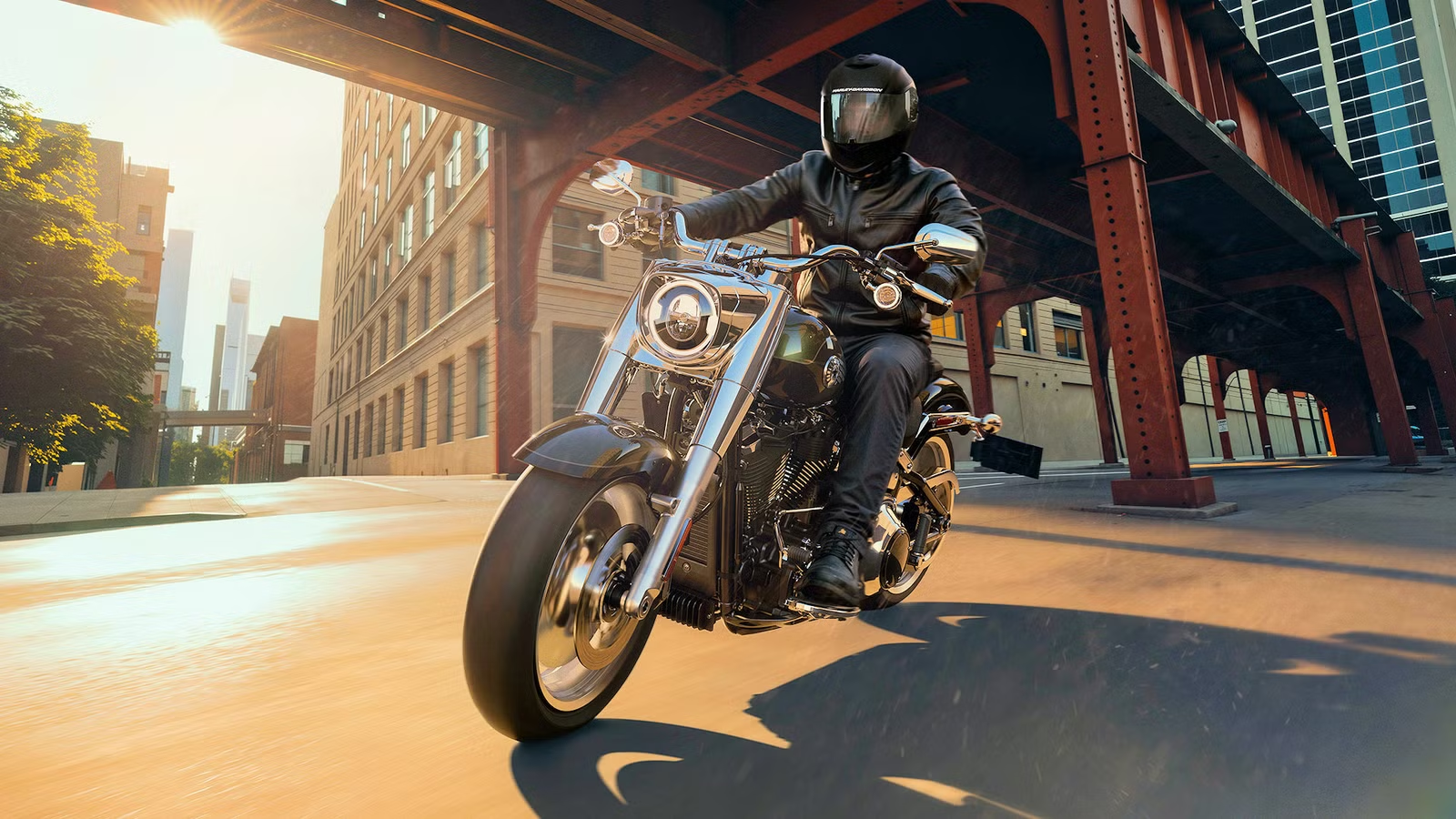
Cruisers have long been the definitive embodiment of open-road freedom. With their low-slung silhouettes, swept-back handlebars, and forward-set foot pegs, these machines are built for the sheer pleasure of devouring highway miles. Yet, for all their emotional appeal, many riders quickly learn that buying a heavyweight cruiser can mean accepting trade-offs. Some deliver breathtaking custom styling at the expense of long-distance comfort; others prioritize reliability but lack the raw mechanical soul.

The best cruisers, however, don’t force you to choose between looking good and being easy to live with. They strike a harmonious balance between muscular design, long-distance ergonomics, and real-world durability – and one heavyweight Harley-Davidson achieves that balance particularly well.
Modern Cruiser Buyers Want More Than Just Road Presence
Cruiser culture has always celebrated style. The low-slung silhouette, gleaming chrome accents, and exhaust note that announces your arrival before you even round the corner give these machines an unmistakable character that few other motorcycles can replicate. But modern motorcycle buyers have evolved. Today’s riders demand a far more complete package. They want a motorcycle that serves as a bold extension of their personal style while fitting seamlessly into real life – comfortable enough for weekend rides, reliable enough to trust on a spontaneous road trip, and equipped with modern safety tech that inspires confidence.
The Right Cruiser Can Balance Character With Everyday Usability


Achieving this balance is a delicate engineering act. The ideal heavyweight cruiser strikes a perfect chord between emotional appeal and practical execution. It delivers the classic V-twin torque and relaxed ergonomics that define the category, while also offering a plush seat, manageable low-speed weight, and electronic aids that intervene only when needed. When a manufacturer gets this synthesis right, the result is a machine that feels special on every ride, whether it’s a quick commute or an epic coast-to-coast tour – and this Harley shows just how rewarding that formula can be.
The Harley-Davidson Fat Boy Still Gets The Cruiser Formula Right
Starting MSRP: $22,599

The motorcycle in question has defined the intersection of style, comfort, and reliability for more than three decades. Of course, we’re talking about the Harley-Davidson Fat Boy. Introduced in 1990 as the brainchild of Harley design chief Willie G. Davidson, the Fat Boy was conceived as a retro-inspired cruiser with solid wheels and fat tires. It soon gained global fame as Arnold Schwarzenegger’s ride in the 1991 blockbuster Terminator 2: Judgment Day.

Over the years, the Fat Boy has remained a best-selling heavyweight cruiser, evolving through successive updates while retaining its unmistakable identity. For 2026, the Harley-Davidson Fat Boy starts at $22,599 MSRP and continues to build on that legacy with the same formula that made it famous – unmatched road presence, muscular American V-twin character, and the performance of Harley’s Milwaukee-Eight 117 engine.
The Milwaukee-Eight 117 Gives It The Muscle To Match The Looks

At the heart of the 2026 Fat Boy sits the Milwaukee-Eight 117 Custom, a massive 1,923cc (117 cubic inch) air/oil-cooled 90-degree V-twin that provides the muscle to match its heavyweight styling. It produces 103 horsepower at 4,800 RPM and 126 pound-feet at just 3,000 RPM, giving the Fat Boy effortless roll-on acceleration across the rev range. This Custom-tuned version of Harley’s latest big-twin platform delivers the kind of low-end punch and sustained thrust that makes highway cruising feel almost effortless. What sets the 117 apart, however, is how effectively it blends old-school V-twin character with modern refinement.

Its four-valve cylinder heads and dual internal counterbalancers help manage vibration without stripping away the satisfying V-twin pulse riders expect from a Harley. The engine is paired with a six-speed Cruise Drive transmission and low-maintenance belt final drive, creating a powertrain designed for relaxed, dependable long-distance riding. And despite its considerable displacement, the Fat Boy returns a claimed 47 mpg, making it surprisingly efficient for a heavyweight cruiser.
Relaxed Underpinnings And Ergos That Suit Both Boulevard Cruising And Weekend Backroads

Cruisers are meant to be ridden for hours on end, and the Fat Boy’s chassis and ergonomics are designed with long-distance comfort in mind. Built around Harley-Davidson’s tubular-steel Softail frame, it features dual-bending valve 49 mm front forks with aluminum triple clamps and a concealed free-piston coil-over monoshock at the rear with hydraulic preload adjustment. The suspension hardware, combined with a 65-inch wheelbase and low 26.6-inch unladen seat height, gives the Fat Boy a composed ride and confidence-inspiring road manners across varying conditions.

The riding position is quintessentially cruiser, with a plush, wide saddle, broad floorboards, and low, wide handlebars that keep the rider relaxed. Its substantial 694-pound weight can make parking and tight low-speed maneuvers a workout, but that heft largely disappears once the bike gets rolling. Despite its wide cast-aluminum Lakester wheels and imposing 160mm front and 240mm rear tires, the Fat Boy remains surprisingly neutral through corners, allowing it to transition smoothly from city boulevards to sweeping backroad curves.
Standard Rider Safety Enhancements Add Confidence

While the Fat Boy still looks unmistakably traditional, beneath the classic styling lies a sophisticated electronics package driven by a ride-by-wire throttle and a six-axis Inertial Measurement Unit. There are three riding modes (Road, Sport, and Rain) that change power delivery, engine braking, and traction intervention on the fly. Moreover, the rider aids include traction control, ABS, drag-torque slip control – along with their cornering-enhanced versions – plus cruise control and a tire pressure monitoring system (TPMS).

With 126 pound-feet of torque on tap and nearly 700 pounds to bring to a halt, the Fat Boy also needs serious stopping power. Harley-Davidson delivers with a four-piston fixed caliper gripping a 300mm front disc, paired with a two-piston floating caliper and 292mm rear disc. It also features a signature high-intensity LED headlight housed within the chrome nacelle, providing superior illumination, and there is a five-inch analog speedometer with a digital information display as well.
The Harley-Davidson Fat Boy Remains The Ultimate All-Rounder Cruiser
In a market filled with increasingly specialized motorcycles, the Harley-Davidson Fat Boy stands apart with a legacy that few cruisers can match. The Indian Super Chief Limited offers strong American styling and touring capability, but the Fat Boy carries greater cultural recognition. Meanwhile, the BMW R 18 brings impressive craftsmanship and classic styling, but its European identity sets it apart from the unmistakable American character of the Harley.

The Fat Boy, by contrast, brings these qualities together in one cohesive package. It combines more than three decades of unmistakable styling with long-distance comfort, modern technology, and the mechanical character expected from a heavyweight American cruiser. Few motorcycles in Harley-Davidson’s current lineup make an entrance quite like the Fat Boy. Park it, walk away, and there’s a good chance you’ll turn around for one more look. For riders seeking a heavyweight cruiser that commands attention, delivers effortless miles, and remains genuinely livable day after day, the Fat Boy makes a compelling case for itself.
Source: Harley-Davidson

Related posts

Latest Post


No Comments