
The American Bike That Still Feels Built to Last
What really makes a motorcycle feel built to last? Well, the answer depends on who you ask. For some riders, it is the history and pedigree behind the brand, and the confidence that comes with knowing generations of riders have trusted the same formula. For others, it is mechanical simplicity: fewer things to break, fewer distractions, and more focus on the core motorcycling experience.

And for some, it is knowing they can never really outgrow the motorcycle, because they can keep changing and customizing it as their needs and tastes evolve. For the American market, a motorcycle that combines all three can be surprisingly hard to find. Today, Harley-Davidson has one that makes a pretty convincing case.
How Seven Decades Of Engine Evolution Made Harley Synonymous With Durability
If someone asks you to picture an American motorcycle, chances are you would immediately think of Harley-Davidson. But it is worth asking why. Harley is hardly the only American motorcycle manufacturer, and its oldest rival, Indian Motorcycle, actually even predates it. The difference here is consistency. While Indian went through a rocky spell of ownership changes and periods without motorcycle production, Harley-Davidson kept showing up, year after year, generation after generation.


Take what lies at the heart of a Harley-Davidson, for example. The Knucklehead evolved into the Panhead, the Panhead gave way to the Shovelhead, and that lineage continued through the Evolution, Twin Cam, and today’s Milwaukee-Eight. The motorcycles and technology changed, but each generation had something to build on. Harley kept showing up, and over time, that consistency made the brand synonymous with the American motorcycle itself.
Harley-Davidson’s Road King Special Might Outlast All Of Us

As a true case in point of what we just talked about, along comes the Harley-Davidson Road King Special. It might have only arrived in 2017, but don’t let that fool you into thinking this is a new motorcycle. Its roots run far deeper, into a touring lineage that stretches back long before the Road King name ever appeared.
The Road King joined Harley-Davidson’s Touring lineup in 1994. But guess what it drew inspiration from? The 1988 FLHS Electra Glide Sport — itself a more pared-back take on the Electra Glide that came before it. And the Electra Glide wasn’t the beginning either. It evolved from the 1958 Duo Glide, which itself represented another step in the development of Harley’s FL touring motorcycles. Follow that trail back far enough, and you start to see how Harley actually evolves: one motorcycle gives the next something to build on, and decades later, those old ideas are still visible in what rolls out of the factory.
How Harley Stripped The Touring Hardware And Created A Factory Custom

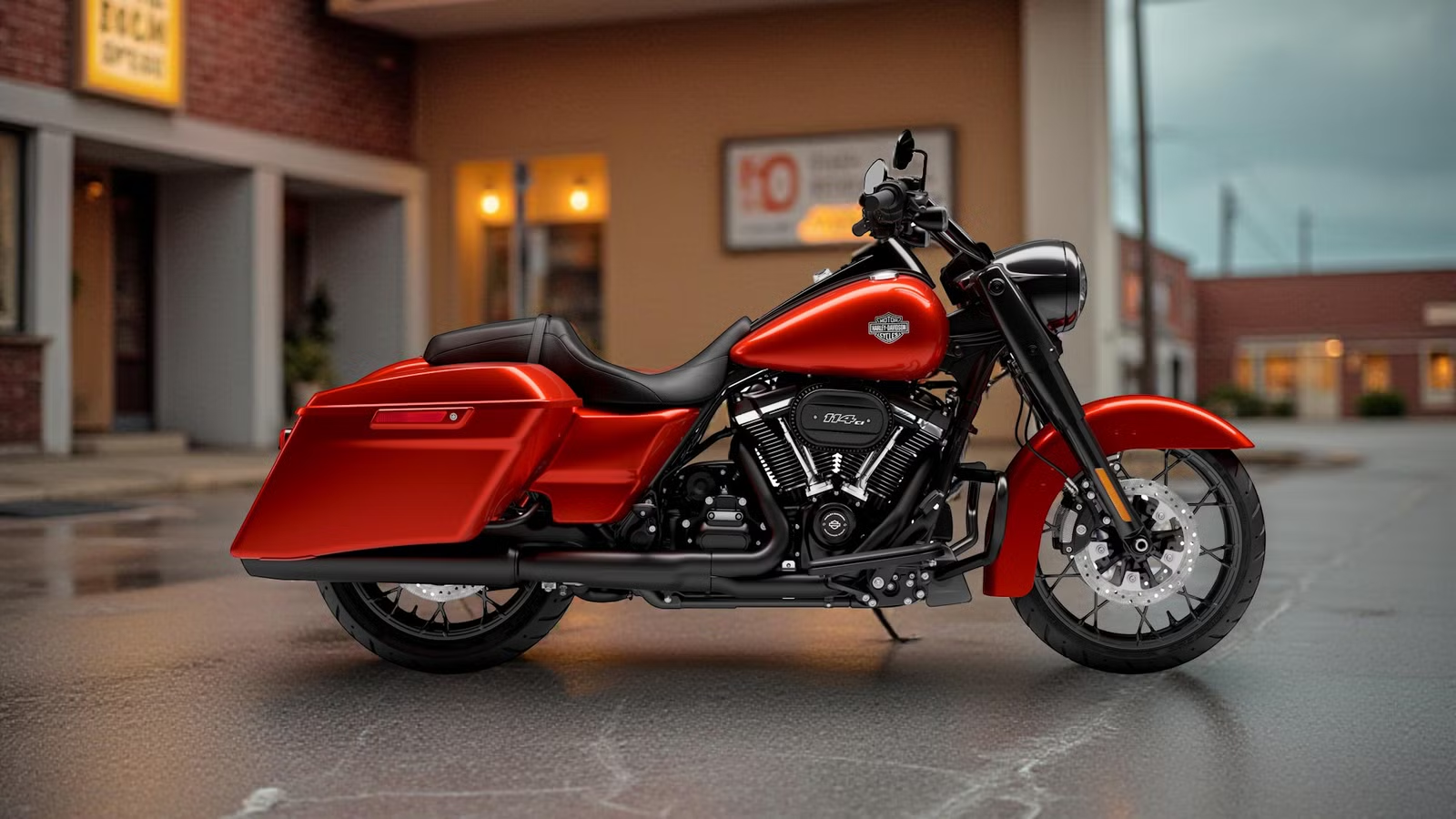
If there was one word to describe it, stripped down would probably be it (okay, maybe two words). Harley took the familiar Road King and stripped away much of its traditional touring hardware, then gave it the sort of visual treatment you would normally expect from a custom. The result was a factory-custom bagger that traded chrome for blacked-out finishes, added mini-ape handlebars, stretched saddlebags, and even bigger wheels.
Simplicity Is What Works Best For The Road King Special

If you’re the kind of rider who appreciates simplicity in a motorcycle, the kind that believes less electronics means less stuff that could go wrong over the years, and if you think a stereo system or a touchscreen has no business being on a motorcycle in the first place, then the Road King Special might be right up your alley.
What you get instead is a motorcycle that keeps things refreshingly straightforward, with an analog speedometer mounted on the tank, physical controls, and a clean cockpit. It still gives you the things you would expect from a proper touring motorcycle, including cruise control, saddlebags, and a comfortable riding position, without making the motorcycle feel like it’s just two wheels away from being a car.
The Milwaukee-Eight 114 Is As Reliable As Harley Engines Come

When you’re buying a motorcycle with the philosophy that it has to last, one thing you wouldn’t want to compromise on is the engine. The Road King Special gets the Milwaukee-Eight 114, a 1,868cc air-cooled V-twin that churns out 95 horsepower and 122 pound-feet of torque at 2,750 rpm.
As you would expect from a Harley of this size, the engine’s big torque figure arrives low in the rev range, giving it plenty of usable shove without having to chase the top end of the rev counter. It is also an engine that has been around long enough for Harley to have continued refining the formula, having first introduced the Milwaukee-Eight across its Touring lineup for the 2017 model year.
Grand American Touring Underpinnings Bring Proven Stability

Underneath all that black paint and fat bodywork, the Road King Special is built around Harley-Davidson’s Grand American Touring platform. It might be easy to mistake it for a typical cruiser given the way it looks, but that’s exactly what makes the Road King Special interesting. This is a touring machine masquerading as a cruiser, with twin rear shocks, a 49mm Showa Dual Bending Valve fork and larger 19-inch front and 18-inch rear wheels.
Of course, the old-school appearance doesn’t mean the Road King Special is stuck in the past. It still gets the modern touring essentials, including ABS with electronically linked braking, cruise control, and LED lighting. There’s also a six-gallon fuel tank and 2.5 cubic feet of storage in those stretched saddlebags, while features such as TPMS and Vehicle Hold Control are available as part of Harley’s Rider Safety Enhancements.
The Aftermarket Helps Keep Things Relevant Over The Years

If you want to keep a motorcycle for a long time, chances are you’ll eventually want to change something about it. That’s where the Road King Special has another advantage, with an immense amount of support from both Harley-Davidson itself and the aftermarket. Harley already sells the Special with a custom-bagger look from the factory, but there’s plenty of room to take it in a different direction. You can add a windshield or fairing and make it more touring-focused, swap the seat and handlebars for a more personal riding position, or go further with different wheels, lighting, exhaust, and suspension.
The Road King Special Isn’t Part Of Harley’s 2026 Lineup

The Road King Special is still available as a 2025 model in North America, with an MSRP of $24,999. That’s a fair amount of money to put down on a motorcycle, even before you start adding accessories and the other costs that come with buying new. And if you’re looking at one as a motorcycle you’re going to keep for years, there’s another question worth asking: do you really need to buy one new? That’s where the used market starts to make a lot more sense.
The Road King Special has been around since 2017, and Harley hasn’t exactly reinvented the formula every few years. A used example can give you much of the same motorcycle for less money, especially if you’re willing to look at an older model and put some of that saved cash toward making it your own.
Sources: Harley-Davidson

Related posts


Latest Post


No Comments