
The Rarest Plymouth Muscle Wagon Is Vanishing From the Market
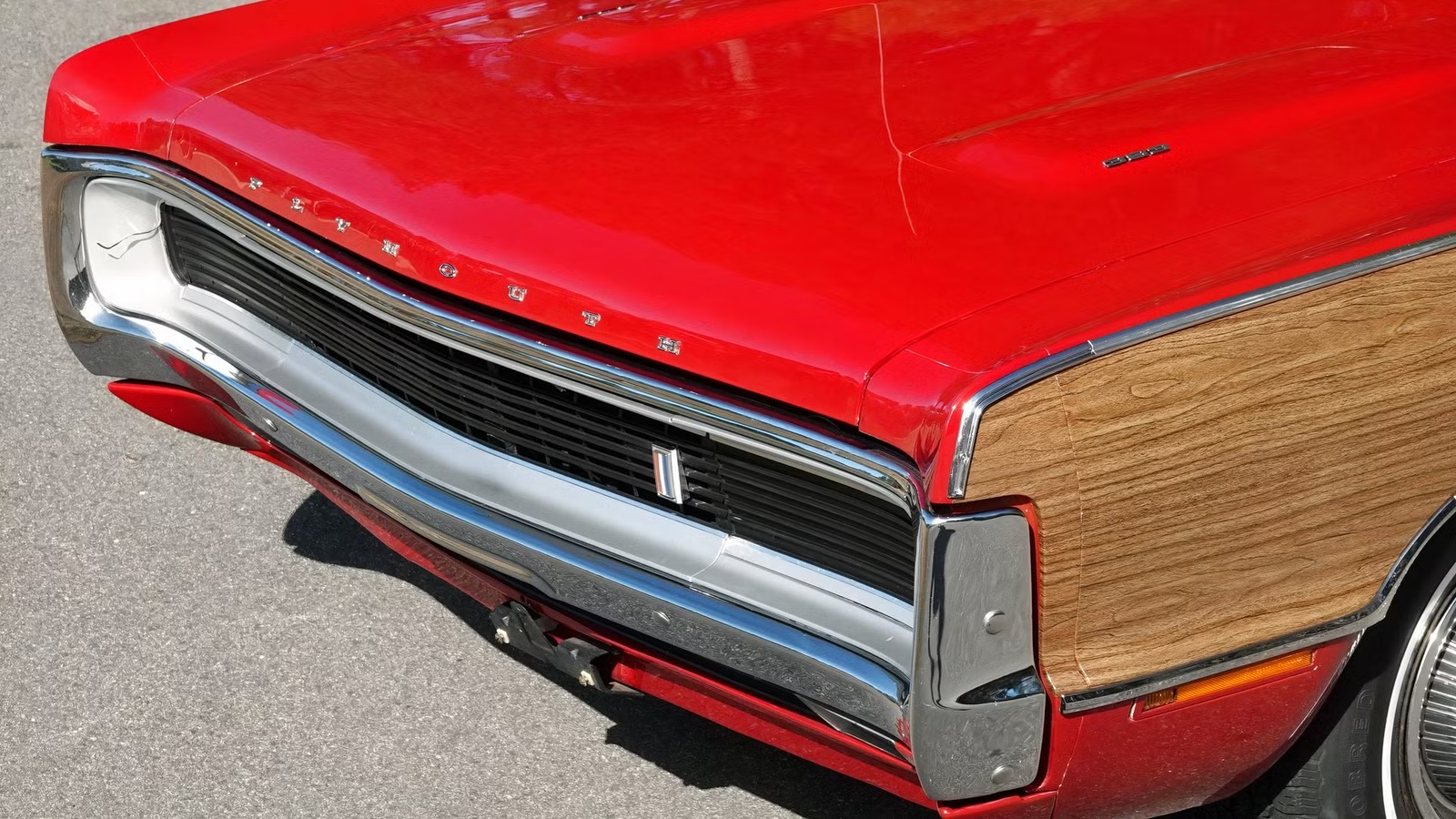
The current number of full-size SUVs that can comfortably seat nine people is, well, pretty scarce. You have the Chevy Tahoe, its upscale cousin the GMC Yukon, and the big brother to both, the Chevy Suburban. Put simply, building something capable of carrying that many people while following every single safety and emissions guideline under the sun is, to put it lightly, pretty difficult. It didn’t used to be this way, however. Back in the 1970s, American OEMs could basically do whatever they wanted when it came to designing people-movers, and they duly did so. In the case of Plymouth, you didn’t even need to buy an SUV.
The Chrysler/Mopar C-body: Large, In Charge, and With Plenty of Power

Oh, the C-body, what a wonderful, outrageous land barge you turned out to be. While the B-body held down the fort with icons like the Dodge Charger and Coronet, plus the Plymouth Fury, GTX, and the Road Runner, the C-body catered to an altogether different clientele. Not the kind of folks who cared much for sporting credentials, mind you. Instead, they were people who wanted as much refinement and luxury as the Chrysler portfolio could offer at the turn of the muscle car era. Unveiled in 1965, the C-body embodied the notion that back in those days, American luxury really was synonymous with making something bigger, and, more importantly, much longer as well.
Beasts like the Dodge Monaco and Polara, plus the Plymouth Fury, Gran Fury, and luxury-spec Chryslers like the Imperial and New Yorker, all used the C-body as their staunch underpinnings. Riding gargantuan wheelbases that routinely stretched past 12 inches, these leviathans were actually unibody construction, not that you would know by looking at them. If you didn’t know any better, you wouldn’t be faulted for thinking these beasts borrowed a truck chassis underneath. In truth, C-body Mopars were surprisingly refined for the day. With front torsion bar suspension up front and the beefiest leaf springs you could imagine in the back, C-bodies were truck levels of tough without being body-on-frame like one.

They were remarkably smooth and well-mannered for cars so big and heavy they might as well have their own ZIP codes. Better still, you could have a range of giant, capable V8 engines under the hood. Heavyweights like the LA-series 318 and the B-series 383 were two of the most common choices. Packing near truck levels of low-end torque and a smooth power delivery from a three-speed TorqueFlite automatic gearbox, C-body land barges were as floaty and smooth as their owners demanded they be. And yet, a select handful left the factory with an engine even more outrageous and, arguably, a bit unnecessary. Still, that was the fun of Mopar in those days. Every so often, they allowed themselves to be a little bit unhinged.

The RB 440: So Much Engine, and Lots of Car to Handle it

In most contexts, the Mopar 440 big block really didn’t NEED to exist in the way a fuel-saving straight-six or a low-tier V8 did. It was an engine born at a time when gas and oil were cheap and plentiful, and words like “moderation” and “good sense” would have made you seem out of place at best. Internally, the 440 “Commando” V8 was closer to a modern-day diesel than a modern gas V8. Its iron block was like an anvil, and its 4.32-inch bore and 3.75-inch stroke nearly made it chug like a steam locomotive. Without hemispherical cylinder heads like high-end variants of the RB 426, a 440 did run out of steam between 4,000 and 5,000 rpm.
Yet we don’t think there was a single soul in a Mopar dealership who was bothered or perturbed by that. They only marveled at how instantaneous that initial surge of torque felt low down in the rev range. With 7,200 cc of displacement to throw around, this was bound to be the case. All that displacement equated to somewhere in the area of 480 lb-ft of torque. Of course, Mopar was notorious for under-rating performance figures for its flagship engines, so the real number was likely somewhere well past 500 lb-ft. As for horsepower, it was somewhere in the realm of 350 at the bare minimum.

Paired with a TorqueFlite and an optional Sure-Grip limited-slip differential, these were astonishingly stout drivetrains by the standards of the late ‘60s and early ‘70s. They were torquey enough to embarrass purpose-built sports cars at a dig from a traffic light, even if the gargantuan weight riding on top meant said sports cars overtook them by the time the next light came into view. In the context of a gigantic personal luxury coupe, a special-ordered 440 Commando V8 made all the sense in the world. As it turned out, they made for a perfect pairing for a heavy-set family station wagon, as we’re about to unveil right now.
1970 Plymouth Sport Suburban: Utterly Ridiculous, Completely Wonderful

How Plymouth managed to use the name “Suburban” on one of its own vehicles without GM and Chevy having a tizzy fit, we have no idea. Well, truthfully, the name used to be a catch-all term and generic body-style descriptor before Chevrolet turned it into something all its own. By the time the Chevy Suburban debuted in 1935, GM could no longer try and claim the name as its own intellectual property under US trade law, and that allowed Plymouth to use the name freely for decades. By the early 1970s, Plymouth’s flagship long-roof station wagon evolved into an aspirational vehicle for rapidly-growing American families, one with a 122-inch wheelbase and a body that stretched a full eight feet combined beyond the front and rear axles.
With that kind of moving real estate, you could easily fit over 100 cubic feet of total cargo capacity behind the front seats, assuming the rear seats were in their stowed position. For some context, a modern three-row Dodge Durango tops out at around 85 cubic feet. In short, the Sport Suburban was more like an enclosed pickup truck or cargo van than a traditional station wagon. In its nine-passenger configuration that featured a rear-facing third-row bench seat, you really could carry six adults in the back of this wagon, plus two people besides the driver up front. In an era where buying gas was no more of a chore than buying cola, the Sport Suburban was one of the most practical motor vehicles around.

All the while, your engine choices included standard fare like the 318 and 383, but also that beloved 440 Commando V8 with a four-barrel carb. It was the same engine you’d often find in the Road Runner, the GTX, the Superbird, and non-HEMI ‘Cudas. For an MSRP of just over $3,800, or a touch over $32,700 in today’s money, a Sport Suburban was a ticket to the American Dream. In total, Plymouth managed to sell over 13,500 of these wagons in 1970. Among them, over two thirds of sales were from the nine-seater. Given the jump from two rows of seating to three was just $100 back then, or roughly $860 in today’s money, the choice was easy for most people.
Totally Impractical Today, But Not Without Value

Let’s be real, there’s absolutely no reason at all to drive a 1970 Sport Suburban in 2026. If you own one, it’s entirely for the novelty of it: to drive it around at car shows and on the occasional trip to the local burger joint, not to make it a daily driver. That said, the sheer nostalgia and the allure of a big V8, rear-drive station wagon means these behemoths can still fetch some real money on the used market.
Because 440-equipped examples are so rare, you’re most likely to find 383s under the hoods of most you find. Even then, they can sell for anywhere between $25,000 and $35,000. If you happen to find one with a 440, expect that number to increase exponentially. At the end of the day, it’s not hard to understand why.
Source: Raleigh Classic Car Auctions

Related posts





Latest Post


No Comments