
The 5,000-Pound Buick Land Yacht With More Torque Than A 1970 Chevelle SS
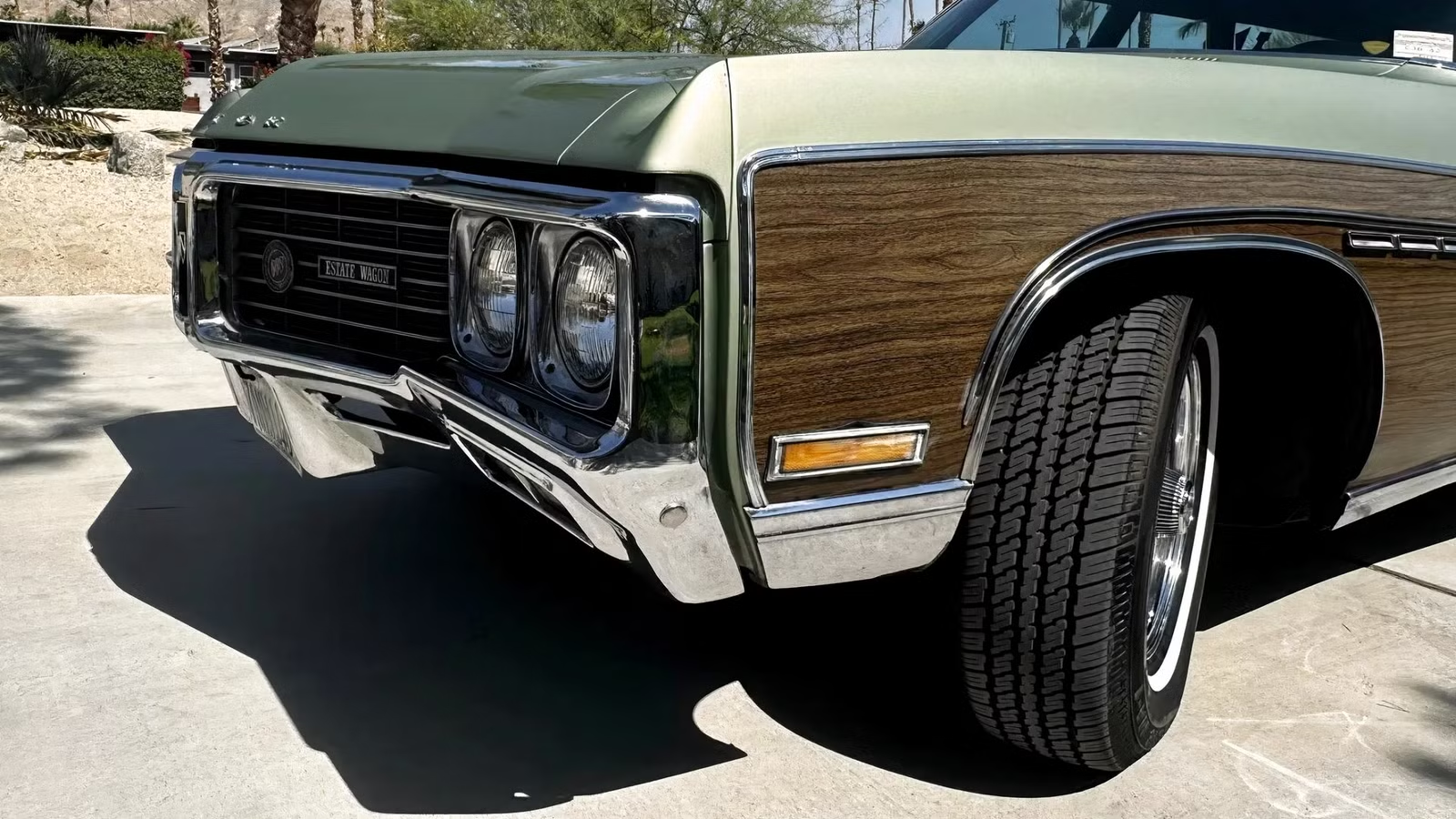
Buick today is a mere shadow of its former self, but it will always be fascinating to take a trip down memory lane and admire all the amazing cars it gave us in the past. Legends like the GNX, GSX Stage 1 or Riviera are just a few notable examples, all ingrained into American automotive history as some of the all-time greats. And even though Buick’s image became more closely associated with older demographics as time went on, performance was at the forefront back in the sixties and early seventies. The car we’ll be looking at today does a great job at illustrating that, yet its true nature was never explicitly promoted by the company.
A Wolf In Sheep’s Clothing

We all love a sneaky sleeper that hides some serious performance cred behind its unassuming appearance, don’t we? Well, that’s precisely the sort of beast we’re about to examine — a massive station wagon with more torque on tap than an LS6-powered Chevelle SS. You’d think that Buick might’ve been very interested in marketing it as a torque monster to appeal to performance-focused buyers, but that wasn’t the case at all. In fact, the car was promoted as a luxurious family hauler without much attention drawn to what sat under the hood, which only makes it more fascinating to look back on after all these years. Essentially, it was the equivalent of a buff special forces operator with a powerlifting background, but dressed in a tuxedo for an evening at the opera.
Buick’s Hiatus From Full-Size Wagons Ended In Spectacular Fashion

Between 1964 and 1970, the company took a break from building full-size station wagons, though it did offer the mid-size Sport Wagon in the meantime. But when Buick did rejoin the full-size segment at the dawn of the seventies, it made a big splash with the model that marked its return. Said car was an outright land yacht that should’ve had no business being as fast as it was, featuring tank-like proportions and tipping the scales at nearly 5,000 pounds. So, without further ado, let’s dive straight into the deep end for a closer look at this classic sleeper, because there’s an awful lot for us to talk about here.

The Buick Estate Wagon Combined Family Hauler Looks With A Muscle Car Soul

Released for the model-year 1970, the Estate Wagon was basically an undercover muscle car that could accommodate up to nine passengers and still have plenty of room for cargo. It was luxurious, incredibly spacious and kitted with one heck of a big-block surprise under the hood. Built on GM’s B-body platform, the Estate Wagon offered optional three-row seating and measured approximately 223 inches in length. It crawled on a huge 124-inch wheelbase, not quite as long as the Electra 225 luxury sedan it was based on but big enough to let you fit the whole family inside. Speaking of which, the interior could be had with a slew of sweet amenities tailored toward passenger comfort, including things like air conditioning, power windows and cruise control. These are no big deal nowadays, of course, but the seventies were a different time.

Let’s get to the part we’re all waiting for, though, that being the hardware located up front in the engine bay. Buick decided to take its beefy 455-cubic-inch V8 — also used in models like the Gran Sport, Wildcat or Electra — and put it into something marketed as more of a family car rather than a big-block gladiator. What’s more, the 455 wasn’t an optional upgrade reserved for those with an appetite for going fast, but the standard engine found in the Estate Wagon up until 1976. That, right there, is a great indication of how wild things were getting before compression ratios dropped, emissions standards tightened and the Malaise Era came to mess everything up. The numbers make that point abundantly clear.
At its peak, the 455-cube colossus would muster 370 horsepower (SAE gross) and a whopping 510 lb-ft of low-end torque, all sent to the rear wheels by a three-speed automatic gearbox called the Turbo Hydra-Matic 400. Meanwhile, a contemporary Chevy Chevelle SS 454 LS6 had 500 lb-ft of twisting force at its disposal, plateauing a little later than the Buick’s output at 3,600 rpm. The Estate Wagon’s torque, by contrast, peaked at just 2,800 revs and would thus have you pulling away from a standstill like a missile. In real-world terms, that meant a zero-to-60 time of about 7.8 seconds and quarter-mile runs in the low 16s — not too shabby for a car weighing close to 4,800 pounds and with the drag coefficient of a bus. So, all things considered, the 1970 Estate was definitely one of the coolest muscle wagons you could get at the time!
The Disconnect Between Marketing And Reality

What makes the Estate Wagon’s story even more interesting is the fact that Buick’s promotional campaign never made a big fuss about its performance capabilities — quite the opposite. The model was simply marketed as your typical family hauler, so you can probably imagine how surprised many buyers were to discover its true potential. And, interestingly enough, the Estate held on to its big-block charm for years after many other manufacturers threw in the towel, only getting the smaller engine treatment for the model-year 1977. Granted, the 455 had already lost a fair bit of its appeal by then, having fallen victim to lower compression, stricter regulations and, on paper, the industry-wide switch from gross to net SAE horsepower ratings. But in 1970, when these things were yet to take effect, the Estate was basically the ultimate full-size muscle wagon money could buy, just not promoted as such by Buick.
Buick’s Sleeper Wagon Today: Muscle Car DNA At A Discount

If you feel the need for some old-school American muscle in your life, the Buick Estate Wagon will likely come across as a very tempting piece of big-block goodness to get your hands on. Iconic muscle cars from the golden age tend to cost an arm and a leg when equipped with top-of-the-line V8s, but a 1970 Estate in good condition will only set you back $7,500 on average according to Hagerty. That being said, though, the pricing range is actually quite broad, as highlighted by a clean example sold on Bring a Trailer for $27,000 back in 2024. But, either way, you will most likely be spending far less than you would on a fully-fledged muscle car with similar power under the hood, so the Estate Wagon shouldn’t be overlooked if vintage big-block thrills are your cup of tea.
And with just under 30,000 units produced by Buick in 1970, it shouldn’t be too hard to find one for sale at a decent price. To better understand why this full-size wagon is such a bargain, just keep in mind that Buick’s very own GSX Stage 1 will likely cost you around $100k, while models such as the LS6 Chevelle SS or a well-kept Dodge Charger R/T might fetch a lot more. That makes the Estate Wagon one of the cheapest ways to experience some authentic muscle car pedigree from the golden days. Not only that, but you also get to surprise everyone with the car’s hidden potential — all you have to do is step on the gas with confidence as you take off from a traffic light. And to top it all off, you will simultaneously enjoy the sort of family-hauler practicality we tend to associate with modern SUVs. All these factors combined make the 1970 Buick Estate Wagon almost irresistible, so be sure to keep an eye on the classifieds and seize the opportunity to grab one for yourself if you feel the same.
Sources: Hagerty, Barn Finds, Bring a Trailer

Related posts

Latest Post


No Comments