
The Lexus SUV Engine Owners Rarely Have To Worry About
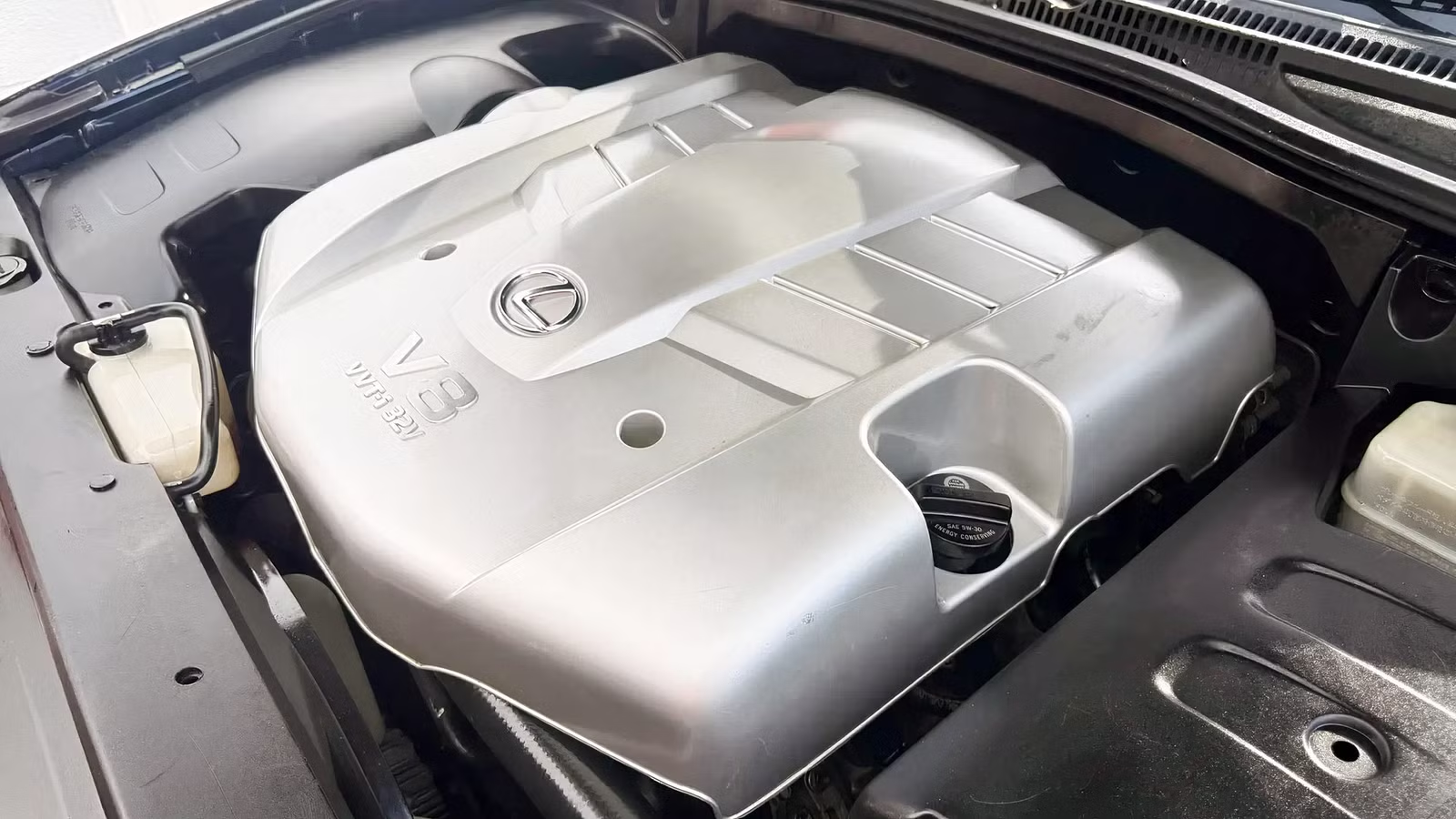
SUV engines. Some of them are made to last forever; some of them have a very finite lifespan. Back when SUVs were built for taking on rough terrain and towing as much as some trucks, the naturally aspirated, high-displacement, and overbuilt engines used made them lifelong companions. Now that the evolution of turbo tech has all but taken over the SUV market, things are a bit more complicated.

That’s not to say that all turbocharged engines can’t last a long time; generally, they just don’t always have the same high-mileage capability as some of their naturally aspirated counterparts. This Lexus SUV engine may well be the best living proof of that.
Some Engines Are Built To Go The Distance
Certain engines seem to develop a reputation for longevity almost in spite of the era in which they were built. BMW’s B58 is a relatively new example, but it does show that a turbocharged engine can be both fun and reliable. Go back a few decades, though, and engines like GM’s 5.3-liter V8 have earned a solid reputation under the hoods of Tahoes and Suburbans, towing, dragging, hauling, crushing highway miles, and really racking up serious mileage. The highest-mileage 5.3-liter Vortec V8-equipped Suburban has put over 1 million on the clock, thanks to proper maintenance.

What is worth noting, though, is that these engines could hardly be more different. The B58 is a turbocharged six-cylinder, whereas the 5.3-liter V8 follows the traditional American philosophy of large displacement and straightforward power. Both do make the point, though, that there is more than one way to build an engine that lasts. Some do it through modern engineering and careful calibration; others do it through giving the mechanical components plenty of room to do their jobs without being pushed to the limits.
Simple Design And Conservative Tuning Can Make All The Difference

Engine longevity tends to start with the unglamorous stuff. The 5.3-liter Vortec V8’s displacement gives it an easy route to useful torque, so it doesn’t need extreme cylinder pressure or sky-high boost to move a heavy SUV. Honda’s K-Series is different, but the principle is similar: no turbocharger means fewer heat- and pressure-related demands on the engine. Even the turbocharged B58 shows that forced induction can work when the engine is made with proper strength and factory calibration that is not overly aggressive.
This approach works very nicely in SUVs, where engines tend to face long highway runs, heavy loads, towing, and repeated heat cycles. Conservative tuning means components such as pistons, rods, bearings, and the valvetrain are not being asked to operate at their limits just to meet a power target. A relatively straightforward layout can also mean fewer systems prone to problems as the mileage climbs.
Toyota’s 4.7-Liter V8 Is Nearly Unkillable

Lexus and Toyota are synonymous with reliability. Currently, the 2026 U.S. Vehicle Dependability Study ranks Lexus as the brand with the fewest problems per 100 vehicles (PP100), with 151 PP100. The market average is 204 PP100, while Toyota reportedly experiences 185 PP100.
Both Lexus’s and Toyota’s reputation for longevity and reliability isn’t just down to the number of dedicated owners who keep their models going, but because they have become a byword for quality control and incremental design changes over generations. This matters more than just releasing a new engine every time a new model hits the road, and the 4.7-liter 2UZ-FE V8 is proof of that.
The 2UZ-FE Was Built With Longevity In Mind

By the time the 2UZ-FE V8 got to the U.S. market, Toyota had a very specific job in mind for its new 4.7-liter V8: to provide effortless torque for trucks and SUVs. The 2UZ-FE V8 first hit U.S. roads in 1998 under the hood of the Lexus LX 470; here it was rated at 230 horsepower and 320 pound-feet of torque. Hardly remarkable numbers for a good-sized V8, even in the late ’90s, but that was the point. The 2UZ-FE V8 was designed to use its displacement to move a heavy SUV without being pushed to its limits.
The 2UZ-FE V8 then got busier. Toyota put it under the hood of the Tundra in 2000, the Sequoia in 2001, and then Lexus equipped it in the 2003 Lexus GX 470. That gave it a very broad brief, but Toyota didn’t radically change the basic setup to suit each application. Instead, the same underlying architecture was carried across trucks and SUVs for different sizes and purposes. As we find with a lot of Toyota and Lexus models, this kind of thinking works very well.
A Cast-Iron Block And Naturally Aspirated Design Give It A Tough Foundation

The 2UZ-FE V8 starts with a cast-iron block reinforced around each of its five main bearings. Inside, it gets a steel crankshaft with eight counterweights, paired with forged connecting rods designed to keep weight variation between cylinders low. Toyota also used aluminum pistons with treated ring grooves to cut out some wear, and tin-plated skirts to reduce friction.
Up top, the camshafts get hardened cam noses, while the valve lifters are steel and the valve adjustment uses an inner-shim arrangement. The exhaust camshafts are also driven through a gear arrangement designed to control backlash, while an automatic timing-belt tensioner has its own oil damper. The two-piece oil pan uses an aluminum upper section secured to the block and transmission housing to increase rigidity, and it is also equipped with a water-cooled oil cooler, which helps keep temperatures in check. In short, Toyota built a lot of protective layers into it.
The 2UZ-FE Became A Lexus SUV Staple

None of what Toyota did to the 2UZ-FE V8 sounds particularly spectacular on its own, but together it shows a consistent engineering priority: keep the rotating assembly lubricated, keep temperatures under control, and limit wear wherever possible. It is more than just overbuilt.
And this is why they just keep going and why it ended up in so many large Lexus and Toyota SUVs and trucks. Early models (1998–2004) are non-VVT-i, and have a maximum stock output of 240 horsepower and 320 pound-feet of torque. Later models (2005–2011) get Toyota’s VVT-i and shift out up to 282 horsepower and 332 pound-feet of torque. Neither is exceptionally powerful, considering its displacement, but most importantly, peak torque is delivered low in the range, at 3,400 rpm.
The GX 470 And LX 470 Put Its Durability To The Test

You may be wondering how a V8 that works well in a truck can also work in luxury SUVs. The 2UZ-FE V8 is made for smoothness. Its 90-degree V, combined with the firing order that makes V8s the best engine configuration, and well-positioned engine mounts help to keep vibrations from making their way into the cabin. For Lexus, that matters, as refinement is part of its philosophy.
A smoother-running engine also makes sense mechanically: fewer vibrations through the mounts, drivetrain, and ancillary components means the broad torque band can do its work without having to change pace all the time. The same characteristics that make it a nice luxury SUV to sit in also suit it for truck-based work. The GX 470 and LX 470 are both body-on-frame four-wheel-drive beasts, so an engine capable of shifting out steady torque at low engine speeds is ideal. It is the Swiss Army Knife of SUV engines: it can pull hard when needed and feel refined when needed. One owner who left a review on Kelley Blue Book sums it up nicely.
Whether you’re crossing a desert or a mountain range, or just trying to get to work on the L.A. freeways, this is a vehicle designed and built to a standard so high, it wouldn’t surprise me at all if this truck is still on the road in 2060.
High Mileage Examples Show Why Its Reputation Has Lasted

iSeeCars estimates the average lifespan of a Lexus GX 470 is 179,542 miles, or 14.5 years. They also say it has a 41.8% chance of reaching at least 200,000 miles, and rate it 8 out of 10 for reliability. There isn’t as much information on iSeeCars about the LX 470, but they do rate it 9 out of 10 for reliability.
While just shy of 180,000 miles is a commendable average lifespan, it is important to note that it is not a ceiling. Not by a long shot. The GX 470 can routinely reach 300,000 miles without major repairs, with many owners reporting 300,000+ miles with the same internals and transmission; one owner on Notajeep Offroaders has even claimed a 400,000-plus-mile ’04 GX 470. The highest-mileage, well-recorded LX 470 example is a 2001 545,000-mile legend. And yes, it has the original engine and transmission.
The 2UZ-FE Remains One Of Toyota/Lexus’ Most Dependable Engines

Of course, no engine is going to last hundreds of thousands of miles without maintenance; that is key here. The 2UZ-FE does have a few well-known foibles, including a hairline crack developing on the exhaust manifolds, secondary air injection system failure, cooling system leaks, starter motor failure, and rubbers wearing out over time. It is also belt-driven, which needs replacing; however, non-VVT-i models are non-interference engines, so if the belt does snap, it shouldn’t destroy the valves. Later VVT-i-equipped models are interference engines, so a snapped belt is much more likely to cause a big problem.
This iconic Lexus SUV engine was dropped in 2011 in favor of the aluminum-block UR-Series engine, but in its time, and to this day, it has become one of the most trusted engines. On Kelley Blue Book, the 228 owners who left a review rate the GX 470 4.9 out of 5 for reliability, with 98% recommending one. There are fewer reviews of the LX 470 (just 132), but again, owners rate it 4.9 out of 5 for reliability, and the same percentage of owners recommend it. It may be old-school and modest by today’s standards, but the 2UZ-FE V8 is one of those engines that doesn’t cause a lot of stress to own and has earned a reputation quite unlike any other engine.
Sources: Lexus, Toyota, iSeeCars, RepairPal, and Kelley Blue Book.

Related posts



Latest Post


No Comments