
Chevrolet’s Largest, Most Powerful Crate Engine Ever
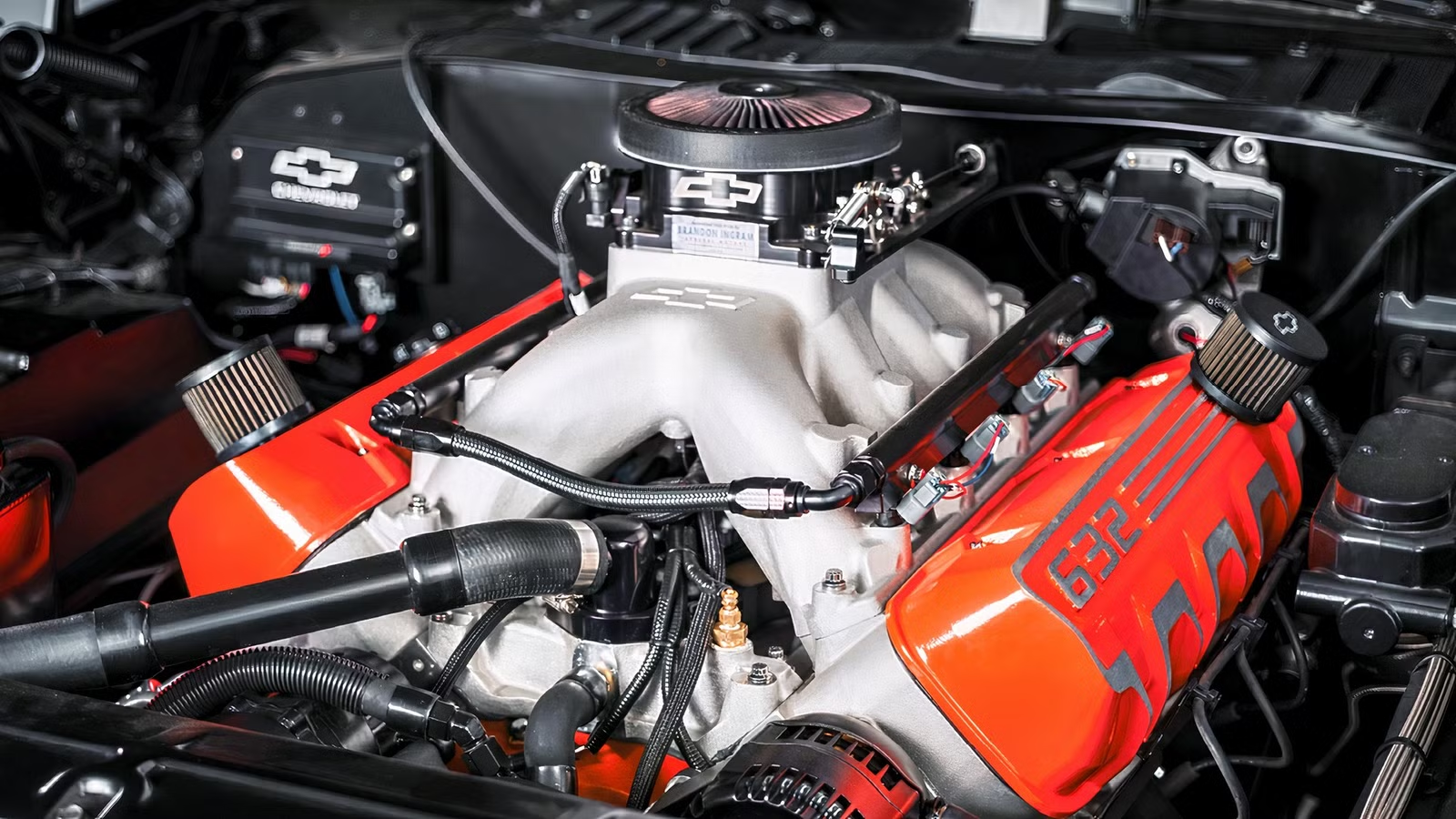
Few automakers have chased displacement with the same relentless enthusiasm as Chevrolet. While rivals were busy downsizing and turbocharged their way to respectability, Chevy’s performance division kept asking a different question: what happens when you just keep making the engine bigger? The answer, it turns out, is something that barely fits on a dyno sheet — a naturally aspirated, pushrod V8 crate engine that cracks four-digit horsepower without a single blower or turbocharger in sight. If you’ve ever wanted proof that cubic inches still matter, the ZZ632/1000 Deluxe is your exhibit A.

Chevrolet embraced the V8 tradition like no other, building a range of engines that powered everything from street rods to full-size trucks. And among them stands the undisputed king: a massive big-block crate engine with more displacement than any other bowtie V8 and horsepower figures that venture into four digits. This is Chevrolet at its most extreme — a crate engine built to dominate on the dyno, the strip, or in any build daring enough to handle it.
The ZZ632/1000 Deluxe Is An Absolute Beast Of A Crate Engine
|
Bore |
 57 autotech 4.6 inches |
|
Stroke |
4.75 inches |
|
Displacement |
632 cubic inches/10.4 liters |
|
Internals |
Forged pistons, connecting rods, and crankshaft |
|
Compression Ratio |
12-to-1 |
|
Horsepower |
1,004 |
|
Torque |
876 lb-ft |
If you haven’t seen it before, the boldly named ZZ632/1000 Deluxe is an absolute beast — a V8 with staggering displacement. In an era where 350-cubic-inch V8 engines are considered enormous, this 632-cubic-inch V8 is mind-bendingly monstrous. Yes, 632 cubic inches. In non-freedom units, that’s a staggering 10.4 liters, which really puts the big in big block.
The Bore Is Massive And Stroke Even Longer

Based on Chevy’s Gen-IV tall-deck big-block architecture, this 632 has some enormous internal dimensions, as required to support this level of displacement. The bore measures a gargantuan 4.6 inches, and the stroke goes even further at 4.75 inches. The pistons filling those massive bores are practically the size of gallon paint cans.
Like A Sumo Wrestler That Does Ballet

Despite the 632’s gargantuan pistons and undoubtedly heavy rotating assembly, this engine can still rev — and hard. Like a sumo wrestler that also does ballet, this V8 pulls like a small Honda four-cylinder, redlining at a heady 7,000 rpm. This is doubly impressive: not just because of the sheer mass of the rotating assembly, but because the forces at work inside an engine don’t increase linearly — they grow roughly by the square of the rpm. That means the engine must be incredibly strong to manage those forces as the massive pistons and connecting rods whirl around at 7,000 rpm. Breathing through a good free-flowing exhaust, this V8 must sound absolutely spectacular at redline.
This V8’s Output Is Absolutely Staggering

So this pumped-up bow-tie big block has massive displacement and absolutely huge lung capacity — but what does that actually get you? Hopefully you’re sitting down, because this engine is rated at 1,004 horsepower and 876 pound-feet of torque.
Yep, this V8 posts a four-figure output number, and it comes tantalizingly close to the 100-hp-per-liter specific output threshold. Well-tuned, high-revving engines can struggle to achieve this benchmark, yet here we have a “primitive” pushrod V8 with just two valves per cylinder pumping out a stellar 96.5 hp per liter of displacement.
Impressive Power And Torque Curves

This biggest of big blocks is an ideal powerplant for all kinds of muscle cars and custom automotive applications, though it might be a little overkill in some vehicles. Imagine one of these V8s stuffed into a small, lightweight T-bucket. If a driver ever sneezed and tapped the accelerator a touch too hard, the frame would probably twist into knots.
Aside from its staggering peak output figures, the 632’s dyno charts may be even more impressive. The horsepower curve is very linear, climbing smoothly and evenly to its peak at 6,600 rpm. Similarly, the torque curve — if you can even call it a curve — is practically as flat as a countertop, with no dips or sags along the way. Maximum torque arrives at 5,600 rpm.
This Engine Is Built To Last But You Pay For The Privilege

Like other Chevrolet crate engines, this one comes with a surprisingly generous warranty: customers are protected against factory defects for 2 years or 50,000 miles, whichever comes first. Obviously, that doesn’t cover neglect or abuse — and since this V8 is “intended for competition use only,” there’s probably going to be plenty of both. That said, if you drop a 632 into your hot rod, muscle car, or street project, we won’t tell anyone.
As you might expect, an engine this large and powerful isn’t cheap, though the pricing may not be quite as outrageous as you’d imagine. These big blocks have been available from various aftermarket sources for around $33,000 new — roughly the price of a brand-new car, and a nice one at that.
A Laundry List Of Premium Components For Massive Output And Impressive Longevity

As mentioned earlier, the Chevy 632’s internals are incredibly rugged — and they have to be to support more than 1,000 horsepower. The crankshaft is forged steel, as are the H-beam connecting rods. The pistons, as you might expect, are forged aluminum for maximum durability under extreme loads.
The cylinder heads are where the magic really happens, and the 632’s block is capped by some very special units. Cast from aluminum with a spread-port configuration, these heads are fitted with massive 2.450-inch-diameter intake valves, while the exhaust valves — made of titanium — measure an even 1.800 inches. It’s this combination that allows the big block to gulp enormous volumes of air and fuel while expelling spent gases with minimal restriction.
A Saucy Camshaft Is Needed To Hit 1,000+ HP

Controlling those valves is a suitably aggressive camshaft. The 632’s bumpstick carries 0.780-inch gross lift on the intake side and 0.782 inches on the exhaust. Sturdy shaft-mounted rocker arms amplify that motion at a 1.8-to-1 ratio for even greater valve lift. Compression is a stout 12-to-1, meaning premium 93-octane fuel is strongly recommended — run anything less and you will start breaking things.
A Rock-Solid Foundation

Interestingly for a high-performance engine, the block is made of cast iron. Many modern powerplants have moved to aluminum, which is significantly lighter. Iron, however, is exceptionally strong, dimensionally stable in service, and straightforward to machine during production. It’s also cost-effective, doesn’t necessarily require separate cylinder liners, and can simplify future rebuilds compared to an aluminum block. Reinforcing this engine’s foundational strength, the forged crankshaft is held in place by four-bolt main caps rather than the two-bolt units found on lesser powerplants.
From the foundation on up, this Chevy 632 big block V8 is built to last. That durable cast-iron block, forged internals, and carefully engineered cylinder heads deliver massive output alongside what should be phenomenal long-term durability.
Sources: Chevrolet, Summit Racing, CrateEngineDepot.com

Related posts



Latest Post



No Comments