
The Adventure Motorcycle That Won’t Wear You Out
Exhaustion has many ways of showing up on a motorcycle ride. Sometimes it is the long hours on the road, and at other times, it is a terrible road that does not end for miles. However, there is a new reason, and it shows up on long adventure bike rides. It starts with a dull pain that creeps into your wrists around the two-hour mark, makes its way to your shoulders when the windscreen isn’t doing its job, and finally to the stiffness in your neck. None of this stress announces itself early, and instead, it just accumulates.

Many riders assume that this physical toll is just part of the ride. After all, ADVs are tall, broad, and muscular. But the thing is, an ADV is supposed to make your life easier on a long adventurous ride, not cut it short. Chasing a big ADV because of extra horsepower won’t help you cover more miles, but reducing the accumulation of fatigue – that surely will. What you need then is something that doesn’t wear you out, and we have a recommendation.
Adventure Bikes Have Become More Physical Than Ever
Over the last decade, ADVs have become more powerful, but along with that has come more weight and a larger footprint. While this increase has made them more capable, especially on paper, it has also made them more difficult to live with in the real world. A flagship ADV, loaded to the gills with a full tank of gas and luggage, can easily push past 550 to 600 pounds. Now, while that number might not seem that bothersome on the move, you do feel every one of those pounds at a red light, gravel pullout, or while making a U-turn in a narrow space.
The Weight You Don’t Notice Until Hour Three

Weight disappears when you are on the move as momentum matters more than gravity once you’re rolling, but it comes back the moment you slow down. For instance, paddling a heavy ADV at a gas station, wrestling it back up if you lean it too far at a stop, or simply holding it upright while fighting a camber in the road you weren’t expecting. All these things do not show up on a spec sheet, and none of it is the one big moment that wears you out. Instead, it’s all cumulative, and by the end of the day, you don’t really know how you ended up getting so fatigued.
This Is Where Small Capacity ADVs Come In

It’s this exact problem of cumulative fatigue that small capacity ADVs solve. By trading outright power and size for a lighter motorcycle, a lot of that fatigue just does not show up. It is less weight to manage at a walking pace or to balance on uneven ground. A small capacity ADV simply asks less of you at different times throughout the day without making it any less of an adventure. A Royal Enfield does that particularly well.
The Himalayan 450 Is Easy-Going And Livable For The Masses

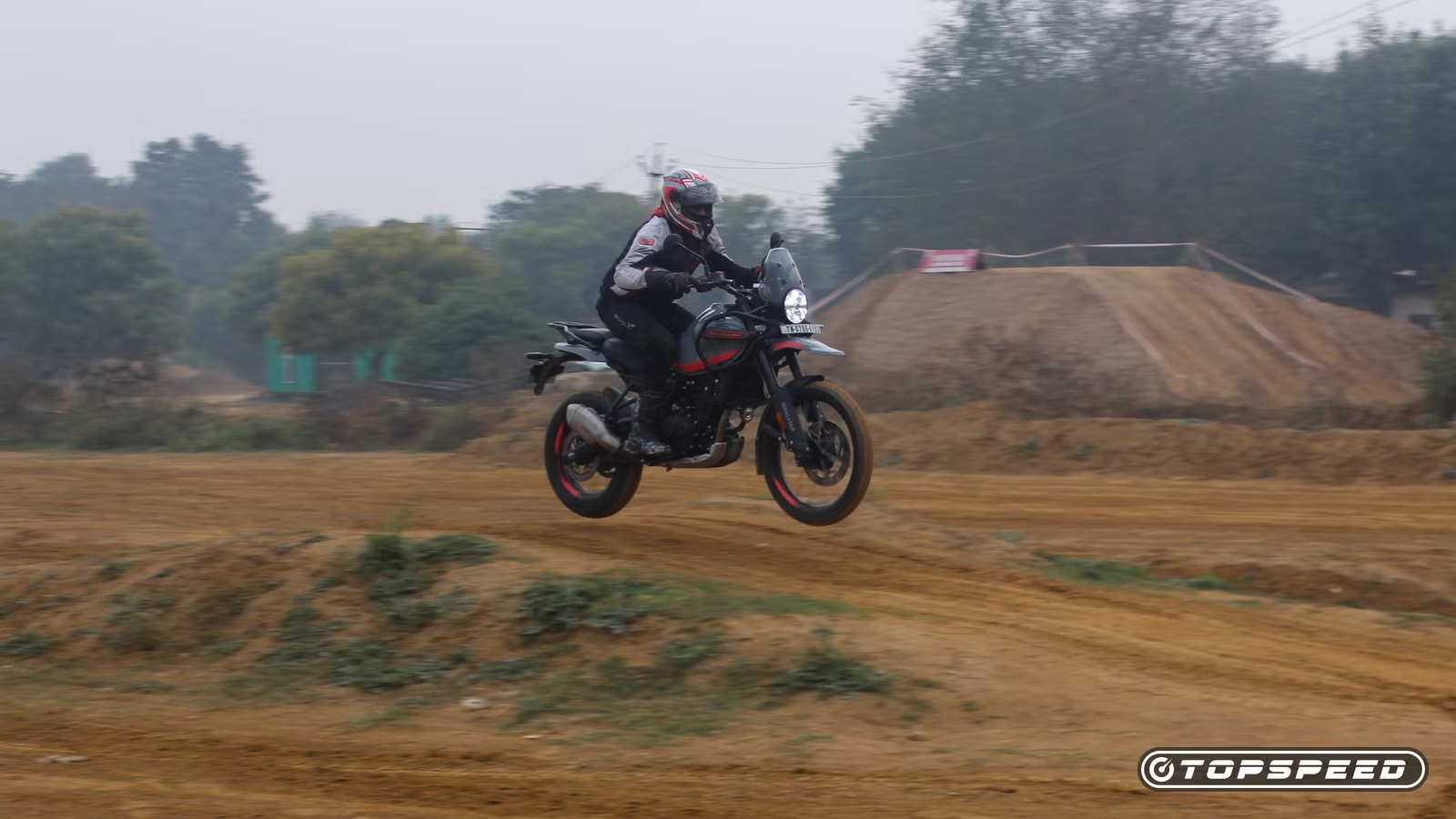
This is the exact thought that Royal Enfield had when making the Himalayan 450 and putting it on showroom floors. It’s an adventure bike that doesn’t demand a rider to hit the gym and bulk up before signing on the dotted line. At a starting price of $5,999, it also doesn’t demand a heavy financial commitment either, considering it is among the lowest-priced ADVs on the market and offers far more value than its price suggests.

Furthermore, all that value is wrapped in a package that is easy to live with. It’s not the most powerful bike out there, and neither is it trying to be, but it can still put a smile across your face irrespective of whether you are headed to the office or out on a multi-day adventurous ride. To put it simply, the Himalayan 450 doesn’t ask you to take a break from itself.
Why We Picked The Himalayan

The case for the Himalayan 450 isn’t built on a single standout spec. Instead, it’s the coming together of a handful of traits that all point in the same direction: keep the rider fresh for as long as possible.
There’s Plenty Of Ergonomic Comfort

Most importantly, the Himalayan 450 offers an upright and neutral riding position which is complemented by wide handlebars and centrally positioned foot pegs. By not forcing your lower back, hips, or knees at an unnatural angle, half the fatigue-inducing factors have already disappeared before you have even thumbed the starter. Additionally, this is one of the rare bikes with an adjustable saddle from the factory.
The stock seat height is adjustable between 32.4 inches and 33.2 inches. A lower seat, available as an accessory ($150), drops that range down to a minimum of 31.7 inches. The logic is quite simple here. A rider who can easily plant their feet on the ground and balance the motorcycle at a stop isn’t wasting energy. The cushioning of the stock seat, which is too firm, is a problem, though.
An Optional Windscreen That Keeps The Wind Away

Wind is an invisible enemy that slowly saps your energy without ever revealing itself. Your neck, shoulders, and upper torso are the ones fighting it, and the right windscreen is the only difference between a battle won or lost. And to be honest, the stock screen of the Himalayan 450 is too short to offer decent wind protection at highway speeds.

If you are under 5’10, you are in luck. Royal Enfield offers an Adventure Screen as an optional extra, and it does a good job of deflecting oncoming wind just above your helmet. You will have to shell out $150 for it, but you do get solid wind protection for your money. Taller riders will have to look for aftermarket options such as the one from GIVI, which is priced about the same.
Why The Himalayan 450 Feels Lighter Than It Is

No, it’s not because the Himalayan has a low center of gravity. In fact, when filled to the brim, the Royal Enfield Himalayan weighs 432 pounds and tends to feel top-heavy. It is, however, the ergonomic advantage of the Himalayan and its comparatively lower seat height that we discussed earlier that make it feel like a light motorcycle at slow speeds. While you are putting in the effort, you are doing so with your body positioned rather comfortably. And once the pace picks up, the top-heavy nature makes it feel flickable, a trait that some might say makes it feel lighter.
Inside the Himalayan 450’s Fatigue-Fighting Powertrain

The powertrain of the Himalayan 450 is another weapon in its arsenal against riding fatigue. The Sherpa 452 engine was specifically designed for this motorcycle, and with 40 horsepower and 29.5 lb ft of torque, it’s not trying to win any spec-sheet battle. The power delivery is linear instead of peaky, a small factor that is a big contributor to keeping the rider fatigue-free. The slip-and-assist clutch not only smooths out downshifts, but also takes real weight off the left hand in stop-and-go traffic or on technical trail sections.
The Chassis And Suspension Are Supportive, Too

A 43mm Showa front suspension and rear monoshock are what suspend the chassis, and while they are not tuned for outright sportiness, they do a good job of isolating the rider from the harshness of the terrain underneath. What you lose on outright performance, you make up for in longevity. You also get a 21-inch spoke front wheel, which gives this proper off-road abilities, unlike some of its rivals with a 19-inch alloy wheel setup.
Decent Electronic Assistance Makes Life Easier

Switchable dual-channel ABS lets the Himalayan adapt to pavement or dirt without asking the rider to think about it, and ride-by-wire throttle response keeps power delivery consistent regardless of conditions. A simple turn-by-turn navigation display rounds things out — nothing flashy, but one less thing for a tired rider to have to think about at the end of a long day.
The Himalayan Slots Well In The Segment

Ultimately, the Himalayan does not rely on one single trait to make the rider’s life easier. Instead, it brings together a series of mannerisms to ensure that it’s an adventure motorcycle that won’t wear you out, albeit with a couple of optional extras. There are a few rivals, though, and they are from all over the world.
Perhaps the biggest one is the KTM 390 Adventure range, which has a single-cylinder engine like the Himalayan. In the parallel-twin space, the CFMoto Ibex 450 is a key player and offers impeccable value. The same can be said for the newest kid on the block: the Kawasaki KLE 500. However, the Himalayan’s balance and value proposition is hard to fault in a broader sense.
Source: Royal Enfield

Related posts

Latest Post


No Comments