
GM Shelved An AWD Corvette In 1964 And Forgot About It
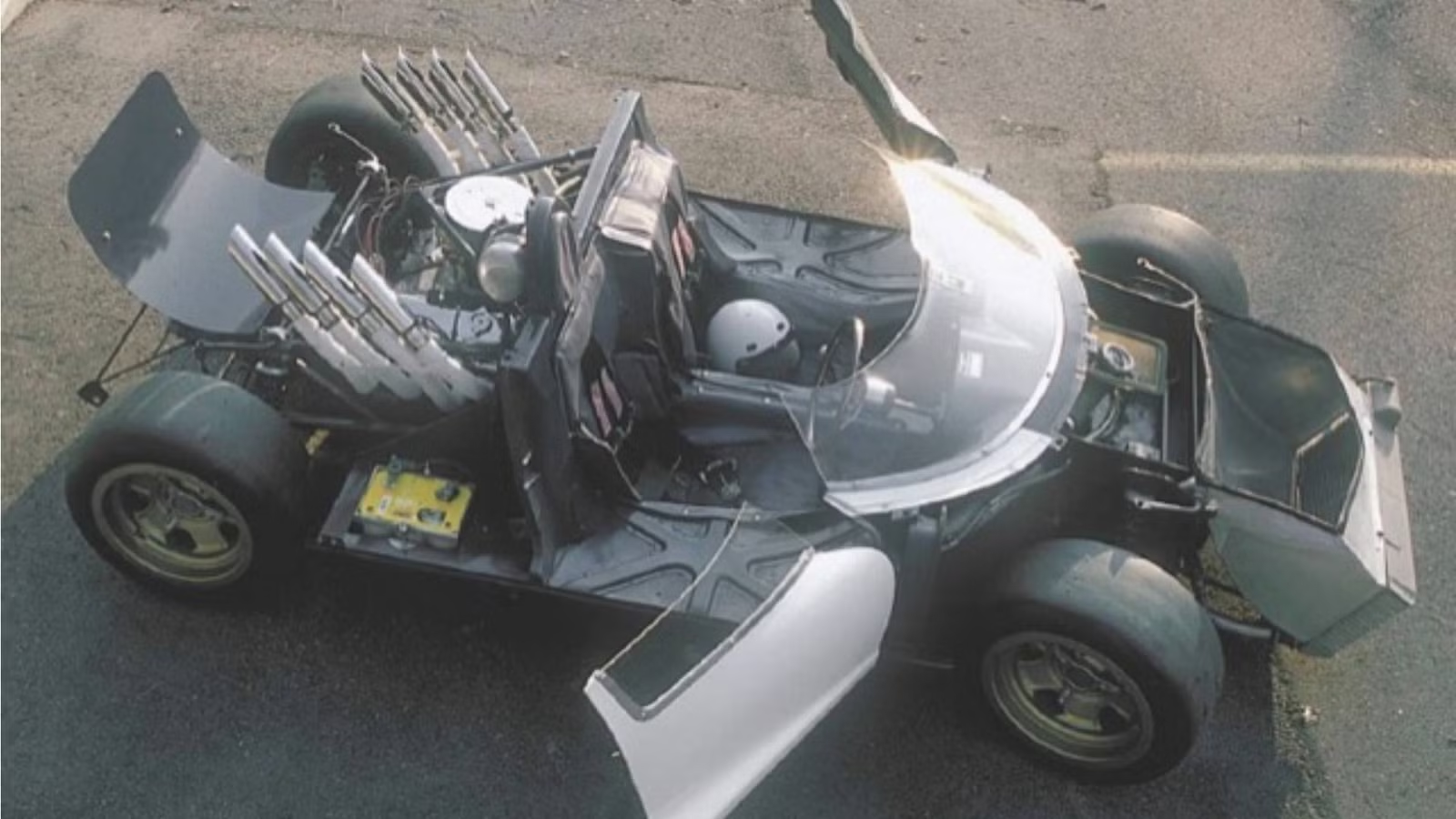
Six decades before the Corvette E-Ray used its front axle to help put V8 power down, Chevrolet had already built a mid-engine prototype that drove all four wheels through two torque converters. It also reportedly reached 212 mph at Milford.

The car’s engineers calculated a 2.8-second run to 60 mph, a number that still sounds maddening today, and the hardware worked. What failed was General Motors‘ nerve, leaving one of Detroit’s smartest performance ideas parked while the rest of the industry caught up.
Le Mans Was Leaving The Corvette Behind
Zora Arkus-Duntov knew the front-engine Corvette had a problem. By the early ’60s, the fastest racing cars were moving their engines behind the driver, improving balance and giving designers more freedom to shape the nose for high-speed stability.

Duntov wanted Chevrolet to fight for overall wins at Le Mans and Sebring, where Ferrari had already made the mid-engine layout look like the future. Ford’s GT40 program then raised the stakes for Detroit.
Trouble was, GM’s racing ban kept getting in the way. The Corvette SS had already been shelved, while the Grand Sport program stopped after only five cars. Chevy had the engineering talent to answer Ford and Ferrari, but its most serious work had to happen behind closed doors.
The Answer Had Four Driven Wheels And No Rulebook
Development began in September 1963 under the XP-817 project code. Chevy planned six race cars, including rear-drive and four-wheel-drive versions, with closed bodies intended for international endurance racing. Only one running prototype was completed, and it emerged as a compact open car with a 92-inch wheelbase.
Larry Shinoda and Tony Lapine shaped the fiberglass body around an alloy-steel structure designed to keep weight down. An experimental single-overhead-cam V8 was also under development, though the prototype used an all-aluminum, 377-cubic-inch pushrod engine related to the hardware created for the Corvette Grand Sport. The car first moved under its own power in March 1964 before heading to Jim Hall’s Rattlesnake Raceway in Texas. Early testing showed plenty of promise, along with the sort of teething problems that appear when engineers build something the rulebook hasn’t anticipated.
The special front two-speed transmission wasn’t ready at first, and experimental aluminum brake discs failed to deliver the stopping performance Chevrolet wanted. Roger Penske reportedly couldn’t feel the front wheels being driven during testing, which counted as praise because the AWD system was supposed to work without announcing itself.
The CERV II Was Chevrolet’s 1964 Hypercar Blueprint

The machine in question was the Chevrolet Engineering Research Vehicle II, or the CERV II. Its mid-mounted 377-cubic-inch V8 used Hilborn fuel injection and produced roughly 500 horsepower, with later development versions making even more. The target weight was around 1,900 pounds, giving Chevy a power-to-weight ratio that belonged in another era.
CERV II’s most famous figure is its 2.8-second run from 0–60 mph. That number wasn’t recorded with a stopwatch, however. It came from engineering calculations using shorter gearing that limited maximum speed to roughly 115 mph. Taller gearing pushed the calculated top speed toward 183 mph, though the estimated sprint to 60 mph stretched to about four seconds.
The 212 mph Milford figure is the stronger part of the legend because the car reportedly achieved it during testing. Other accounts place its maximum between 200 and 210 mph, so 212 mph is best treated as the upper documented figure rather than a reason to round up for dramatic effect. All that said, even the lower numbers were astonishing for 1964.
Two Powerglides Became An Analog AWD Computer

The CERV II’s drivetrain was even more interesting than its engine, which is saying something when roughly 500 hp is involved. Duntov’s team calculated that hard acceleration would shift enough load rearward to reduce the weight carried by the front axle, making a fixed torque split less useful.
The car’s static distribution was planned at 46.5 percent front and 53.5 percent rear. Under 1.0 g of acceleration, the front share could fall to about 32 percent. Chevrolet therefore wanted the front axle to receive roughly 35 percent of engine torque at lower speeds, increasing to around 40 percent as the car accelerated.
Complex Internals

Engineer Raymond Michnay created the solution with two differently sized Powerglide torque converters. An 11-inch converter fed the rear wheels, while a 10-inch Corvair Powerglide unit drove the front axle through a shaft connected to the crankshaft. Because the converters approached lockup at different speeds, the effective torque split changed as the car gathered pace.
Both axles also used compact two-speed gearboxes controlled by a single cockpit lever, offering direct drive and a 1.5:1 reduction. The result acted like an analog AWD computer, managing front-to-rear torque without sensors or software. In 1964, diagnosing a system failure probably meant isolating the faulty converter and resetting the drivetrain manually.
The E-Ray Took Six Decades To Finish Duntov’s Job

The CERV II never raced at Sebring or Le Mans. By late ’64, Chevrolet management decided against a direct motorsport fight with Ford, and the program ended before Duntov’s prototype could prove itself in competition. The car survived because Chevrolet repurposed it as a development mule.
Around 1969, CERV II received an all-aluminum 427 ZL1 V8 and continued testing into 1970. It covered hundreds of laps during tire and aerodynamic work before GM moved it into storage. The company had built a mid-engine AWD Corvette blueprint, learned from it, then put the answer in a warehouse.

The prototype later passed through the Briggs Cunningham Museum and private ownership before undergoing restoration. When it crossed the auction block in New York in 2013, CERV II sold for $1.1 million. Essentially, the collector market placed seven-figure value on a program GM had once treated as a dead end.
Chevrolet finally revealed the production mid-engine C8 Corvette roughly 55 years after CERV II’s 1964 tests. The 2024 Corvette E-Ray completed the larger idea by adding all-wheel drive, although its electrified front axle works very differently from Duntov’s paired torque converters. The modern ZR1 pushes the mid-engine platform’s performance mission even further, yet CERV II’s 212 mph run proves Chevy had already entered that conversation decades earlier.
Sources: Revs Media, Corvette Club Of Windsor, Hemmings, CarGuy Chronicles, Sports Car Market Magazine

Related posts

Latest Post


No Comments