
The Cruiser That Makes Riders Appreciate Simplicity Again
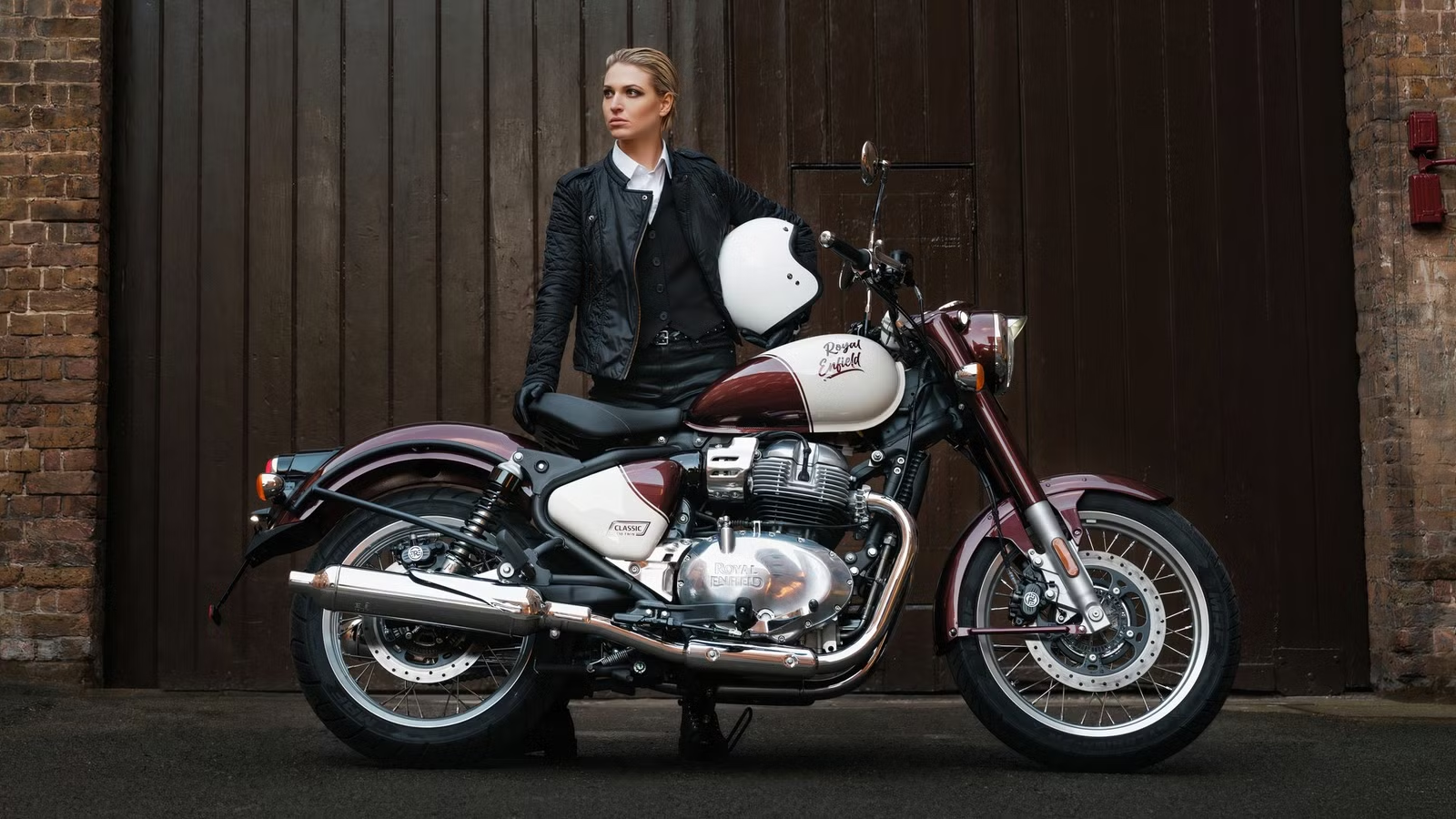
At some point in the last decade, the cruiser segment in America quietly forgot what it was supposed to be. The machines that once stood for accessibility — wind in your face, engine beneath you, nothing between you and the road — started arriving with ride mode selectors, cornering ABS, smartphone integration, and price tags pushing past $15,000 to $20,000. That is not necessarily wrong. Technology improves motorcycles, but somewhere along the way, a gap opened up between what cruisers cost and what most riders actually need from one. Nobody seemed to be filling it.
The Cruiser Segment Has A Complexity Problem
When “More” Becomes The Enemy Of Enjoyment

Walk into a dealership today and the entry price for a well-regarded cruiser from a major American or European brand is a serious number. The Triumph Bonneville T100 sits around $11,495. The Indian Scout Sixty Bobber starts at roughly $9,999. These are genuinely good motorcycles, but they carry with them an implicit expectation — that the buyer wants a premium product with a premium feature set and is willing to pay accordingly. That works for a portion of the market. It leaves another portion underserved: riders who want the experience, not the electronics package.
The cruiser’s original promise was about feel and accessibility, not specification sheets. A machine that looks right, sounds right, and does what you ask without demanding much in return. Somewhere between the Milwaukee-Eight baggers and the liquid-cooled sport-cruisers, that proposition got harder to find at a price that doesn’t sting.
What Simplicity Actually Means In 2026

To be clear, simplicity in this context does not mean primitive. Dual-channel ABS and fuel injection are not optional luxuries anymore — they are baseline safety and reliability features that any credible modern motorcycle should carry regardless of price. What the gap in the market describes is something more specific: a machine that is easy to understand, easy to own, and honest about what it is. One that does not require a settings menu to enjoy on a Sunday morning. Only a few cruisers in the USA come at an accessible price point and deliver that combination.

The Royal Enfield Classic 650 Makes Riders Appreciate Simplicity Again
Base Price: $7,499

Royal Enfield has been making motorcycles since 1901, with roots in Redditch, England, and operations in Chennai, India, since the mid-1950s. The Classic family has been the backbone of the brand for decades — a line of machines styled after the pre-war and postwar British roadsters that defined the look of motorcycling in the 1950s. The original Classic 500 carried a single-cylinder air-cooled engine and served as Royal Enfield’s international calling card for years.
The Classic 650 is its spiritual successor — bigger in every direction. Longer wheelbase, heavier footprint, twin-cylinder engine — and built for the speeds and distances that American riders actually ride. At $7,499, it costs roughly $3,000 to $4,500 less than the nearest comparably styled competition. That gap is not the only reason to consider it, but it is a good place to start.
A 648cc Twin That Rewards Restraint
Modest Numbers, Honest Character

The Classic 650 is powered by a 648cc air/oil-cooled, inline twin — the same basic platform found across Royal Enfield’s 650cc lineup. As per the spec sheet, it produces 47 horsepower at 7,150 rpm and 38 pound-feet of torque at 5,250 rpm, fed through a six-speed constant-mesh gearbox. Those numbers will not win a drag race, but the torque curve is broad and accessible, which means the power is right there from the moment you roll off a stop — no need to rev hunt, no need to chase a powerband that only shows up past 8,000 rpm.
For relaxed cruising on two-lane roads and city traffic, the engine does exactly what this kind of motorcycle needs. The dual peashooter exhausts deserve a mention on their own. They are not just a styling reference — they produce a genuine parallel-twin sound that is part of the identity of the bike.
The Slipper Clutch Does More Than You’d Expect At This Price

The six-speed gearbox is paired with an assist-and-slipper clutch — a feature that would not have existed on a Royal Enfield at this price bracket ten years ago. The assist function reduces lever pull, which proves very helpful in stop-and-go city riding where a heavy clutch becomes a real fatigue factor by the afternoon. The slipper side of the equation smooths out rear-wheel behavior when downshifting aggressively into a corner or decelerating hard. Neither function is exotic technology at this point, but at $7,499, their inclusion represents a meaningful upgrade over what older Classic-era Enfields delivered.
Retro Styling With Modern Touches That Don’t Undercut the Character
The Design Language Is the Point

The Classic 650 draws its proportions directly from the 1950s G2 Royal Enfield lineage — and unlike a lot of retro-styled motorcycles, it does not feel like an approximation. The teardrop fuel tank holds 3.9 gallons. The casquette-style headlamp gets a modern LED upgrade. Chrome finishing runs throughout.
The spoked wheels are 19-inches up front and 18-inches at the rear, and they carry tubed tires, not tubeless. That is a genuine caveat worth flagging before purchase: a roadside puncture means an inner tube replacement rather than a quick plug fix. It is manageable, but it is not the convenience of tubeless, and riders planning remote routes should factor that in. The pillion seat is removable with a single bolt, and the solo silhouette is noticeably cleaner without it. Both configurations look good, but the solo version has a different charm.
Build Quality That Surprises For The Category

Reviewers all across the world were consistent on this point: the fit, finish, and chrome quality of the Classic 650 exceeded what the price tier typically delivers. Royal Enfield has invested significantly in manufacturing quality over the past decade, and the Classic 650 shows it. The paint work, including hand-painted pinstriping on select color variants, is a detail that reinforces the craftsmanship angle.
Tripper Navigation And The Analog Cluster

The instrument setup is a large analog speedometer with an integrated LCD sub-display showing fuel level, gear position, and trip data. It keeps the old-school visual identity intact while still giving you the information you need. The Tripper navigation pod — Royal Enfield’s turn-by-turn system that pairs with the RE app — is available on select variants. Prospective buyers need to confirm trim-level availability with their nearest dealer.
A USB-C charging port sits on the bars. Dual-channel ABS is standard across the range. There is no traction control, ride modes, or cornering electronics suite, but for a motorcycle that is meant to exude old-school charm, the lack of these features is part of the charm.
The Riding Position That Makes It a Daily Rider, Not Just a Weekend Machine
Ergonomics Tuned For The Everyday

The Classic 650’s seat height measures 31.5 inches, which is low enough to be accessible to a range of rider heights, though the seat itself is fairly wide, which will cost shorter riders some footing. Wide handlebars and an upright posture create a riding position that is relaxed rather than aggressive. With a 535-pound curb weight, the bike is a real presence in a parking lot or during slow U-turns, where the steering sweep is tighter than some riders would expect. Once rolling, however, the mass settles. The weight sits low in the chassis, giving the Classic 650 a planted, stable feel in motion that does not match what the numbers on a spec sheet might suggest.
Handling That Exceeds Expectations

The chassis is a steel tubular spine frame, which is simple, proven, and appropriate for this kind of machine. Suspension at the front is handled by 43mm Showa telescopic forks with 4.7 inches of travel. The rear runs twin shock absorbers with rear preload adjustment, offering 3.5 inches of travel. Neither end is adjustable beyond that, which some riders accustomed to fully adjustable suspension will notice. Most reviewers have praised this setup, stating that it works well enough on smooth roads and city streets, while on rougher terrain, the stiff calibration becomes more apparent.
Braking is managed by a 320mm front disc with a twin-piston floating caliper and a 300mm rear disc with the same caliper arrangement, both governed by dual-channel ABS. The setup is said to deliver consistent and predictable stopping performance rather than aggressive initial bite.
Source: Royal Enfield

Related posts



Latest Post


No Comments