
The Sport Bike That Proves You Don’t Need 200 HP To Have Fun
Over the last decade or so, 200 horsepower sport bikes have been normalized. For the most part, these bikes offer the kind of riding experience that is pretty hard to beat. In the past, these bikes were reserved for the skilled, brave, and clinically insane. Today, modern rider aids are able to harness this power in such a way that these motorcycles can now be ridden safely and without fear, in the real world. But one fact remains: most of us simply don’t possess the skill set to make the most of this kind of power. That’s where lighter, sharper middleweights like the one we’re going to talk about come in.
Less Weight Proves To Be More Beneficial For Most Of Us

The biggest issue with adding power to a motorcycle has always been weight. While in racing circles this is solved by using lighter components and materials, this is rather obviously a costly endeavor. We do have a few featherweight liter-class bikes on the market, and they cost a fortune. In the real world, where customers are only really willing to part ways with a certain amount of money for a high-performance motorcycle, this is not a practical solution.

As such, the vast majority of these overpowered motorcycles seem fairly heavy when compared to racing machinery. For most riders, the supersport class offers a more balanced approach. With almost 150 horsepower on tap, this lightweight supersport promises to be just as exciting as any bigger, more powerful liter-class sports bike.
The MV Agusta F3 R Is A Lightweight Dream Machine
MSRP: $15,998


Understandably, most riders will be a little put off by the price of an F3 R. It is a lot of money for a supersport, but in our opinion, it is well worth the added expense. While expensive when compared to the more powerful Japanese bikes, it is actually both cheaper and more powerful than its most direct Italian rival. For anyone more interested in dynamic performance than overall power output, this is a motorcycle that simply needs to be on your radar.
A Potent Triple Delivers More Power Than We Need
Power: 147 Horsepower

For most riders, 150 horsepower is ample. This impressive triple has been around in some shape or form since 2012, and was initially developed to take on the powerful inline-four 600cc supersports. That 675cc version of the lump gave way to this 798cc version, which is now capable of producing 147 horsepower. Like any good triple, it offers the best of both worlds kind of power delivery, with the meaty midrange of a twin supplemented by the kind of top end performance usually associated with an inline-four.
High-Performance Problems

Unfortunately, this really is an exotic, high-performance motorcycle, with exotic high-performance motorcycle problems. Ducati stuck with desmodromic valves for literal decades in an effort to avoid valve float, and that is exactly what can happen to this engine. To be fair, it can technically happen to any engine which employs valve springs, but on regular road-going motorcycles, it isn’t an issue. This can only happen at maximum load, and as far as we understand it, it has only happened to bikes that have been modified, and can rev past the limiter. Which is a fairly common modification for race bikes, but not something that we would recommend, and definitely not something you should ever do to an MV Agusta.
A Best-In-Class Chassis Promises Unrivaled Handling

If you are going to be buying the F3 R, you most likely will only be buying it for one reason, and that will be for its dynamic handling. While the suspension is fully adjustable and extremely competent, it is the chassis that always makes more of a difference. The steel trellis and aluminum side plates arrangement is unusual in the sense that it cuts against the grain of conventional wisdom that favors the twin-spar aluminum arrangement for production motorcycles. This is not, however, your average production motorcycle.
It has long since been accepted that this particular chassis arrangement offers superior dynamic performance, but it is also significantly more expensive to produce, or more precisely, mass produce. This is what you are paying for, and even though it is not the lightest bike in its class (424 pounds without fuel), it is the most dynamic, and in the right hands will make those bigger, more powerful bikes all seem pointless. It gets to 60 just as quickly (well, depending on your weight) and with a top speed of 149 MPH, it won’t exactly run out of puff on the straightaways.
No Shortage Of Features

Along with that impressive chassis, it also offers a long list of tech features, including lean-sensitive traction control, cornering ABS, ride modes, a quickshifter, and a TFT dash. For a bike in this price bracket, this is more or less expected these days, and is also right in line with all the modern liter-class bikes. The fact that this is technically a “base model” is pretty funny, though, considering how many premium components it has. From the Marzocchi fork, to the Brembo brakes, it is well stocked in this department.

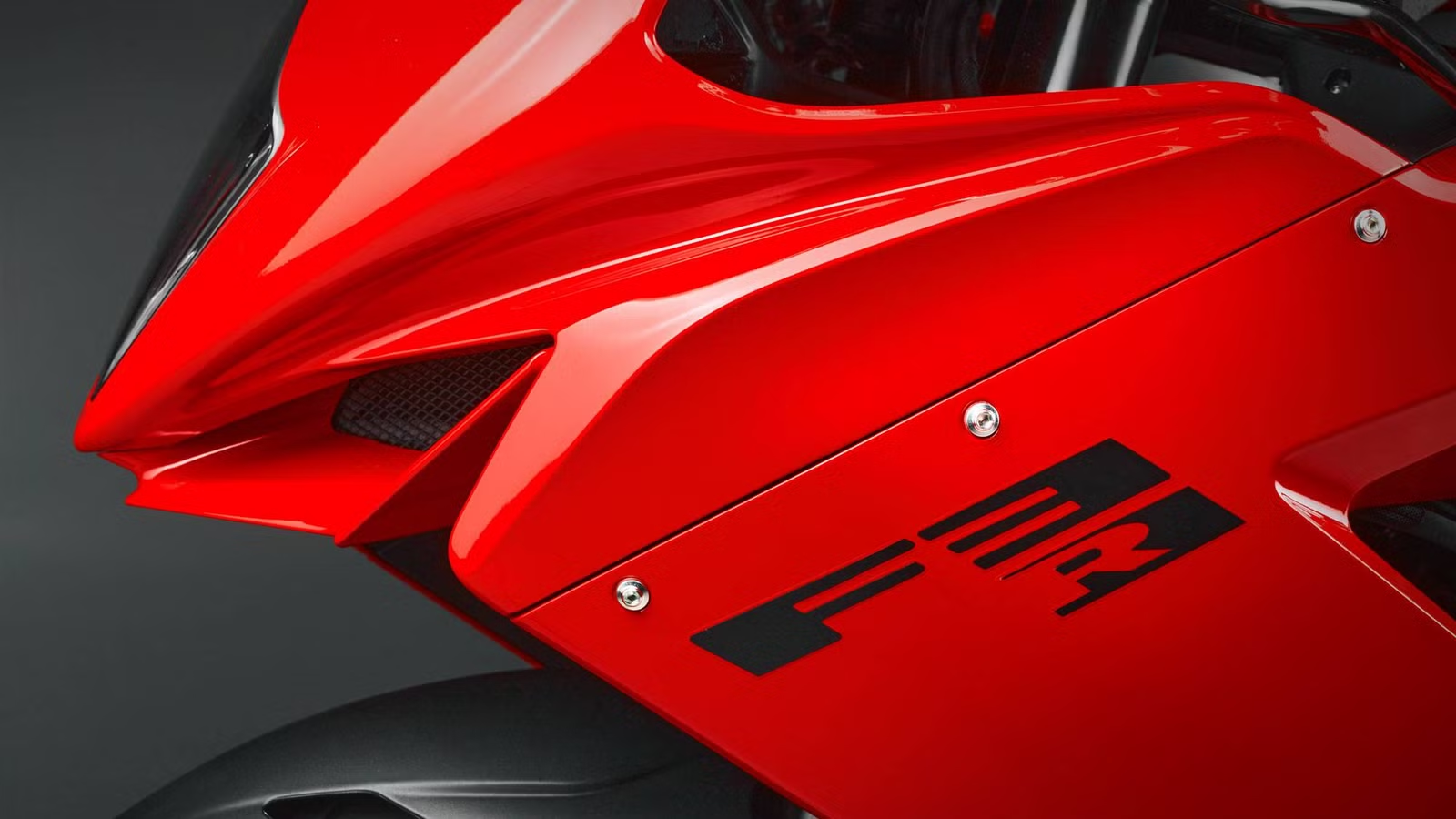
It isn’t a half bad-looking motorcycle either. This was indeed one of Massimo Tamburini’s last contributions to the world of motorcycling, along with the F4 which has since gone out of production. The lines flow beautifully, and we don’t think anyone will be bothered by the fact that there is only one color choice, because this Rosso Ago is simply stunning, and highlights all the best parts of the motorcycle.
Naturally, no matter how good it is, not everybody will want an exotic Italian motorcycle. While the initial price of admission is enough to make grown men shed a tear, it is the running costs that will really get you. This is not the kind of machine that can be left to its own devices. It needs to be pampered, and if you dare miss a service, or use the wrong oil, it will punish you down the line with an even more expensive problem.
Source: MV Agusta

Related posts





Latest Post


No Comments