
Toyota RAV4 Hybrid Has A New Problem: Hyundai Is Coming For Its Buyers With A Full Hybrid Push
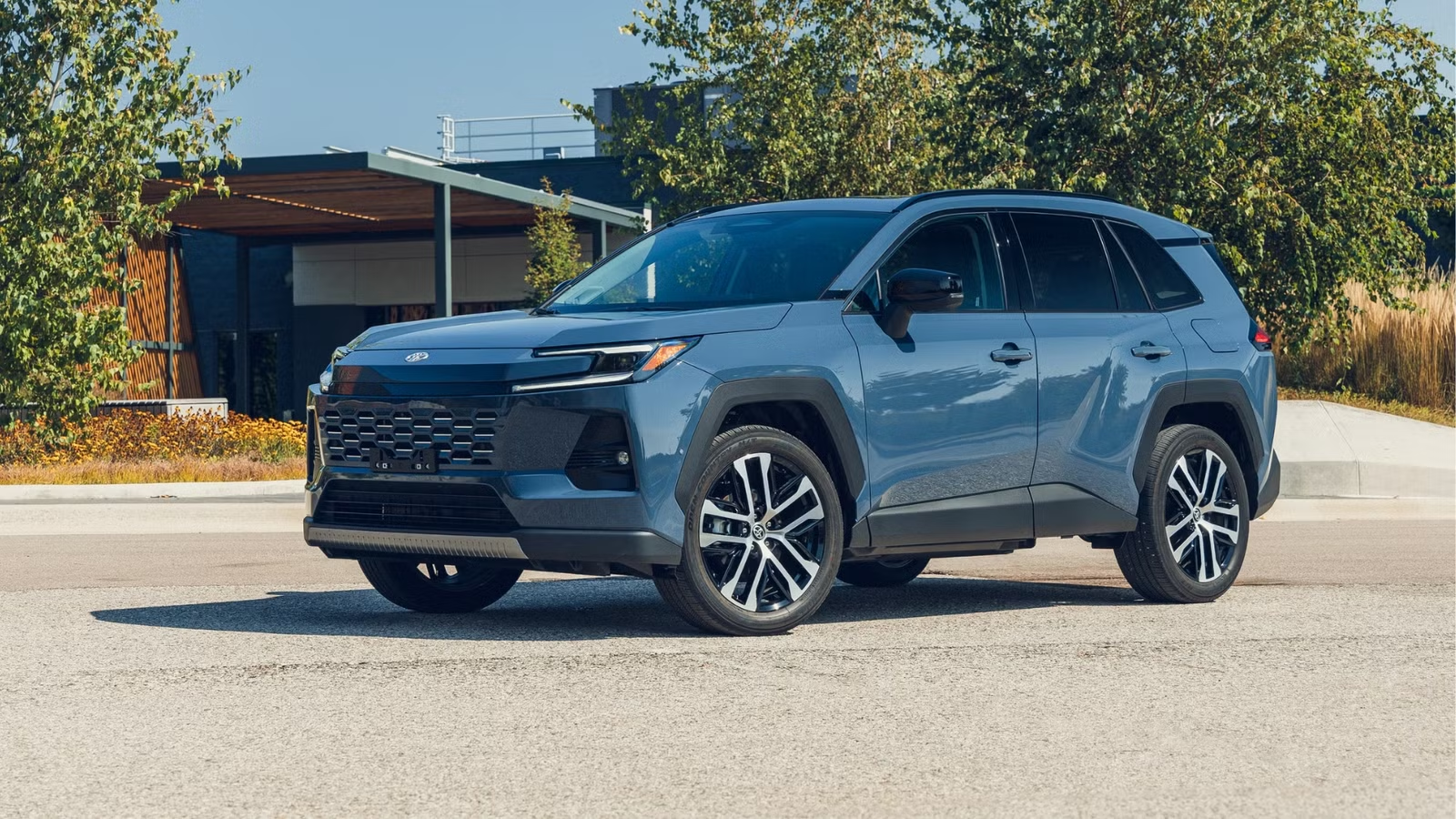
Hyundai put its cards on the table at its 2026 CEO Investor Day this week, and the message was direct: hybrids are no longer a bridge to something else — they are the strategy. The company plans to offer more than 10 hybrid models in North America by 2030, targeting hybrids as roughly half of its regional sales mix, with production anchored at its Alabama and Georgia plants. For anyone shopping a Toyota RAV4 Hybrid, that announcement is worth paying attention to.

The Tucson Hybrid and Santa Fe Hybrid are the sharpest competitive weapons in that plan. Both already sit in the same family-SUV segment where the RAV4 Hybrid has built its dominance, and Hyundai is now backing them with a commitment to local production, aggressive pricing on new trims, and a sourcing target of more than 80 percent North American parts by 2030. CEO José Muñoz framed the shift plainly: build more vehicles on U.S. soil, fill showrooms with hybrids, and raise the operating margin target above 9 percent in the process.
Why Hyundai Is Moving Now, and What’s Driving the Timing
The context behind the announcement matters as much as the announcement itself. Hyundai currently faces a 15 percent U.S. tariff on imported vehicles, and that cost pressure is accelerating decisions the company might otherwise have spread over several years. Raising local parts sourcing from 60 percent to 80 percent by 2030 is partly a tariff hedge — vehicles built in Alabama and Georgia with predominantly American-sourced components carry less exposure to trade-related cost swings.

At the same time, buyer behavior is shifting in Hyundai’s favor. TrueCar CEO Scott Painter noted recently that hybrid searches on the platform have climbed to nearly three times their normal level, driven by affordability pressures and uncertainty around trade policy. Buyers who might have stretched toward a battery EV are reconsidering. The hybrid value proposition — better fuel economy, no charging infrastructure dependency, lower lifestyle disruption than a full EV — is resonating with exactly the mainstream SUV shopper Hyundai is targeting.
Hyundai’s own numbers reinforce the case. U.S. hybrid sales jumped 71 percent year over year in the second quarter of 2026, and the brand’s first-half North American total of 595,457 units was a regional record. The Sonata HEV, Elantra HEV, and Tucson HEV each posted record July sales figures.
What the Tucson Hybrid and Santa Fe Hybrid Bring to the Fight

The Tucson Hybrid is the most direct answer to the RAV4 Hybrid. An all-new Tucson and Tucson Hybrid are set to arrive in the fourth quarter of 2026, with updated trims that bring lower starting prices and more standard all-wheel drive — two areas where RAV4 Hybrid shoppers have historically had to spend up to get what they wanted. The Santa Fe Hybrid covers the slightly larger end of the segment, and Hyundai is also preparing a Santa Fe Extended-Range EV, due in the first half of 2027, that targets more than 600 miles of combined range and will be built in Alabama.
For a buyer cross-shopping these vehicles today, the practical differences come down to familiarity and resale confidence as much as specs. Toyota’s hybrid reputation was built over two decades of Prius, Camry, and RAV4 ownership. Hyundai’s hybrid powertrain track record is shorter, but the gap in real-world reliability perception is narrowing as more Tucson and Santa Fe hybrids accumulate miles in the field.
How This Stacks Up Against Toyota’s Entrenched Hybrid Position

Toyota’s advantage in this segment is not just the RAV4 Hybrid itself — it’s the depth of the lineup around it. The 2026 RAV4 moved to an entirely electrified range of hybrid and plug-in hybrid powertrains. Toyota Motor North America sold 383,091 electrified vehicles in the second quarter of 2026 alone, representing 56.8 percent of its total U.S. volume. The RAV4 Hybrid posted its best-ever quarterly sales during that same period.
Hyundai is not trying to out-Toyota Toyota on any single model. The strategy is volume and coverage — more than 10 hybrid nameplates across compact, large, and premium segments, with Genesis adding its first hybrid as well. That breadth changes the competitive dynamic. A buyer who walks into a Hyundai dealership in 2028 will have hybrid options across nearly every segment, which reduces the likelihood they cross-shop at a Toyota store simply because Toyota has a hybrid and Hyundai doesn’t. The addition of 500,000 units of annual North American manufacturing capacity by 2030 is meant to ensure those models are actually in stock when buyers arrive.
For a RAV4 Hybrid shopper today, the immediate takeaway is straightforward: the competitive pressure on Toyota is real, and it’s likely to produce better pricing, more standard features, and stronger incentives across the segment over the next two to three years. Hyundai’s hybrid push doesn’t make the RAV4 Hybrid a worse car — but it does mean the default choice is worth questioning in a way it wasn’t 18 months ago.

Related posts



Latest Post


No Comments