
The Suzuki Owners Refuse To Part With
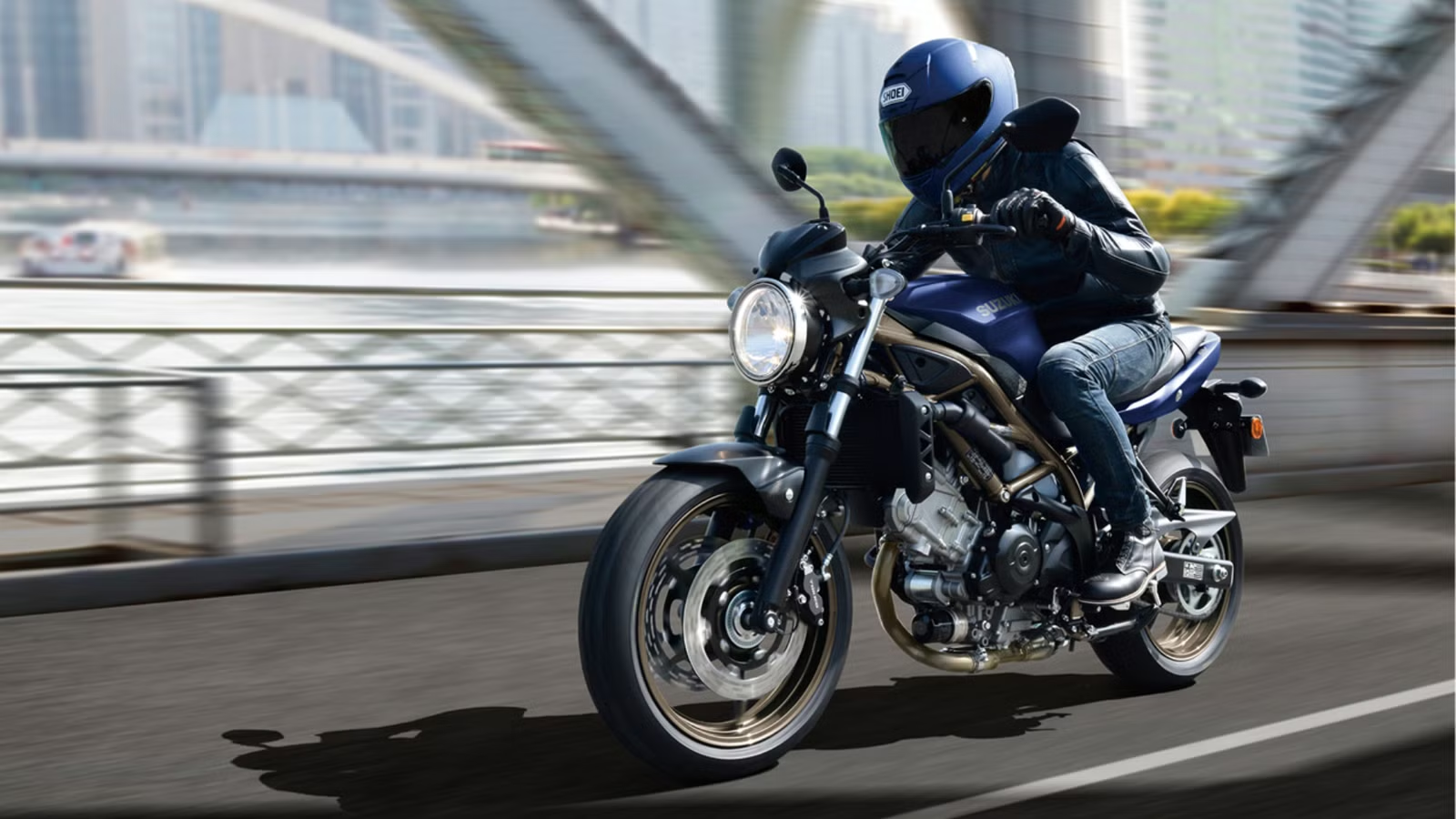
Motorcycles are often replaced because something newer promises more power, more technology, or a shinier answer to an old question. But this isn’t the case with all of them. Their owners may buy faster bikes, bigger bikes, or bikes loaded with screens and riding modes, but they still find a reason to keep that one particular naked motorcycle that they fell in love with tucked away in the garage. This loyalty doesn’t come from fancy advertising. It comes from personality, handling, manageable running costs, and, most of all, versatility in the motorcycling world.
Suzuki Has Built More Than Its Share Of Cult Favorites
The Katana Proved Suzuki Was Willing To Be Different

Suzuki has never been particularly interested in making every motorcycle look or feel sensible. That willingness to color outside the lines helped create some of motorcycling’s most recognizable machines. The original GSX1100S Katana arrived in the early 1980s with styling that looked as though it had escaped from a sci-fi movie and somehow found its way into the hearts of its fans. Suzuki’s own historical records list the Katana as one of its landmark models.
The GSX-R750 Created A Brotherhood That Outlasted The Bikes Themselves

Then came the GSX-R750, another machine that riders remembered long after they sold them. Introduced as a 1985 model, the GSX-R750 brought race-inspired thinking closer to the street. But what made the GSX-R750 especially significant wasn’t that it was fast. Suzuki gave it lightweight construction, aggressive engineering, and a purpose that was obvious: racetrack performance over general-purpose usefulness. Later generations changed dramatically, but the “Gixxer” name retained a powerful following, and to this day, you’ll find “gixxer bros” all across North America.
From The Hayabusa To A Different Kind Of Legend

In 1999, Suzuki introduced the Hayabusa, a motorcycle that built on the Gixxer’s capabilities with enormous performance, unusual aerodynamics, and a silhouette that was impossible to confuse with anything else. Suzuki itself describes the original as a motorcycle created to make a dominating impact, and the bike’s quarter-century history shows just how successfully that idea lodged itself in motorcycling culture.


Now, Suzuki’s cult classics have all followed the same formula. Some became legends because they were extreme, while others earned their following because they were uncomplicated and versatile. Take the DR650S, for example, built around simplicity and usefulness rather than outright performance. This camp is also where our favorite Suzuki sits. It’s the one bike that has been around for decades, with minimal changes and a following that could be described as hoarders. But what is it about this particular machine — with no exotic specs, no record-breaking numbers — that makes owners hold on for decades?
The Suzuki SV650 Is The Motorcycle That Gets Under Its Owners’ Skin
Riders Buy The SV650 To Learn, Then Never Find A Reason To Sell It

You don’t buy the Suzuki SV650 because of its spectacular specifications. In fact, riders buy it as their first big bike, something to learn the ropes on. But the SV650 was built to be so versatile that owners end up keeping them long after they’ve graduated from training wheels and moved on to more powerful machines.
None of the SV650’s specifications sound revolutionary. It’s a standard 645cc V-twin, six-speed transmission, and conventional suspension. The latest version comes with ABS as standard. But these are the parts riders interact with the most. The SV650 continues to remain refreshingly mechanical. There’s no fighter jet-like startup sequence; just turn the key, thumb the starter, and settle into the rhythm of the road.
The SV650’s 645cc V-Twin Is Still The Main Event

Everything begins with the engine, and the SV650 has seen a few changes since its introduction back in 1999. The current SV650 comes with a 645cc 90-degree V-twin that produces 73 horsepower at 8,500 rpm and 47.2 pound-feet of peak torque at 8,100 rpm. While the architecture remains the same as the original’s, continuous evolution has completely overhauled the inner workings of the engine, making the bike even better than it was.

A parallel twin may make excellent sense on paper, but the 90-degree V-twin gives the SV650 a different character. Riders don’t form opinions about compression ratios, but an engine’s feel is always the first thing they notice. Because of the V-twin, there is enough punch throughout the rev range, making the engine feel alive but not unruly like some other middleweights.
The SV650’s Chassis Works As Well On Mountain Roads As It Does In City Traffic

The SV650’s appeal has always depended on predictability. The Suzuki SV650 is built on a high-strength tubular steel trellis frame. Suspension comes from conventional telescopic front forks and a single link-type monoshock. Now, conventional does not mean ineffective.
Riders want a bike that responds naturally, whether taking a corner or riding around a pothole-ridden city. The suspension on the SV650 supports this in the best way possible. It isn’t stiff like sport bikes for the city, but it isn’t springy enough to toss you around in the bends either.

Braking hardware is straightforward, too: two discs and four-piston calipers in the front, and a single disc and a one-piston caliper in the rear. ABS comes standard on today’s SV650, adding a mild layer of safety for a new big-bike rider. The character the bike has always been known for has not changed.
The entire package itself is also compact, so it doesn’t feel out of place in the city. Yet, thanks to this same size and consistent hardware, the SV650 is equally at home on a mountain road. It occupies this wonderful middle-ground that is hard to find in many machines.
Character Matters More Than A Perfect Specification Sheet
The Suzuki SV650’s Design Refuses To Chase Fashion

The SV650’s design is one of its quieter strengths. It is unmistakably a naked bike, but not in the way you see today’s nakeds. The design is from an era where curves meant something. It’s not just folds and angles from an origami school. The exposed engine, compact fuel tank, no bikini fairing, and the round headlamp all keep this bike refreshingly retro.
This is another reason owners hold on to SV650s. Bikes designed around fast fashion tend to lose their wow factor when the trend moves on. The SV650 is one of those bikes that doesn’t become obsolete so easily. It is the kind of fashion that always comes back around, much like baggy pants.
SV650 Owners Say 46,000 Miles Isn’t A Reason To Walk Away

Spend enough time in the SV650 communities, and a pattern emerges. The details vary, but the attachment remains consistent. On a Reddit thread, a potential buyer of a 46,000-mile 2006 model was worried about mileage.
A long-term owner, however, advised focusing on the maintenance records rather than the odometer, stating that these bikes, even when serviced only occasionally throughout the years, continue to run without issue. Another owner of 20 years maintained that high mileage alone was not a reason to walk away from an SV650. Small problems crop up, but the SV650 is easy to maintain and can be serviced by any mechanic, thanks to how simply this bike was built.
Suzuki Didn’t Change The SV650 Into Something It Did Not Need To Be

The current Suzuki SV650 still revolves around the same essential ingredients: a characterful engine, an approachable chassis, and decades of fun and memories all in a package that’s designed to stand the test of time. There are faster middleweights; there are technologically more advanced ones, too, but those advantages have never fostered the kind of relationship with their owners that an SV650 has. The magic is less dramatic, but it is more impactful. The SV650 is a bike that a newcomer can learn on, that can entertain a more experienced rider, and that can serve as a commuter if necessary.
Source: Suzuki Cycles, Reddit

Related posts

Latest Post


No Comments