
The Honda Roadster That Stayed Within Seven Seconds Of A Boxster S At The Nürburgring
At the turn of the century, the Porsche 986 Boxster S was the definitive compact drop-top sports car with a penchant for performance, delivering unparalleled thoroughbred driving dynamics – but at a premium price.

Then a lightweight, high-revving Japanese roadster from Honda entered the fray and came within seconds of beating its German rival’s time on its home turf at the Nürburgring’s Nordschleife. And it cost almost $10,000 less, making it a real underdog in the battle for lap time glory.
Porsche’s Home-Grown Advantage
For decades, the Nürburgring has been the benchmark for vehicle manufacturers to prove the performance prowess of their cars. The twisty and undulating 12.9-mile route through the Nordschleife (North Loop) is commonly referred to as ” The Green Hell” due to its high speeds, ever-present barriers, and bewildering array of 154 corners with all sorts of cambers, radii, and lengths. It is an unforgiving test of power and speed, handling precision and balance, stability and braking performance.

Porsche, which is headquartered just 185 miles away from this legendary circuit, has consistently used it to develop and test its machines to the absolute limit, and the 986-generation Boxster S was no exception. Renowned for its precise handling, exceptional feedback, and gutsy performance from the meaty 256 hp 3.2-liter flat-six, the Boxster S set an exceptionally high standard for its class from the outset. The first-generation model achieved an impressive lap time of the Nordschleife of 8 min 32 sec, at an average speed of 90 mph.
This was three seconds faster than a 321-hp BMW M3 Coupe SMG, six seconds up on the first-gen 276 hp Honda NSX and eight seconds ahead of Chevrolet’s 339-hp C5 Corvette, which was an impressive performance. All three rival tests were conducted in 1997 by German magazine Sport Auto, with the same driver, Horst von Saurma, who also set the Porsche’s time two years later, and the rule-breaking Honda one year after that.
The Roadster Boom

The compact two-seater roadster segment grew significantly during the 1990s, based on the enormous success of the original Mazda MX-5 Miata which first debuted in 1989. The Germans followed in quick succession with their premium offerings. BMW kicked things off in 1995 with the Z3, Porsche launched the 986 Boxster in 1996 (with the underpowered 201 hp 2.5-liter engine at first), Mercedes-Benz delivered the SLK a year later, and Audi arrived with the TT in 1998.
It was the 256 hp 3.2-liter Boxster S, introduced in 1999, that significantly raised the benchmark and gave the car and its brilliant chassis the performance it deserved. With the flat-six engine mounted just ahead of the rear axle in a mid-rear configuration, the Boxster S achieved a 46% front / 54% rear weight distribution that delivered the handling precision and finesse that its nose-heavy rivals could only dream of.
While BMW countered with the lively Z3 M Coupe and Roadster, and Merc with its supercharged SLK32 AMG, the Porsche was in a different league for driving engagement, control and pace on any twisty piece of tarmac, on the road or track.
Honda’s 50th Birthday Present To The World

Honda’s answer to the proliferation of compact two-seat sports cars was a sleek and seductive yet highly focused car that embodied its finest engineering expertise. It ended up being the most driver-oriented roadster of them all.
First shown in prototype form in 1998, the S2000 was a celebration of Honda’s 50th anniversary – and thus a very memorable birthday present to itself and automotive enthusiasts around the world.
Relying on its vast motorsport heritage, Honda’s S2000 engineers ensured that, despite its traditional front-engined rear-wheel drive layout, it had the perfect 50/50 weight distribution. This was complemented by race-bred double-wishbone suspension and exceptional body rigidity.

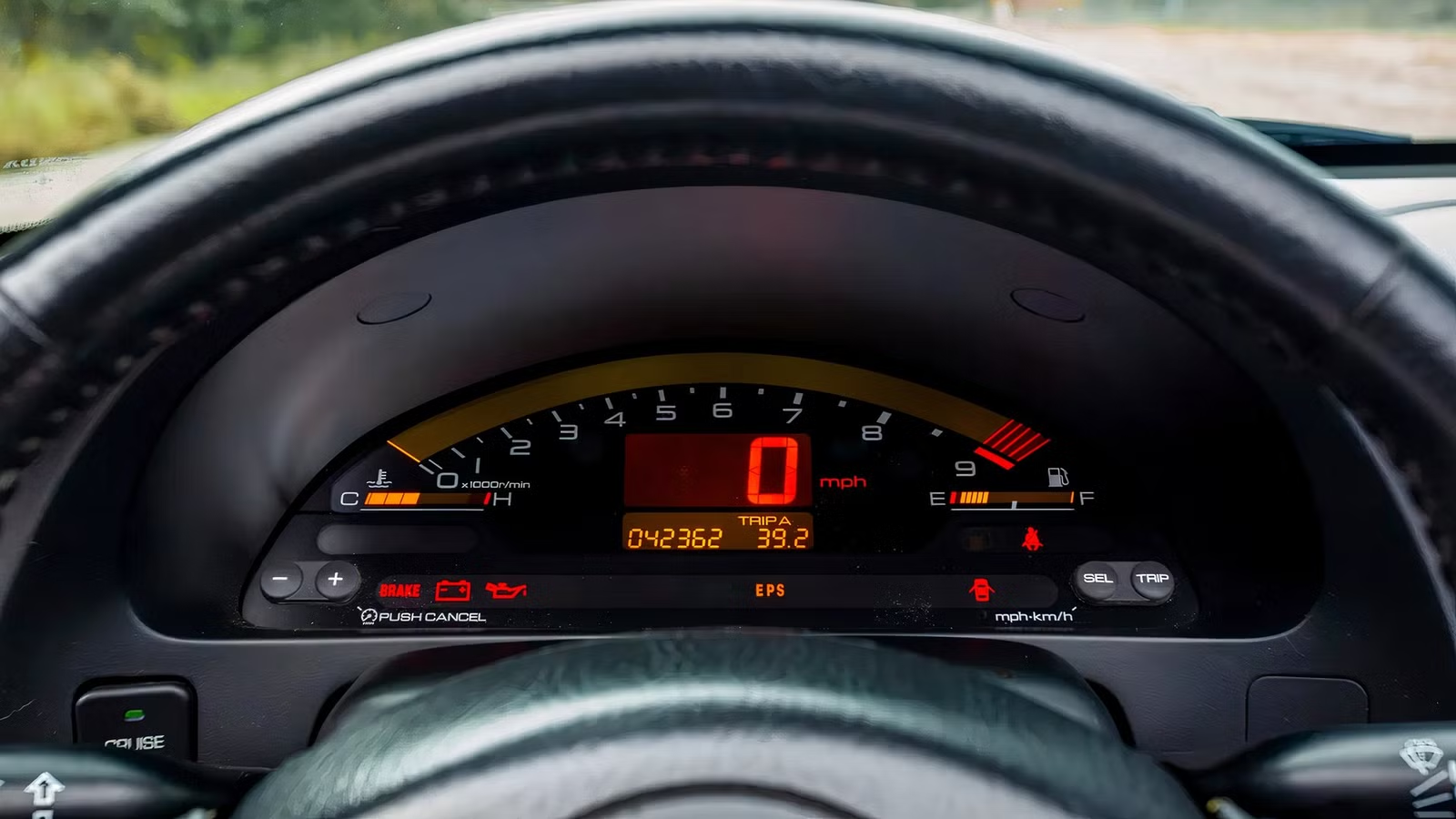
The cabin was minimalist and entirely driver-focused, with form-hugging bucket seats. The cockpit-style driver’s view was dominated by an F1-inspired digital instrument cluster with a horizontal 9,000 rpm rev counter with integrated shift lights, and a simple, clear digital speedometer. A well-proportioned three-spoke steering wheel and sharp steering rack offered loads of feedback and pinpoint accuracy.
And, lest we forget, the S2000 was graced with one of the best short-throw six-speed manual shifters ever produced.
Lightweight Agility, High-Revving Power

The most important ingredients in the S2000 formula were low weight and high performance. Honda’s engineers adopted a ruthless approach to making the car as light and agile as possible, and it paid off. With a curb weight starting at 2,756 pounds, the S2000 was around 200 pounds lighter than the Boxster S.
In the engine department, Honda went all high-tech. Its 2.0-liter four-cylinder naturally aspirated F20C engine revved to a ridiculous 9,000 rpm, and produced its peak power of 240 horsepower at a stratospheric 8,300 rpm. It achieved a specific output of 120 hp per liter – the highest for any naturally aspirated production engine at the time.

Despite using its latest VTEC variable valve timing technology, the extreme high-revving nature of the engine sacrificed low-end torque, with just 153 lb-ft produced at 7,500 rpm. This resulted in the S2000 requiring a far more hard-core, full-commitment approach to its driving experience than any of its rivals. This was one of the main criticisms of the car, especially compared to the larger-capacity premium roadsters such as the Boxster S, Z3 and SLK.
The 7,200 rpm Porsche had the benefit of an additional 1.2-liters of displacement compared to the S2000, an extra 16 hp delivered 2,050 rpm lower in the rev range, and a much more readily accessible 225 lb-ft of torque at 4,500 rpm. This ensured that it would happily plod along in the daily commute, and was just as capable of being driven flat out with its soulful six-cylinder boxer engine howling towards the red line.
Against the Clock

It’s no surprise that the Boxster S was quicker in every performance metric, posting a 0-60 mph time of 5.2 sec, crossing the ¼-mile in 13.8 sec and going on to a top speed of 163 mph. With its rev-happy nature, the S2000 wasn’t far off though, completing the 0-60 mph sprint in 5.4 sec, doing the ¼-mile just a tenth slower than the Porsche, and maxing out at 146 mph.
Despite its small engine capacity and significantly lower outputs (specifically in the torque department), these performance figures against the more upmarket and pricier Porsche were a real surprise. At a launch list price of $32,000 for the S2000, it was undeniably a genuine performance bargain.
On the punishing test of the Nordschleife, the S2000 proved that it had the race-engineered capability to threaten the premium Germans. It lapped the course in an impressive 8:39 – a mere seven seconds off the time set by the Boxster S a year earlier. The test was once again conducted by Sport Auto, with test driver Horst von Saurma at the helm.

In bang-for-buck terms, this meant that you had to spend an additional $9,430 to go a mere seven seconds faster over the full 12.9 miles of the winding, undulating and challenging Nürburgring circuit. That’s a staggering $1,347 per second.
Although official Nürburgring times for the later AP2 and S2000 CR (Club Racer) were never recorded, a test was conducted in 2017 by One Lap Heroes, using a slightly modified 2001 AP1 S2000. It was equipped with D2 coilovers, different brake pads, a lightweight flywheel, stage 2 clutch and grippy Kumho V70A tires, plus a couple of aero tweaks. It achieved a Bridge to Gantry time on the Nordschleife of 7:59.8 seconds, which translates to an estimated full lap time of 08:35 – four seconds quicker than the original car, and within three seconds of the Boxster S.
It proved just how capable the original AP1 S2000 was right from the beginning, and why it remains revered as a prime example of a genuinely driver-focused sports car that rewards enthusiasts with an undiluted and exhilarating driving experience.
Continuous Evolution To The S2000 CR

The later AP2-generation S2000 arrived in late 2003 for the 2004 model year. It was equipped with a larger 2.2-liter engine that had the same 240 hp, but peak power was produced 500 revs lower at 7,800 rpm. Torque was also boosted from 153 to 162 lb-ft at 6,500 rpm, a significant 1,000 rpm lower than the original.
Numerous other tweaks were included in the updated car, including an even more rigid body, revised six-speed manual transmission with 4% shorter ratios in the first four gears, 17-inch wheels to replace the original 16-inch versions, along with updated suspension tuning. The design was refreshed too, giving it a sharper appearance while also improving aerodynamics (Cd) by 5%.
Cabin space was increased and more creature comforts added, with curb weight increasing slightly by 24 pounds. The 2006 model year saw the introduction of Vehicle Stability Assist and electronic drive-by-wire throttle control, with engine outputs changing to 237 hp at 7,800 rpm and 162 lb-ft of torque at 6,800 rpm.

The ultimate S2000 CR (Club Racer) edition was launched exclusively for the US market in 2008. It was a lighter, stiffer and more aggressive machine, but without any engine upgrades other than a sportier exhaust. Designed for track day events, it had front and rear spoilers, track-oriented suspension settings, an even more rigid chassis, faster steering rack, more aggressive Bridgestone Potenza RE070 tires and a weight saving of around 90 lb. A fully equipped S2000 CR with air-conditioning and an audio system was priced at $37,300, some $3,000 more than the standard car.
Only 699 S2000 CR editions were produced, while total S2000 sales in the US from 2000 to 2009 topped out at approximately 66,550 units, which accounted for 58% of the global production of about 113,900 vehicles.

While the AP2 has the appeal of the larger engine, improved space and more features, there’s something appealing about the original AP1 S2000 with its classically clean lines and its hard-edged performance that demands that the car is driven exceptionally hard to extract its best – as intended by its creators.
Nevertheless, whatever the year or generation, the S2000 has firmly cemented its status as a modern classic that had the premium sports car brands sweating, and for good reason.
Sources:FastestLaps, Honda

Related posts
Latest Post


No Comments