
The Rarest Small Block V8 Engine In A Ford Muscle Car
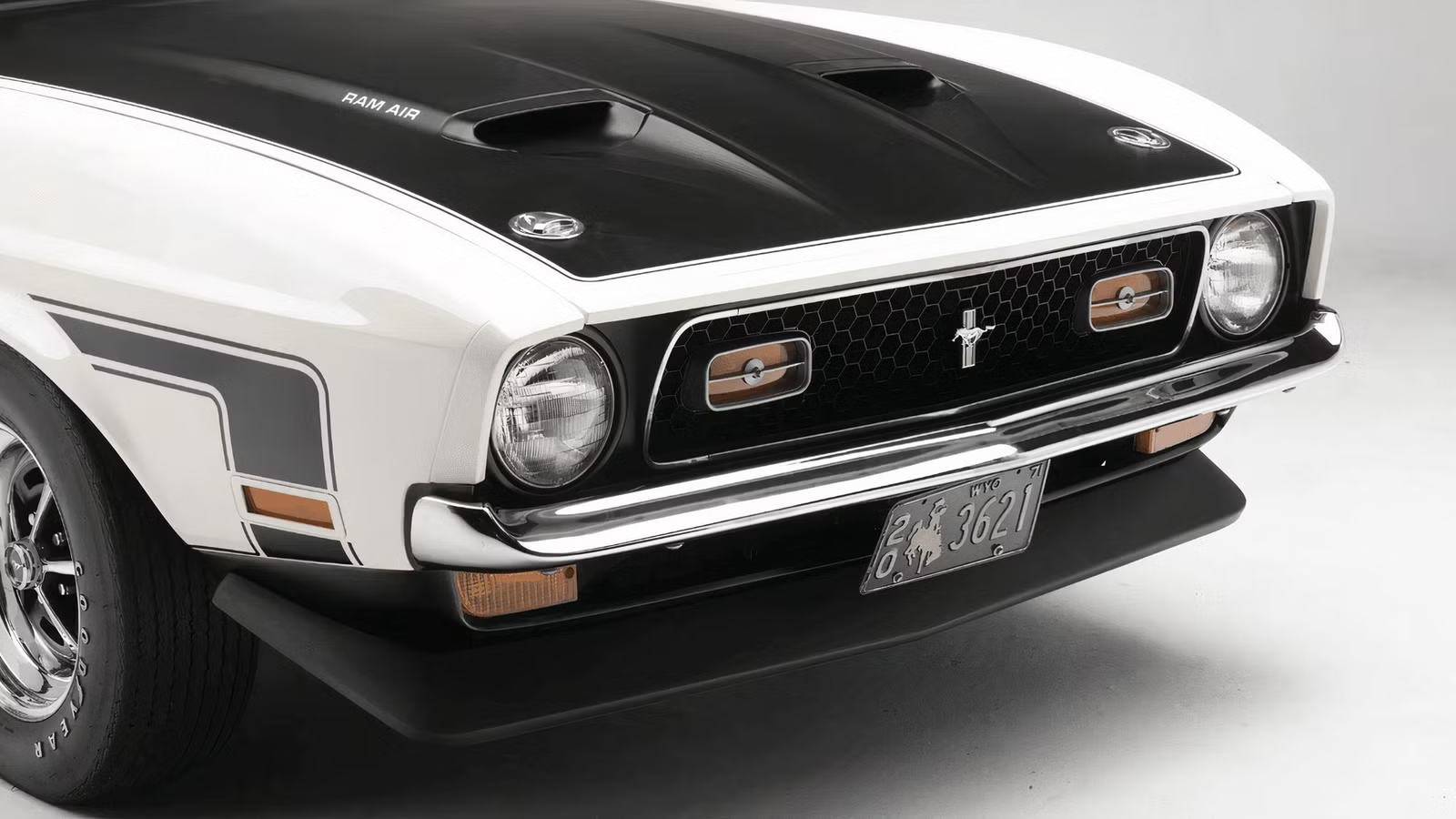
Few powerplants have shaped American performance culture quite like Ford’s small block V8. Compact, tuneable, and endlessly versatile, the engine family powered everything from luxury sedans and workhorse pickup trucks to some of the most fearsome muscle cars ever to roll out of Dearborn. But within that storied lineage, one variant stands apart — built in such limited numbers that most enthusiasts have never seen one in the metal. This is the story of the rarest small block V8 Ford ever dropped into a production car, and it just so happens to call one of the most aggressive Mustangs of the early 1970s its home. Here’s everything you need to know.
The Boss 351 Mustang Engine Is Ford’s Rarest Small Block V8

During the 1960s, Ford had enviable success not just in the showrooms, but on racetracks too. The Mustang was at the center of it all, and so a number of dedicated racers were created, dubbed ‘Boss’ models. The Boss 429 came along in 1969, with a massive big block V8 under the hood, while the Boss 302 catered for small block customers. Both were homologation specials, built and sold to comply with racing regulations — in short, the ’60s Boss cars were racers for the road.
This is where the ’71 Boss 351 differs. It boasts a model-specific 351ci V8, along with a wide range of aesthetic touches such as two-tone paintwork, aggressive bodywork, and the ‘must-have’ muscle car accessory of the era, a Hurst shifter. However, the Boss 351 was only ever intended as a road car, and never for the track.
Much like the 429 and 302 that preceded it, production was tightly limited. In total, only 1,806 examples of the 1971-only Boss 351 were produced, making this small block the rarest ever equipped to a production model Ford.

The Mustang Boss 351 Makes 330 Horsepower At 5,800 RPM
Engine & Performance Specs
|
Configuration |
Small block V8 |
|
Displacement |
351ci |
|
Aspiration |
Naturally aspirated |
|
Power |
330 horsepower |
|
Torque |
380 lb-ft |
|
0 to 60 |
5.8 seconds |
|
Quarter mile |
14.1 seconds |
(Specs courtesy of Ford and Car & Driver)
Despite not being developed with a racing series in mind, Ford was clearly keen to protect the reputation that Boss models had earned. So the 351 had to be more than a marketing gimmick dressed up with fancy spoilers — it had to perform.
Fortunately, the Boss 351-specific engine had a bite to match the model’s bark. It produced 330 horsepower along with a meaty 380 lb-ft of torque — a combination that propelled the Boss 351 from 0 to 60 mph in just 5.8 seconds, and allowed it to complete a quarter mile in just over 14 seconds when tested in period by C&D. In their quest for performance, Ford turned to the newer Cleveland V8 in place of the Windsor engine used in the Boss 302, which allowed for greater compression and larger displacement. Forged aluminum pistons were also employed to further sharpen the engine’s output.
The Boss 302 Mustang Engine Is Another Rare Small Block V8 From Ford
In the early 1960s, Ford beat everyone to the punch and launched the first-generation Mustang while the competition was still half asleep. As a result, the likes of Chevrolet and Pontiac had to rush their pony cars out the door in an effort to keep up. However, fast-forward a few years, and Ford was fighting to keep the Mustang’s image fresh in the minds of consumers.
Racing was a great way to do this, and so the team decided to launch an all-new model for the SCCA Trans Am series — a racing series that had served them well in the past, both on track and in the showrooms.
The new Mustang would sport a 302ci V8 engine to comply with then-current racing regulations, and Ford would need to produce a road-going model for homologation purposes. Therein lies the Boss 302’s creation story, in a nutshell.
Ford Only Made 8,642 Muscle Cars With The Boss 302 V8
Ford ended up making just 1,628 Boss 302 cars in 1969, and then 7,014 in 1970. In total, just 8,642 Boss 302 Mustangs were ever created. The small block 302 V8 that featured in these models was unique, and so Ford needed only to make enough for those 8,642 cars, making it another of the rarest small blocks ever fitted to a production model Ford.
A Closer Look At The Boss 302 Small Block V8

Engine & Performance Specs
|
Configuration |
Small block V8 |
|
Displacement |
302ci |
|
Aspiration |
Naturally aspirated |
|
Power |
290 horsepower |
|
Torque |
290 lb-ft |
|
0 to 60 |
6 seconds |
|
Quarter mile |
14.57 seconds |
(Specs courtesy of Ford and Car & Driver)
Ford had enjoyed considerable success with the old Windsor engine, but its outright performance simply wasn’t up to the task for the Boss 302. After all, the goal wasn’t to build a cool muscle car — this one had races to win. Meanwhile, Ford was developing an all-new Cleveland V8. It showed promise, but it wasn’t eligible for the Trans Am racing series.
The cylinder heads from the Cleveland, however, turned out to be the answer. When fitted to the old Windsor block, the engine came alive thanks to the less restrictive head design. Couple that with a strengthened block, stouter connecting rods, and revised spark plugs, and the Boss 302 V8 was born. This race-winning design boasted 290 horsepower and torque in equal measure, and according to period C&D tests, it could dart down the quarter mile in just 14.57 seconds.
Before The Boss 302 V8, Ford Developed The 302 Tunnel-Port Small Block V8

Although the Boss 302 and 351 V8s are undoubtedly rare, Ford did develop another engine with Boss intentions that is even scarcer. That engine is one that tried to fill the Boss 302’s shoes beforehand, but for various reasons, it just wasn’t meant to be.
Ford developed the tunnel-port 302 V8 just prior to crafting the Boss 302, designed with the same purpose in mind — winning at the SCCA Trans-Am racing series. The 302 TP engine was powerful, but only within a very narrow rpm band at high revs. While that characteristic suits oval racing, where cars spend virtually all their time in the same high-rev range, it proved a liability on a road course. It was back to the drawing board for Ford’s engineers. The total number of 302 TP engines produced remains unknown.
Here’s How Much A 1971 Boss 351 Mustang Costs Today

Pricing Details
|
Condition |
Price |
|
Concours |
$127,000 |
|
Excellent |
$91,200 |
|
Good |
$64,400 |
|
Fair |
$44,900 |
(Current values secured from Hagerty’s Valuation Tool)
For fans of Fords and small block V8 engines, adding a Boss 351 Mustang to a collection should be a top priority. Unfortunately, it’s not that easy. With only 1,806 ever built — and many driven hard in the decades since — scarcity has had a significant effect on values.
If you’re handy with the wrenches, a fair driver-quality example can be found for around $45,000. If, however, you’d like one perfect and show-ready, expect to triple that figure, with concours-condition cars fetching in the region of $127,000.
Sources: Hagerty, Car & Driver, Bring A Trailer, CarBuzz, TopSpeed, CJ Pony Parts, Motor Trend

Related posts



Latest Post


No Comments