
The Rare ’80s Chevy Body Kit That Hid Zero Performance Upgrades
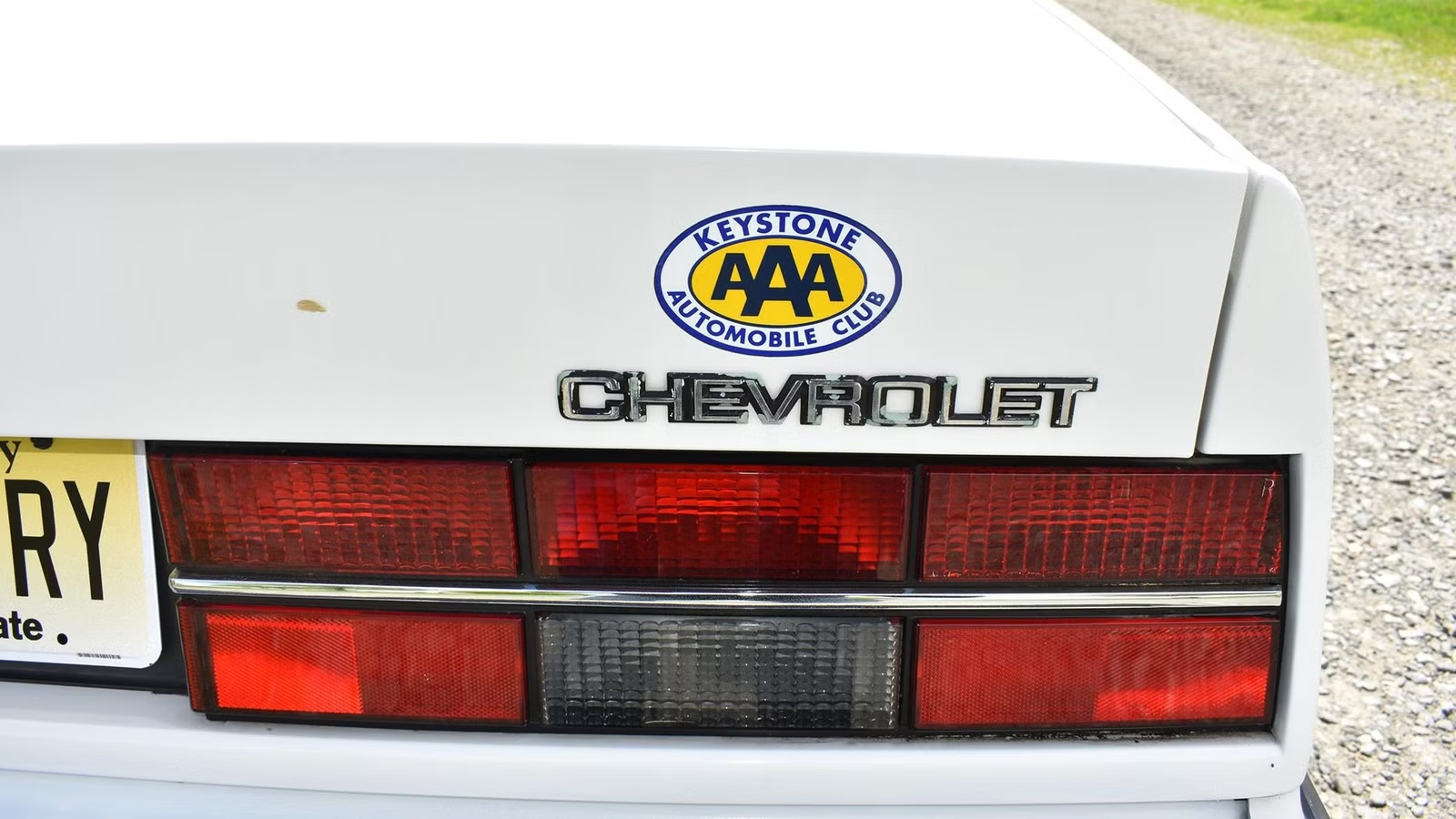
The year is 1987; you walk into a showroom with $17,000 in hand, a small fortune at the time, and in exchange, you drive off in a mid-size family car that looked like it belonged on the European touring car scene. With its blanked-off aero grille, wide ground effects, and a cabin lined in blood-red carpet, Detroit’s latest looked like it could dominate the streets, but that was it. It just looked like it. Underneath all the European-inspired swagger was the exact same commuter chassis as the base model next to it. A masterclass in how not to approach a performance vehicle.
Detroit’s Quick Fix For The European Invasion

To understand why one of the biggest automakers in America made such a bizarre decision and greenlit a radically styled visual spectacle, we need to look at the context. We have to wind back the clock and take a dive into the automotive landscape of the time. During the mid-1980s, European manufacturers BMW and Mercedes-Benz were dominating the market, capturing the cash-rich baby boomer population with stylish, firm-riding sporty sedans. General Motors wanted a piece of that pie. That said, it was easier said than done to design a ground-up, rear-wheel-drive European-style chassis with a multi-valve engine; it would have required a lot of time and testing, and corporate was unwilling to invest the capital required for such a massive undertaking.
During that time, GM’s mainstream, high-volume model, which was also very practical, earned the title of America’s top-selling car in 1986. But being the bestseller also meant the car was everywhere, from corporate fleets to rental companies and suburban commuters, with virtually no performance credentials to speak of. In a bid to inject young, vibrant energy into its showrooms, GM unveiled a concept car on the 1986 auto show circuit. The car featured a lowered stance, flush headlights, monochromatic paint, and ground effects; public reaction was overwhelmingly positive, and the corporation instantly approved a limited production run for 1987. But in doing so, they completely skipped the spectacle under the hood.
Fiberglass, Monochromatic Paint, And Blood-Red Carpet


Getting this visual spectacle from an auto show to the dealership floor needed an unusual logistical solution. The main assembly plants were optimized for producing high-volume vehicles quickly; adding hand-fitted body kits and custom interior trim directly on the main assembly line would have caused obvious manufacturing delays. General Motors instead decided to outsource the cosmetic transformation to a specialty contractor, AutoStyle Cars, located less than a mile from the main factory in Oklahoma City. The plan was to build regular commuter models of the car on the factory line, then send them down the street to AutoStyle for the cosmetic overhaul and have them ready to ship.
The mechanics at AutoStyle bolted on a deep front air dam, flared side rocker skirts, lower door moldings, and a custom rear bumper fascia. The standard mesh front grille was replaced with a flush-mounted, body-colored header panel designed to match the styling of its European counterparts. The car was available in four monochromatic colors: red, white, silver, and black; every exterior trim piece, mirror, and set of cast-aluminum wheels was body-matched. The interior featured bright, blood-red carpeting; custom sport seats wrapped in charcoal fabric with red piping; a chunky steering wheel; and matching door accents. All these upgrades made the car look like something out of the European touring spec series. But was it really?
The Celebrity Eurosport VR: 125 Horsepower And A Stock V6

The Chevrolet Celebrity Eurosport VR was on sale from 1987 to 1988. For a price hike over the standard version that was nearly a third of the sticker price, once you look beyond the cosmetic details and ground effects packaging, the real story becomes clear. Enthusiasts and buyers expected the mechanical upgrades to match the styling, but beneath the bodyshell, the Eurosport VR was 100 percent mechanically identical to the standard Celebrity. Underneath the hood was the off-the-shelf Multi-Port Fuel-Injected 2.8-liter LB6 V6 that produced a stock 125 horsepower and 150 lb-ft of torque.
That power was sent to the wheels via a standard three-speed automatic, or buyers could opt for a four-speed automatic with overdrive or a Getrag-designed five-speed manual transmission. With the accelerator pedal pinned to the floor, the race-ready-looking Eurosport went from 0 to 60 mph in a lethargic 9.0 seconds and hit a top speed of 118 mph, making it slower than the genuine sports sedans of its era.
The car received the same front MacPherson struts, gas-pressurized rear shocks, trailing arms, and stabilizer bars that were installed on all the standard mid-size family haulers in the Chevy lineup. Urban legends circulated about whether the Eurosport had an upgraded suspension setup, but that was false; GM factory documentation and period tests confirmed that the VR had the same setup as any base Celebrity.
Why Buyers Rejected Chevrolet’s $4,000 Visual Package

It did not take long for enthusiasts to realize the Eurosport VR did not have the performance credentials to justify its price. Reviews at the time pointed to the car’s sluggish straight-line acceleration and a complete lack of dynamic ability to rival other cars in the class. Buyers were paying a roughly $3,500 to $4,000 markup for what was essentially a cosmetic package. A fully loaded Eurosport VR’s sticker price was around $17,000, which put it in direct competition with legitimate performance machines like the Ford Mustang GT, Chevrolet Camaro, and the BMW 325i.
The market’s cold reaction to this uninspiring attempt at capturing the sports-sedan segment could be seen in the production numbers. In 1987, approximately 1,021 units were produced across all body styles, including just 124 Eurosport VR station wagons and two-door coupes. By 1988, sales hit rock bottom; the model managed to sell only roughly 600 units as enthusiasts became completely disinterested in the Eurosport VR. That resulted in total production of fewer than 1,700 units across the VR’s entire two-year production span.
In a last-ditch attempt to cut production costs and save the program for 1988, General Motors stripped out the signature interior. The VR models also lost the custom sports seats, special door panels, and the blood-red carpeting, going back to the standard Celebrity interior. When GM stripped the cabin of its unique identity, which was one of its few redeeming qualities, the move backfired badly; buyers now had to pay thousands of dollars extra for what was essentially plastic trim marketed as ground effects, which inevitably left Chevy with no option but to pull the plug on the Eurosport VR.
A Living Proof That Real Speed Can Never Be Bolted On

Enthusiasts have always loved cars with a sleeper element: unassuming sedans and station wagons that secretly pack a massive punch under the hood, with track-ready suspension hidden beneath regular sheet metal. But the Chevrolet Celebrity Eurosport VR did the exact opposite; it was the ultimate “anti-sleeper.” It was an example where 100 percent of the development budget and focus was on the visuals rather than on the performance.
Today, Eurosport VR models are extremely rare due to the limited production run, yet the collector value remains on the lower side. Unlike the legitimate performance icons of the 1980s, like the Buick GNX or the Shelby Omni GLHS, the VR’s low collector value could be directly tied to the gap between its bold visual promise and its actual performance. The Eurosport VR remains a lesson and a case study in automotive history in what not to do. A car that attempted to fake performance with styling cues and ground effects proved that real performance can only be engineered, not bolted on.
Source: Chevrolet, Cars&Bids.

Related posts


Latest Post


No Comments