
10 Rare Muscle Cars Built in Shockingly Low Numbers
There’s a lot of debate regarding who made the first muscle car, but one thing is clear: the segment was a godsend, making serious performance and fun on the road accessible to the average American. With that in mind, most muscle cars were produced in fairly large numbers. However, as the competition among American brands heated up in the ‘60s, the battle to create the wildest, most powerful, and most unhinged muscle car inevitably resulted in ridiculously rare and almost unsellable cars in virtually every brand’s stable. Whether they were built to homologate NASCAR or NHRA race engines or just to flex on their rivals, most of these muscle cars were fully factory-backed models anyone could order, but in some cases, almost no one did.

The 10 muscle cars we’ve selected for this list are all official street-legal factory-built models sold by their respective brands. To make things more interesting, we’ve decided to showcase the single rarest production muscle car built and sold by each major American manufacturer, ranking them all from least rare to rarest.
10
1966 Ford Fairlane 500 R-Code: 57 Units
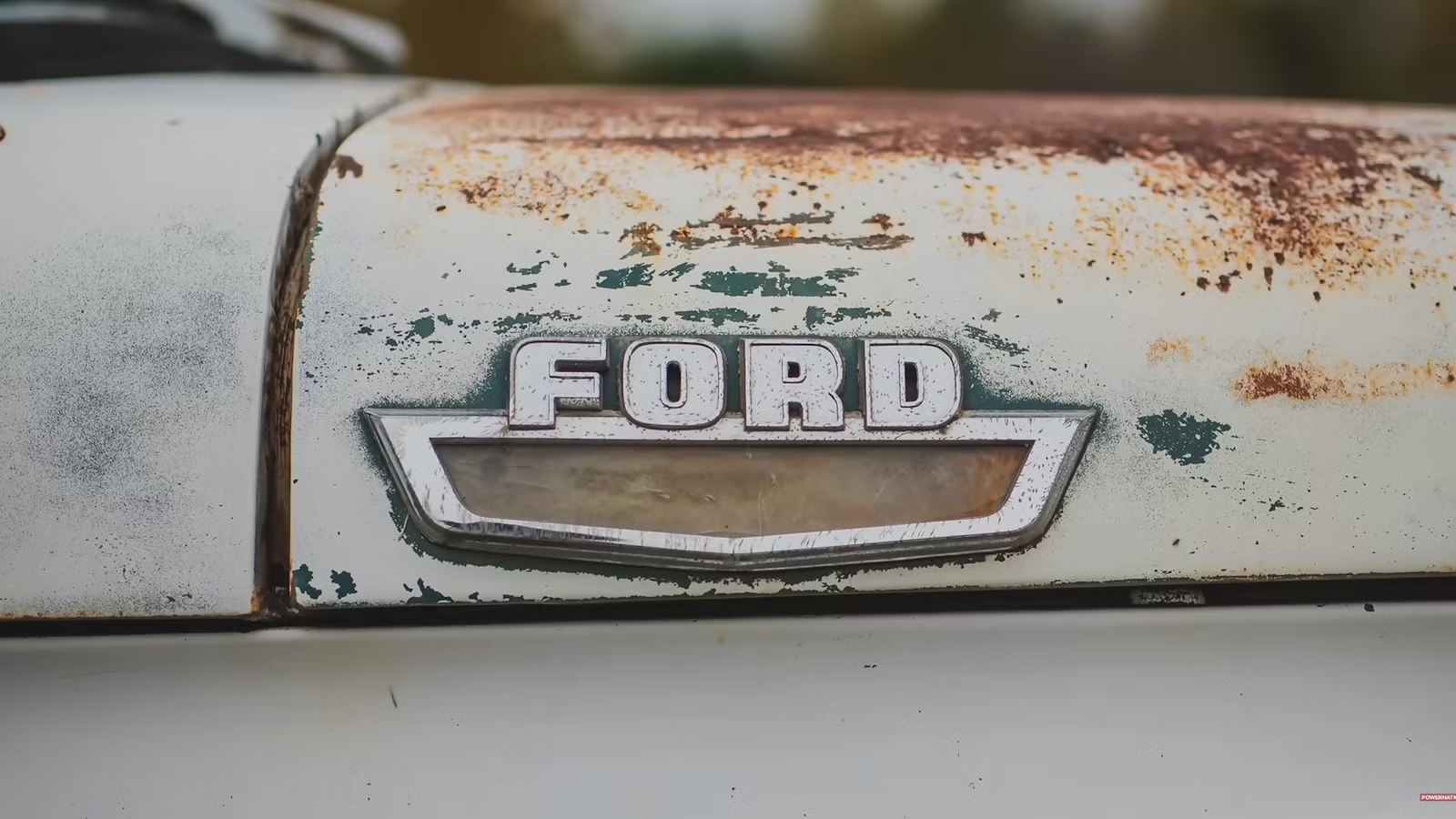
That’s right. Not counting non-production prototypes like the Ford Torino King Cobra, the mythical Fairlane R-Code is the rarest muscle car Ford ever built. It’s also the least rare muscle car on this list, which should give you an idea of just what kind of muscle cars we’re dealing with here. As a refresher, the 1966 Fairlane 500 GT is Ford’s first actual muscle car, built as a direct answer to the red-hot segment’s popularity and the new Pontiac GTO.

To make it happen, Ford gave the compact Fairlane a complete redesign to fit the FE 390ci big block and make it a true midsize muscle car. However, the brand also secretly packed 57 Fairlanes with the race-bred 427 FE “Side-Oiler” V8 to homologate it for NHRA’s Super Stock division. Produced only for ‘66 and ‘67, R-Codes were virtually identical to standard Fairlane 500 GTs, except for the inconspicuous R-Code badging and a large center hood scoop. Ford rated them each at 425 hp and 480 lb-ft, but on a dyno, they regularly pushed over 500 hp, putting these R-Code Fairlanes easily among the most powerful classic muscle cars ever built.
8 Rarest Muscle Cars That Weren’t Camaros, Mustangs, Or Chargers
Not every rare muscle car wore a big-name badge. From HEMI ’Cuda convertibles to factory-built drag racers, these 8 obscure cars are harder to find.
9
1966 Oldsmobile 442 W-30: 54 Units

At just three units fewer than the Fairlane R-Code, the W-30 is Oldsmobile’s rarest muscle car of all time. Olds was early to the muscle car fight. But while the 4-4-2 first hit the streets in ‘64 as a budget GTO fighter, its 330 V8 lacked the muscle to keep up, so for ‘65, Oldsmobile gave it a new four-barrel 400ci L78 V8 rated at 345 hp. The following year, Oldsmobile added the extremely rare Tri-Power L69 engine into the mix, which bumped the power up by about 10 hp thanks to new triple two-barrel carburetors. However, alongside them, Olds also decided to unleash the rare W-30 package, which took the same L69 and added Ram-Air cold induction, a 308-degree race camshaft, and stripped it of power brakes and A/C. It was rated at 360 hp and 440 lb-ft, but realistically made a lot more.
Only 54 of these were ever built with factory-blueprinted L69 engines: 25 F-85 Club coupes, 16 Cutlass hardtops, 8 Deluxe hardtops, and 5 Cutlass Sport coupes. However, 93 more W-30 packages are said to have been dealer-installed. The L69 engine never made it to 1967, as GM decided to reserve multi-carb setups only for its flagship Corvettes. Considering their rarity, ‘66 W-30s are surprising bargains today – many sell for less than $70k at auctions.
8
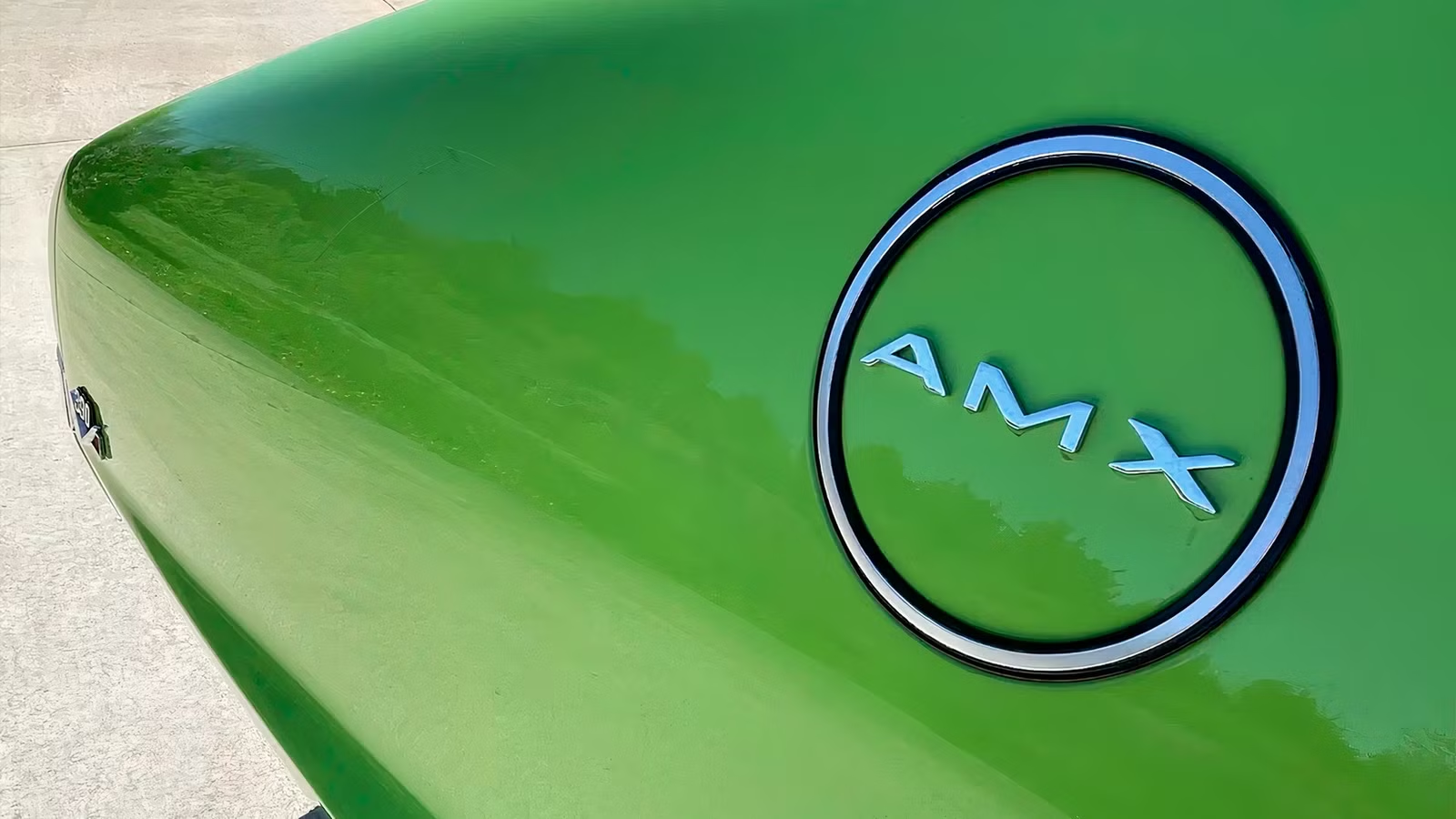
1969 AMC AMX “California 500 Special:” 32 units

AMC is a name that has largely been forgotten among enthusiasts today, but in the ‘60s, the brand produced some seriously cool muscle cars. It all started with the AMX. When it hit the streets in 1968, it completely revamped the brand’s “boring economy car” image. It was a feisty, two-door sports coupe with the shortest wheelbase among any American muscle car at 97 inches, along with side exhausts, and a long hood with aggressive bulges that only ever packed V8s.
It was so attention-grabbing that the following year, a Big Bad Green-painted AMX became the official pace car for the 1969 Motor Trend Riverside 500. To capitalize on the hype, the Southern California American Motors Dealer Association asked AMC to build roughly 32 replicas of the car exclusively at their dealership. Each featured the model’s top engine – a 390ci V8 pushing 315 hp and 425 lb-ft – featured Saddle tan leather interiors, and carried a steep $4,933.31 price tag.
7
1966 Buick Wildcat GS Super Wildcat: 21 Units

Most gearheads have heard about the incredibly rare and potent Buick GSX Stage 1 models, but a specific 1966 Wildcat GS remains by far the rarest muscle car Buick ever built (notice a pattern?). Short for Gran Sport, the GS package injected midsize muscle attitude into the full-size luxury Wildcat platform in 1966. In the GS trim, the 425ci Nailhead V8 under the hood received a heavy-duty suspension and dual exhausts for 340 hp and 465 lb-ft. Not only is the ‘66 Buick Wildcat GS a potent muscle car, but it’s already a rarity at just 1,244 examples built for 1966. However, that same year, the brand also decided to throw in a high-performance option to fight the big boys.
With an estimated production of just 21 units, the ridiculously rare Super Wildcat option added in another 4-barrel carb for a dual quad-carb setup, pushing the factory power rating to 360 hp – all mated to 3-speed Turbine 400 automatics – and putting the Super Wildcat in the elite company of legendary big blocks such as the Chevy 409, 426 Hemi, and Ford’s “Side-Oiler.” The dual quad-carb Super Wildcat V8 also made it into the Buick Electra and Riviera in the ‘60s, but the GS remains the rarest.
Only Two Were Made: Dodge’s Rarest Hemi Muscle Car Ever Built
It’s not a Challenger or a Charger. It’s the other Mopar muscle car that got the ball rolling. Today, this unicorn is worth millions.
6
1969 GTO Judge Ram Air IV Convertible: 5 Units — Rarest Pontiac

Inspired by the famous Rowan & Martin’s Laugh-In catchphrase “Here come ‘Da Judge,” the Pontiac GTO Judge debuted in late 1968 as a fresh youth-oriented performance version of the GTO. Aside from the cool name and attention-grabbing badging and stripes, the Judge also came with a blackened grille, large spoiler, standard Hurst T-handle shifter, and a choice between Pontiac’s 400ci Ram Air III and race-bred Ram Air IV V8s. However, most enthusiasts will only ever see them in coupe variants, unaware that the rarest and most desirable GTOs are actually convertibles.
Exactly 108 of these open-top muscle cars were ever built for the 1969 model year. However, just five of those came with Pontiac’s vaunted Ram Air IV V8. On paper, its output was similar to the RAIII at 370 hp and 425 lb-ft, but gearheads know these engines are night and day. With round-port heads, larger intake ports, 4-bolt main caps, a high-lift camshaft, forged pistons, and an aluminum intake manifold, the RAIV is a proper high-revving race engine. And while a RAIV Judge is already worth well over six figures today, one of these five ‘69 Judge convertibles can fetch over half a million, such as this one that RM Sotheby’s sold for a staggering $682k in 2010.
5
1970 Plymouth Road Runner HEMI Convertible: 3 Units

In the late ‘60s and early ‘70s, the Road Runner was the epitome of the muscle car: It was affordable, offered a range of powerful V8 engines between the 383 and the optional 426 Hemi, and featured cartoon graphics to appeal to younger buyers. In 1969, to keep up with the new convertible offerings from Ford, Chevy, and other Mopars, Plymouth also offered the Road Runner as a convertible.
However, the convertible option added a whopping $368 to the Road Runner’s price tag, and the Hemi added close to $800 itself, shattering the car’s “affordable” image. By 1970, Plymouth only produced 834 convertible Road Runners, three of which were Hemi-fied. Each of these three open-top Hemi monsters was rated at 425 hp and 490 lb-ft, but Mopar fans know those numbers are conservative. Sadly, this would mark the last year a convertible Road Runner would ever leave the factory, and with just three in existence, it’s nearly impossible to estimate their value.
4
1970 Dodge Coronet R/T HEMI Convertible: 2 Units

With just two examples known to exist, the 1970 Dodge Coronet R/T HEMI narrowly beats out the Road Runner Hemi convertible as the rarest Mopar muscle car ever produced. It’s even more surprising that this model would be a Coronet – Dodge’s intermediate volume seller – instead of something like a Charger.
A $718 premium already made the Hemi option on these cars virtually untouched, and the expensive convertible trim only made things worse. Only two ambitious buyers specced theirs in 1970 before Dodge completely removed the convertible option from its muscle car lineup: One was a Sublime bright green automatic, and the other – Restored by Graveyard Carz – was Dark Tan Metallic with a white cabin and an A833 4-speed manual. Both are nearly priceless today.
3
1968 Chevrolet Camaro Z/28 Convertible: 1 Unit

The rarest factory-built Chevy is not a Corvette nor an over-engineered big-block Camaro – it’s this very special Z/28 Convertible. Ask most enthusiasts, and they’ll tell you that the first-gen Z/28 – born for SCCA Trans-Am with a 302 small block – has only ever been a coupe. And they’d be right if we’re talking about cars sold to us, regular people. However, in 1968, Chevy also carried out one special COPO order for then Chevy exec (and later GM President) Pete Estes, who was a massive fan of convertibles.
Chevy fans will also tell you that Z/28s were sold completely stripped down to save weight and improve performance. However, the same rules did not apply to Estes, who got his Z/28 absolutely packed with luxury features, including 4-wheel disc brakes, power windows, auxiliary gauges, and an upgraded suspension with Koni shocks. It was painted in Fathom Green with a white interior. And while it’s technically a 1-of-1 prototype, the car is fully factory-built by Chevy, so it meets our criteria. Today, the Z/28 convertible is owned by Dana Mecum – the president of Mecum Auctions – who first unearthed it and sold it, before buying it back decades later. Smart choice, Dana.
10 Cheap Modern Muscle Cars That Are Guaranteed Future Classics
These rare modern muscle cars are the classics of the future.
2
1970 Chrysler 300 Hurst Convertible: 1 Unit

Chrysler’s 300 has long been the standard for big-car performance, but as the muscle car wars intensified in the ‘60s, the brand needed to inject some fresh performance into its lineup. Enter Hurst Performance. Famous for their lightning-quick manuals that helped legitimize factory hot rods, Hurst partnered with Chrysler to produce roughly 485 limited-edition 300 Hardtops – all painted in that distinctive two-tone Spinnaker White and Satin Tan paint with gold accents and powered by massive 440ci TNT V8s pushing 375 hp and 480 lb-ft.
The companies never planned on producing a convertible, but one was factory-built as a special promotional vehicle for Hurst in 1970. With Miss Hurst Golden Shifter Linda Vaughn usually behind the wheel, it turned heads at NASCAR and USAC events nationwide. The top was power-operated, and it featured a TorqueFlite automatic. Surprisingly, this “Parade Float” actually popped up for sale in 2015 – on eBay of all places – with a reasonable price tag of $150,000. However, after failing to find a buyer, it’s now once again in private collector hands, making appearances at car shows and YouTube videos.
1
1967 Comet Capri 427 W-Code: 1 Unit

Originally intended to be sold as an Edsel Comet and based on the compact Falcon platform, the Mercury Comet hit the market as its own standalone model in 1960 after the Edsel brand had almost bankrupted Ford in the late ‘50s. By 1966, it rode on a whole new, midsize Fairlane chassis, and by 1967, Mercury offered it with the ultra-rare 427ci FE “Side-Oiler” V8 in order to homologate the engine for NHRA’s Super Stock division. Two distinct versions of the engine were offered in the Comet: the 425-hp dual quad-carb R-Code – the same one as in the Fairlane R-Code – and a slightly more street-friendly 4-barrel W-Code, rated at 410 hp and 476 lb-ft.
The goal was ostensibly to allow Mercury to compete in slightly lower NHRA classes, but it’s exactly this W-Code option that ended up producing one of the world’s rarest muscle cars. See, eight of those nine W-Code Comets were Cyclone hardtops, and just one was a more relaxed Capri coupe, making it the rarest Mercury Muscle car ever made. A car so rare, it seems the W-Code Capri has become the stuff of legends, never publicly trading hands. We can only guess where it hides today.
Sources: Classic.com, Barrett-Jackson, Hagerty, Hemmings, HotRod, The Globe And Mail, RM Sotheby’s, Oldride.

Related posts
Latest Post


No Comments