
This Twin-Turbo Japanese Sports Car Had More Power Than A Porsche 911 Carrera… Now It’s A Bargain
The Japanese car industry has produced many incredible twin-turbocharged sports cars over the years, but getting into JDM culture has never been more expensive. The collector market has been ruthless: the twin-turbocharged rotary-powered FD Mazda RX-7 has appreciated beyond most buyers’ reach — and for good reason, since nothing else quite like it has ever been made.

Yet while most twin-turbo Japanese sports cars of that era have become pricey collector’s pieces, one of the very first to reach American showrooms remains stubbornly underrated — and surprisingly attainable. It packs more power than most of its ’90s Japanese rivals delivered from the factory, it once went toe-to-toe with the Porsche 911 on spec sheets, and today it might just be the best-value twin-turbo sports car bargain the JDM world has to offer.
The Z32 Nissan 300ZX Offered A Mighty Twin-Turbo V6 In The ’90s
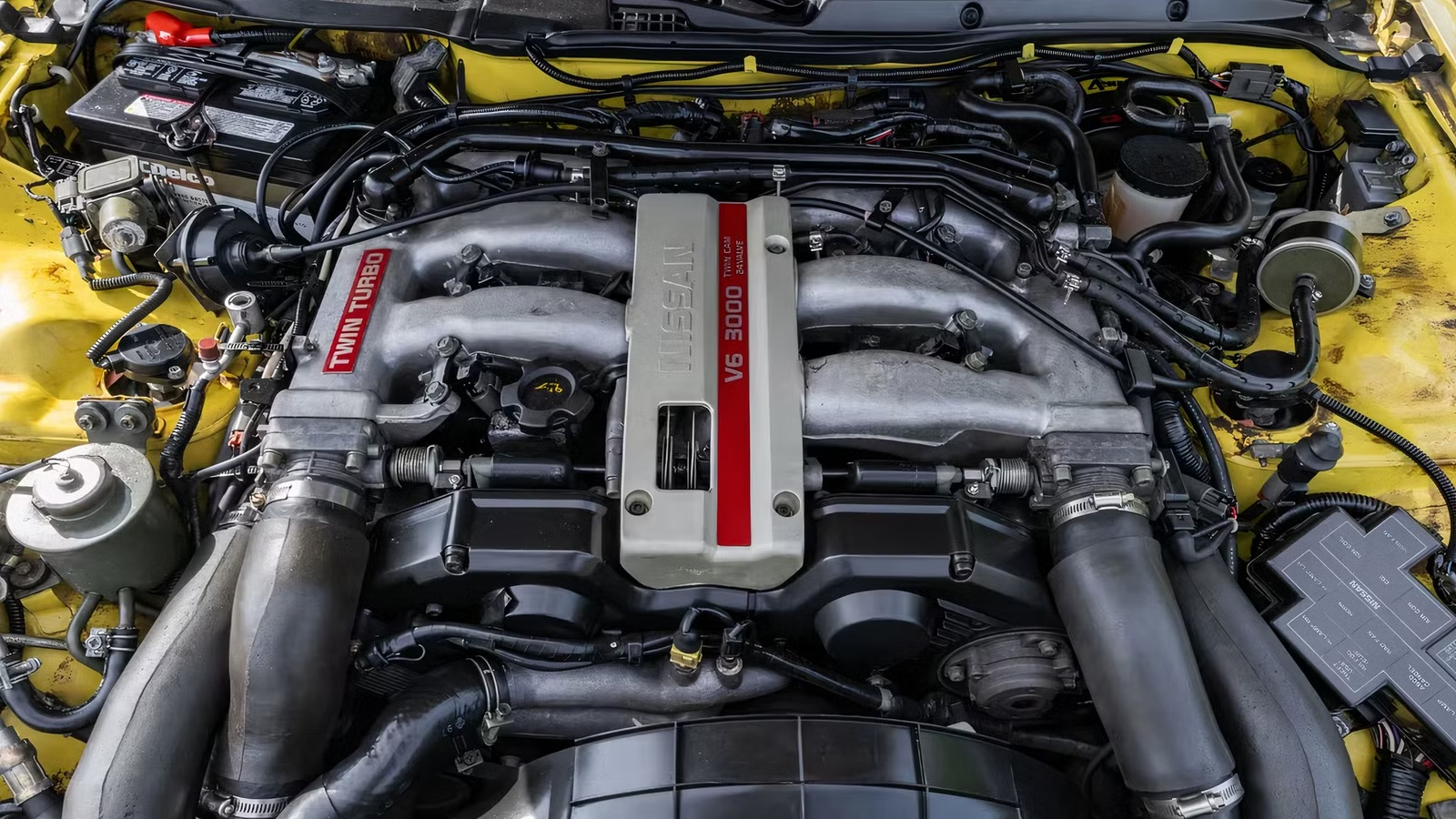
The Z32 Nissan 300ZX marked the second generation of Nissan’s V6-powered sports car. Built from 1989 to 2000 in Japan (badged as the Fairlady Z) and sold globally until 1996, it was designed to move the Z lineup upmarket with more power, sophistication, and refinement than the original. The headline addition was a twin-turbocharged V6 that gave the car genuine muscle for its era.
Specs
 90 autotech Engine |
3.0-liter twin-turbocharged V6 |
|
Transmission |
5-speed manual, 4-speed automatic |
|
Power |
276 hp (Japan), 300 hp (Global) |
|
Torque |
283 lb-ft (Global) |
Source: Nissan
With the 300ZX, Nissan didn’t just want to make a fast car. The brand wanted to go toe-to-toe with full-on luxury sports car marques and European exotics such as Porsche. With roughly 300 horsepower under the hood (officially rated at 276 in Japan under the gentlemen’s agreement), it packed more grunt than most of its Japanese rivals, including the Mazda RX-7, and even outgunned the base Porsche 911 Carrera for most of the ’90s.

When the 300ZX arrived in 1989, the 911 Carrera 964 made just 250 hp from its naturally aspirated flat-six. Even the newer 993 that arrived in 1994 only managed 282 hp. By the time the 996 came along in 1999 with 296 hp, the twin-turbo Z still held the upper hand. Porsche did offer quicker 911 Turbos, but those cost nearly double the Nissan’s sticker price — and even the base 911 wasn’t cheap. In 1995, a Carrera started at around $63,000, while the 300ZX Turbo listed for just over $41,000 according to Kelley Blue Book.

The performance backed up the numbers. In U.S. specification, the twin-turbo V6 produced around 300 hp and could sprint from 0 to 60 mph in just over 5 seconds, with a top speed near 155 mph. That was genuinely quick for the early ’90s and placed the 300ZX in the same conversation as lighter, more focused sports cars like the RX-7 — though the 300ZX leaned further toward grand tourer territory.
The 300ZX Was Ahead Of Its Time

The Z32 wasn’t just a turbocharged Japanese speed machine. It carried genuine sophistication to match its rivals. Nissan loaded it with technology that was cutting-edge for the period, including the Super HICAS (High Capacity Actively Controlled Steering) rear-wheel-steering system.


This third-generation version used an onboard computer rather than simple speed sensors to determine when the rear wheels should turn — a genuinely futuristic piece of engineering for the time, and one that modern performance cars are only now revisiting in earnest. Heck, the brand-new Nissan Z takes many of its styling cues and character straight from the 300ZX, including the overbuilt and cramped engine.
It also had a touch of luxury flair. The Twin Turbo model could be optioned with removable T-top panels that transformed it into a sort of semi-convertible — ideal for warm-weather driving without giving up chassis rigidity. It wasn’t a full drop-top, but it was a clever compromise for drivers who wanted open-air style without sacrificing structural integrity.
The 300ZX Could Be The Most Underrated Japanese Sports Car
JDM sports cars of the ’90s have been climbing in value. They were once genuinely affordable until the collector community recognized them as classics, pricing them out of reach for most enthusiasts. Surprisingly, this hasn’t happened with the Nissan 300ZX Twin Turbo. As a result, you can still get one of these underrated sports cars without breaking the bank.
Nissan Z32 300ZX Twin-Turbo Pricing
According to Classic.com, Twin-Turbo Nissan 300ZX models currently sell for an average of $29,076. However, that figure includes rare and pristine variants. Across more than 20 recent auctions, the average sale price sits around $20,453. Given that most cars listed on Classic.com are in excellent or even pristine condition, finding a clean example for under $20,000 isn’t unrealistic — which is remarkable for a 300-hp Japanese sports car that once traded punches with Porsches on the spec sheet.
Sure, twenty grand isn’t pocket change, but when you stack it against what buyers are paying for an FD Mazda RX-7, it starts to look like one of the best JDM deals on the market. The 300ZX might just be the most underrated performance bargain of the ’90s. And if the broader market for Japanese icons tells us anything, it’s that 300ZX prices aren’t heading down anytime soon. Get one while they’re still relatively accessible, and you could be sitting on a future classic that appreciates while you enjoy it.
It’s Not The Only Twin-Turbo Bargain Japanese Sports Car

The Nissan 300ZX Twin Turbo isn’t the only bargain twin-turbocharged Japanese sports car. There is the Mitsubishi 3000GT VR4, which has managed to stay relatively affordable. According to Classic.com, the average value of an early example sits around $19,594.
How has this happened? It’s because the 3000GT VR4 never achieved the same cultural cachet as its rivals. The 300ZX Twin Turbo was simpler and more reliable, and even though the Mitsubishi was impressively advanced for its day, the Mazda RX-7 was the more exotic choice. With competition like that, it’s no surprise the Mitsubishi 3000GT VR4 has faded into relative obscurity — and held onto its bargain status as a result.
Other Cars That Used The 300ZX’s Twin Turbo V6
The twin-turbocharged V6 that powered the Nissan 300ZX Twin Turbo didn’t originate in that car. The engine actually made its debut in the 1987 Nissan MID4-II concept. That prototype was Nissan’s ambitious take on a mid-engined, all-wheel-drive sports car and served as a testbed for future technology. It even featured an early version of the HICAS rear-steering system that would later appear in the production 300ZX Twin Turbo.
The MID4-II could have made it to production. Everything on it worked; it looked like something Nissan could have built in the early ’90s, and it might have beaten the Acura NSX to market — but Nissan ultimately pulled the plug. The engine and the HICAS system were the only elements that survived into production.
Unexpected Racing Pedigree
Nissan quickly realized its twin-turbo V6 had the bones to be tuned into a serious racing weapon. Just like the earlier single-turbo V6 from the first-generation 300ZX, the Z32’s engine found its way into full-blown competition cars. It powered Nissan’s IMSA Championship entries in the U.S. from 1990 to 1995 and even went endurance racing at the 1994 24 Hours of Le Mans.
That same engine also lived under the skin of the Nissan NPT-90 and NPT-91 GTP machines, where it reportedly made over 950 horsepower — right in line with the near-1,000-hp monsters that defined early-’90s IMSA racing.
It wasn’t only Nissan-built cars that used a racing-tuned version of the twin-turbo engine. The BRM P301 Group C car, which raced for a single season in 1997, used it as well. A re-engineered version of the V12-powered BRM P351 that had raced in 1992, the original chassis required heavy modification to meet stricter regulations — including removing the roof to create a true open-cockpit configuration and installing the Nissan engine.
Source: Nissan, Classic.com.

Related posts
Latest Post


No Comments