
The Volkswagen Wagon Hiding An Exotic W8 Engine Almost Nobody Bought
High-performance wagons are a perennial enthusiast’s favorite. That’s especially the case when they have a cool engine under the hood. There have been plenty of examples of those over the years. Perhaps none are as quirky, though, as the car we’re going to talk about.
Volkswagen Did A Lot Of Crazy Experiments Under Ferdinand Piëch’s Leadership

Volkswagen may be a fairly conservative automaker now. But, during the era where it was under Ferdinand Piëch’s leadership, things were very different. Piëch looked at things from an engineer’s point of view, wanting to develop the best-engineered cars he could create with the resources he had. He was also a proper engine enthusiast, with a focus on really pushing innovation with VW’s powertrains. As a result, there were some absolutely crazy cars that came out of this era. There are some you may know, like the almost comically over-engineered Volkswagen Phaeton. But others have become forgotten. One of these is perhaps one of the brand’s most divisive, yet most important cars ever…
One Of Those Crazy Experiments Involved One Of Its Most Humble Cars

Out of all the models Volkswagen sold during the 2000s, you can’t get much more ordinary than the Passat. This was Volkswagen’s main sedan and wagon offering during this time, and it really was as humble and boring as it got. The regular Passat did have some fun engines — you could get it with the 1.8-liter 20v Turbo, the 2.3-liter VR5, and the 2.8-liter VR6.

That clearly wasn’t enough for Ferdinand Piëch, though. He wanted to develop this humble family car into a high-performance rocket that could really take the fight to cars like the E39 BMW M5 and the C5 Audi S6. So, under his instructions, Volkswagen took that ordinary Passat platform and put one of the craziest engines ever devised into it…
The Volkswagen Passat W8 Wagon Is A Quirky Performance Estate

The result of Ferdinand Piëch’s crazy idea (which, according to legend, he came up with while he was on a bullet train in Japan) was the Volkswagen Passat W8. A precursor to what we could expect from the Volkswagen Phaeton and the Bentley Continental GT and Flying Spur, this car was a wild experiment that anyone with enough money could actually go and buy from a VW dealership.
As you’d expect from a car that was built to challenge the E39 M5, it was available as a sedan. But Volkswagen offered you something with this that BMW wouldn’t in many regions. They would happily sell you the Passat W8 as a wagon! This created what was, at the time, a bit of a unicorn in the market. There weren’t many options out there for high-performance wagons with 8-cylinder engines, and the Passat W8 wagon was easily the quirkiest one on the market.
It Has The Only Production W8 Engine Ever
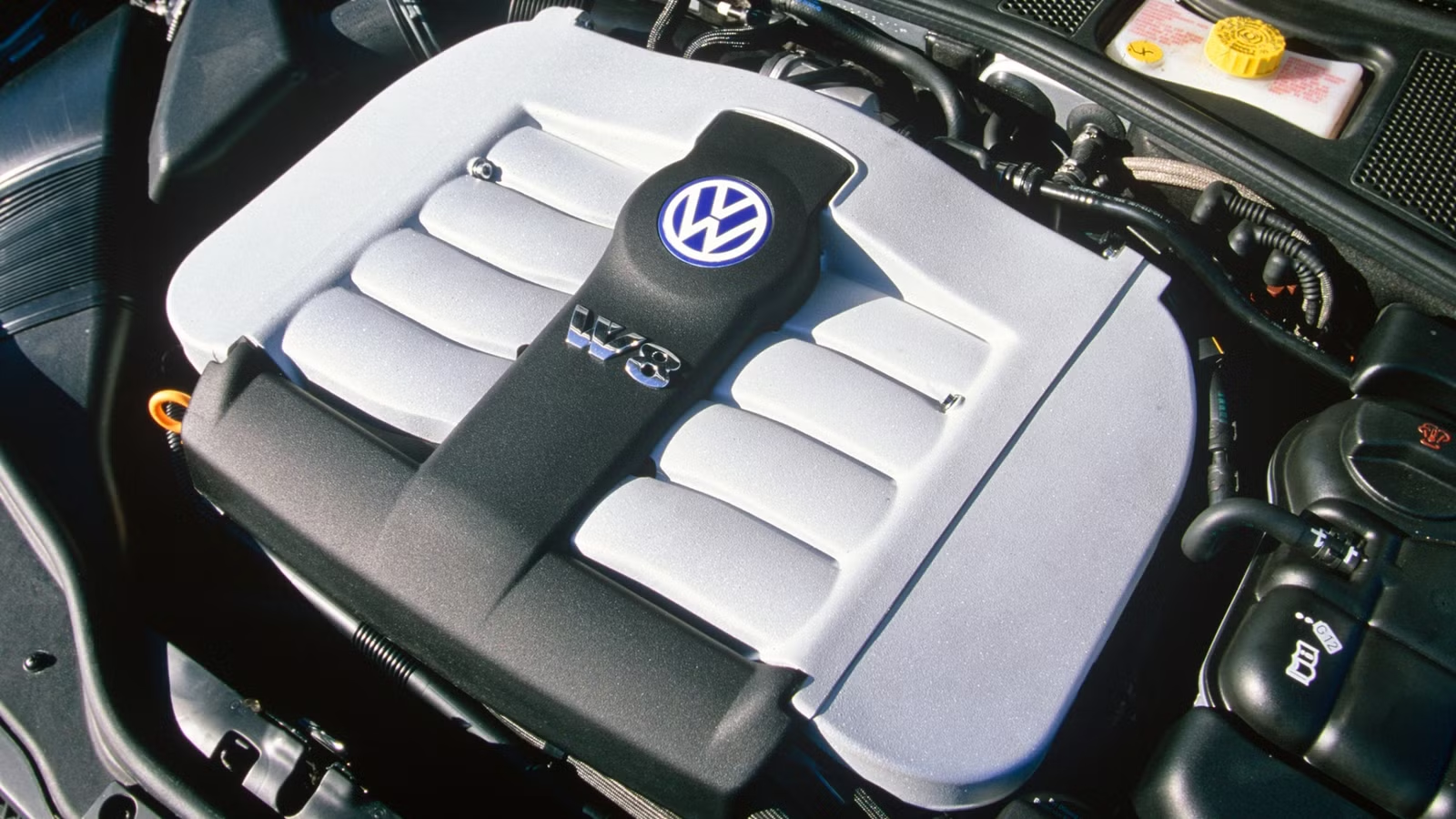
The true defining feature of this crazy high-performance wagon is that W8 engine. It’s the only production W8 ever made, and it was only ever put into the Passat W8 sedan and wagon. It’s quite possibly one of the wildest engines anyone will ever make, and that’s entirely down to how mechanically weird it is. The core of the engine is two VR4 engines (two 4-cylinder V-formations where all four cylinders share the same cylinder head), placed next to each other in their own, more conventional V-shape. The two VR4 blocks share a common crankshaft, making them one big 8-cylinder engine.
As wild as this engine configuration was, there was a method to it. The B5 Passat needed V8 power to be able to compete with other European sports sedans. But, its engine bay just couldn’t be made big enough for a regular V8. By fusing two VR4 blocks together into one 8-cylinder engine, the W8 made that V8 size and power much more compact. It could fit into the B5 Passat’s engine bay with no problems at all.
The result of this engine’s compact 8-cylinder design was exactly what its engineers had hoped. Both the sedan and wagon versions of the Passat W8 have up to 275 hp and 273 lb-ft of torque, sent through either a 6-speed manual or a 5-speed automatic transmission. This resulted in a 0-60 mph time of 6.8 seconds, and an electronically limited top speed of 155 mph. That reasonably fast 0-60 mph time is partly thanks to the Passat W8 having Volkswagen’s 4MOTION all-wheel drive as standard.
Barely Anyone Bought One
With a quirky, powerful engine up front, and lots of practicality in the rear, you’d think that the Passat W8 wagon might have had at least some sales successes. However, the complete opposite happened. VW had planned for 10,000 Passat W8s to be built annually. But only 11,000 were produced over the car’s entire 4-year run (2001–2004). The rarest configuration among them are the wagons with the manual transmission. According to one forum poster who managed to obtain some sales information, in most years of the Passat W8’s production, fewer than 100 manual W8 wagons were sold per year.
How come it didn’t sell well? It could have something to do with the fact that, actually, it was underwhelming. While the Passat W8 looked impressive on paper and the wagon version seemed like it could be a genuinely great sleeper car, it just wasn’t as impressive as VW had hoped. It couldn’t challenge cars like the E39 BMW M5 (400 hp and 369 lb-ft of torque) or the C5 Audi S6 (340 hp and 310 lb-ft of torque).
It’s Now A Used Market Bargain
What is the upshot of the Passat W8 wagon being a mundane-looking sleeper that was actually a bit underwhelming? It’s now an absolute bargain on the used market! The collectors haven’t caught onto it yet, and it’s still a car that’s very much only enjoyed by people who love the quirkiest production cars. One example of a W8 wagon with the automatic transmission sold for only $4,100 recently. On the other side of things, a manual W8 wagon sold for $18,000 a couple of years ago. The fact that the rarest of the rare when it comes to Passat W8 specs still didn’t crack $20,000 with its sale price really shows how cheap these cars are, and are likely to remain for the time being.
Used Values Stay Low Because It’s A Maintenance Nightmare
While the Passat W8 wagon was underwhelming and that has absolutely contributed to why it’s so cheap now, there’s another darker reason why its used values are likely to stay low. Because of how quirky that engine is, it’s a maintenance nightmare. Very few mechanics would be willing to risk working on a Volkswagen W8 engine. Those that do want to take that risk might charge you an absolute fortune to do so. According to The Drive’s former Executive Editor Jonathon Klein, he was quoted $22,000 for a brand-new engine for the Passat W8 he once briefly owned. The reason for that high cost is that the engine is such a unique and mechanically odd piece that only the Volkswagen factory can properly fix any serious problems with it. If you’ve ever thought about buying a Passat W8 wagon, that’s definitely something you should bear in mind before you take the plunge.
Sources: Audi, BMW, Bring A Trailer, The Drive, Volkswagen, VWVortex

Related posts

Latest Post


No Comments