
Honda’s Hand-Built Titanium-Rod V4 Is Widely Called The First Homologation Special
When World Superbike debuted in 1988, privateers faced an awkward question: how do you beat factory-backed teams with better machinery?
One Japanese manufacturer offered an expensive answer. Build the racer first, make it street-legal afterward, and put factory hardware within reach of ordinary competitors.
World Superbike’s New Rules Created A Very Expensive Problem
Grand Prix racing had drifted away from what enthusiasts could purchase. Two-stroke race machines shared little with the four-stroke sportbikes filling showrooms. Production-based competition offered an appealing alternative, putting familiar road machinery back at the center of the action. Fans could finally recognize a motorcycle in the paddock as something related to a dealership model.

America had embraced the concept through AMA Superbike racing in 1976, while the Isle of Man’s Formula TT followed a similar production-based approach. The new world championship gave manufacturers another international stage, along with a serious engineering headache.
Ordinary 750cc sportbikes were designed for road use; championship contenders faced relentless competition. Homologation rules required eligible motorcycles to be offered publicly, opening a tempting loophole: build something outrageously capable, then put a license plate on it.
Honda Decided Its Next Race Bike Needed A License Plate

Honda already had formidable V4 experience through its RVF750 endurance racers. Instead of dressing a showroom model in racing stickers, its engineers worked backward from competition hardware. The racer set the specifications; road equipment made the motorcycle legal to sell.
Honda Racing Corporation assembled the machines by hand at Hamamatsu alongside factory racers. Magnesium and titanium were part of the engineering brief, suggesting accountants had wisely been kept away from the drawing boards. The resulting production machine shared its ambitions with the factory racers beside it.
All At A Cost

Endurance racing influenced the design, too. Swift pit stops could decide an entire event, so Honda prioritized fast wheel changes and predictable handling. Those requirements were built into the motorcycle instead of being left for race mechanics to improvise. For a rider racing on limited resources, easier servicing could be every bit as valuable as extra speed.
Naturally, the price hurt. When it reached the United States in 1990, the motorcycle cost roughly $15,000, about twice a conventional 750cc sportbike. American enthusiasts could finally purchase factory-derived engineering, assuming their wallets survived the experience. The surcharge was steep, but those exotic components had genuine competitive purpose.
The Honda VFR750R RC30 Was A Factory Racer In Street Clothing

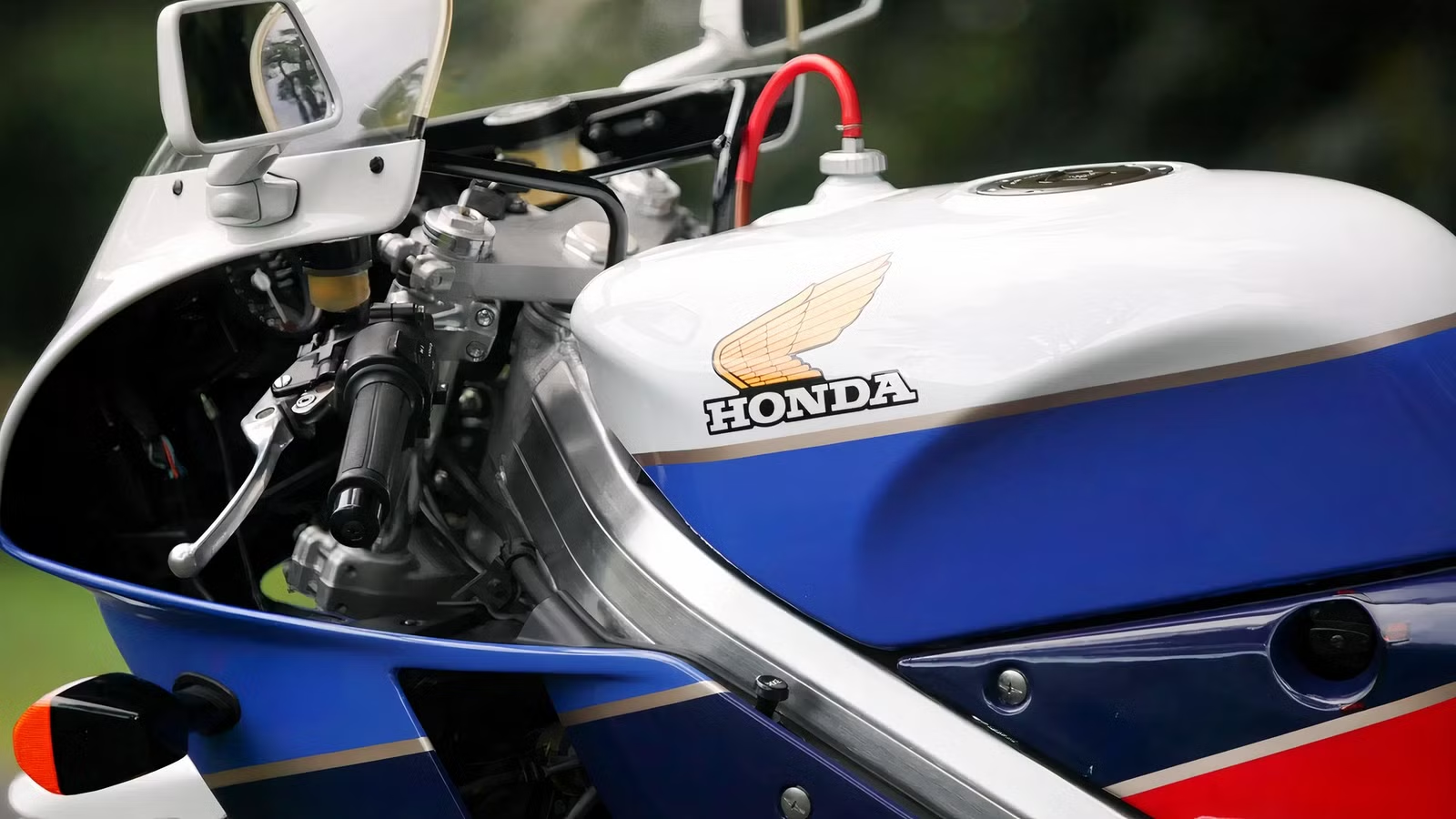
What you got was the Honda VFR750R RC30, sold in Japan from 1987, Europe from 1988, and America from 1990. Often described as the first true World Superbike homologation special, the RC30 has a commonly cited production total of roughly 3,000. The street version was effectively a racing credential with headlights, an expensive distinction that helped make it legendary.
Its liquid-cooled 748cc, 90-degree V4 featured titanium connecting rods and gear-driven double overhead cams. Two-ring pistons reduced weight, while the 360-degree crankshaft gave it a distinctive pulse compared with the regular VFR750F’s 180-degree arrangement. Its 16-valve layout reflected Honda’s commitment to the V4 format, but the internal hardware was considerably more specialized.
Unrestricted export models were rated at roughly 112 to 118 horsepower, while Japanese versions were limited to around 76 to 77. Honda allocated its first 1,000 Japanese-market examples through a lottery. Apparently, people were happy to compete for a motorcycle before competing on one.
The RC30 also had a close-ratio six-speed gearbox, slipper clutch, aluminum twin-spar frame, and adjustable Showa suspension. Its single-sided Pro-Arm swingarm simplified rear-wheel changes, complemented by quick-release front-axle clamps. These details saved precious pit-stop seconds instead of merely impressing people outside a dealership. First gear could stretch past 80 mph, a neat racing advantage and an awkward companion in city traffic.
Fred Merkel Made Honda’s Expensive Experiment Look Like Cheating

American racer Fred Merkel rode a Rumi Honda RC30 to the inaugural World Superbike riders’ championship in 1988, then repeated the feat in 1989. Honda’s engineers had evidently interpreted the new rulebook with almost suspicious enthusiasm. Their expensive experiment became a two-time world champion. For independent teams watching from the paddock, the connection between showroom hardware and race-winning potential was suddenly difficult to ignore.
The RC30 conquered other disciplines, too. Joey Dunlop won the 1988 Isle of Man TT Formula One and Senior races on one, while Steve Hislop set an outright TT lap record aboard the model in 1991. Its endurance-racing roots also made Honda’s rapid wheel-change hardware especially relevant.
The success reached American tracks, where Miguel Duhamel won the 1991 Daytona 200 aboard an RC30. Its linear throttle response and composed chassis helped riders exploit the available performance instead of wrestling the motorcycle through corners. All this is to say that horsepower grabs headlines, but repeatable, manageable speed wins races.
The RC30 Left Its Rivals With A Very Expensive Homework Assignment

Honda’s rivals took the hint. Yamaha introduced the FZR750R OW01 for 1989, Suzuki fielded special GSX-R750 variants, and Kawasaki later joined with machines including the ZX-7RR. Honda continued its own approach with the RC45. Road legality had become a ticket to the starting grid. Every rival now faced the same unpleasant question about how much racing technology to sell publicly.
Yamaha’s YZF-R7 OW02 and Ducati’s Panigale V4 R subsequently showed how the formula could evolve. Regulations changed, but the attraction stayed constant: road riders could purchase remarkably serious equipment developed with racing in mind. The strategy also made ordinary showroom machines look rather restrained by comparison.
The Need To Win

That legacy is more important than modern auction prices. The RC30 showed manufacturers how homologation could put sophisticated factory-derived machinery within reach of private racers, narrowing the equipment gap between independents and works teams. That accessibility, rather than the current collector premium, is the most persuasive measure of its importance.
Earlier production-based racing complicates any claim that Honda invented homologation. But the RC30 helped establish the modern World Superbike blueprint. Honda effectively sold the public a factory-racing head start, and its rivals spent years writing their response. Few street motorcycles have had such a lasting effect on what manufacturers consider necessary to win.
Sources: Motorcycle Specs, Motorcycle Classics, Moto America, Iconic Motorbikes Auctions.

Related posts


Latest Post


No Comments