
AMC’s One-Year Muscle Car Was Kenosha’s Loudest Underdog Statement
AMC is a strange addition to American car making history. Founded in 1954, and folded into the Chrysler corporation in 1987, it wasn’t around particularly long, and not many people will remember its run of compacts, off-roaders, and family machines. But AMC was great, with a quirky innovation that might not have beat the Big Three, but it made the company a true pioneer. To paraphrase Frank Sinatra, AMC did it its way. But while AMC was often the plucky underdog that problem-solved its way into the market, or just plain took a hard turn to left field, there was one market that it never stood a chance in: the serious Muscle Cars scene. Or did it? An AMC creation of the early ’70s suggests otherwise…
AMC Was A Carmaker Playing Catchup

By the ’60s, the Big Three (that’s Ford, GM and Chrysler) had the US car market sewn up. It would have been foolhardy for anyone to try and compete with these behemoths of industry. But American Motors Corporation wasn’t going to take no for an answer. This relatively new car maker wanted a seat at the table, and its weapon of choice was innovation.
The Big Three had the resources to update (or completely redesign) models almost every model year, so AMC relied on both sharing parts and components across the ranges (something we see extensively today) and creating cars that stood out from the crowd. Case in point is the Rambler Rebel, an odd-looking ride that could almost beat the Corvette and is considered by some to be the first true muscle car. When the real muscle car wars kicked off in the mid-’60s, AMC had earned a reputation for being practical and slightly stodgy — so Kenosha decided to go all in to change that.
Enter The AMC Rebel Machine


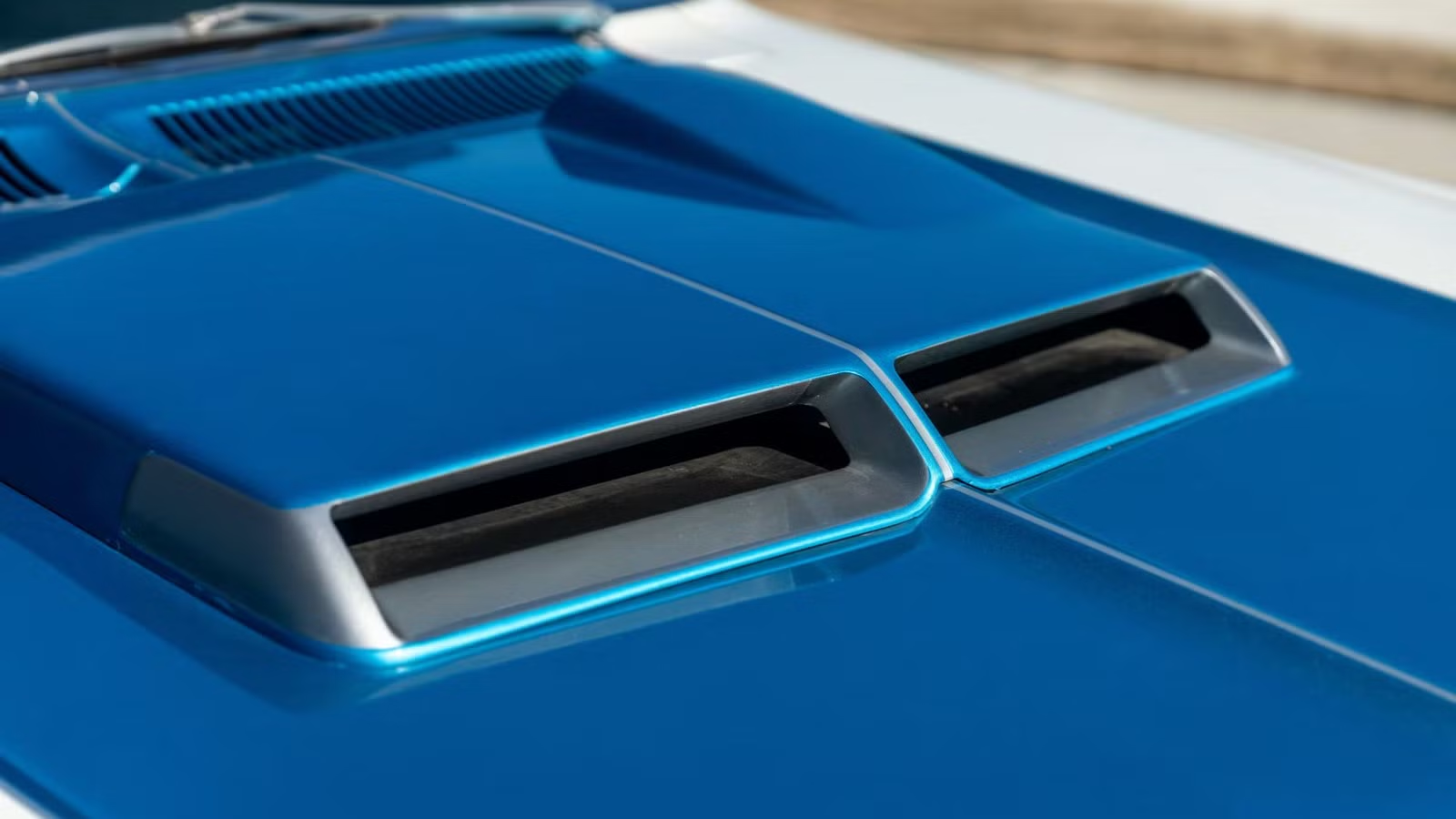
By 1968, AMC had launched the Javelin and the underrated AMX, and turned its attention to the Rebel. The AMX 390 engine became available in the Rebel SST that year, pushing out 315 hp. But AMC wasn’t finished. For 1970, the company released the Rebel Machine, a full-blooded muscle car that came covered in an unmistakable all-American combination of large reflective decals and a thick red reflective stripe running down the beltline, with 15-inch Machine wheels at each corner. With a look this bold, the Machine needed the firepower to back it up. Here, the Rebel Machine didn’t disappoint.
The Rebel Machine Was All About The Numbers

Beneath the functional ram-air hood scoop sat AMC’s 390-ci V8, which was good for 340 hp and 430 lb-ft of torque. This was 15 more hp than that year’s AMX 390 thanks to a high-flow dual-plane intake manifold, dog-leg port heads, and larger 21/4-inch-outlet exhaust. The Machine’s mill shared the same 10.0:1 compression ratio with the lesser 390. The engine was mated to Hurst-supplied shifters for the Borg-Warner T-10 manual, although a Borg-Warner Shift-Command automatic transmission was available.
The Rebel Machine Was A Rare But Powerful Rival To The Big Guns

American Motors apparently said that the initial 1,000 Machines would have the red/white/blue paint and stripes bodywork, says Hemmings, with other colors available later. But it is believed that more left the factory with this color scheme. Hemmings also says that either 1,936 or 2,326 Rebel Machines left the factory in total, depending on the source. What everyone knows for sure was that the Machine was a legit muscle car hero from a plucky underdog that could take on the might of the Big Three.
1970 AMC Rebel Machine Vs 1970 Dodge Challenger R/T Hemi
|
Engine |
6.4-liter V8 |
7.0-liter V8 |
|
Power |
340 hp |
425 hp |
|
Torque |
430 lb-ft |
490 lb-ft |
|
Quarter Mile |
14.1 seconds |
14.1 seconds |
A stock Machine will run a 14.4-second quarter mile, says Hemmings, which is pretty much on a par with a 1970 Dodge Challenger R/T Hemi. When tested, the Challenger ran a 14.1 second quarter mile, despite the fact its 7.0-liter mill had way more power. The Hemi was rated at 425 hp and 490 lb-ft of torque, which just adds to the Machine’s underdog status.
The Rebel Machine Was A Victim Of Bad Timing

Despite bursting onto the scene with seemingly a lot going for it, the Rebel Machine only lasted a single year in 1970. The car was caught in the middle of the muscle car power wars, and the end of the genre, which was about to be brought down by an oil crisis and new emissions controls. For 1971, the Rebel would be redesigned and renamed the Matador, with a four-speed Go-Package that was good for 330 hp.
By 1975, the Matador’s performance options were a 304 and 360 V8, but output had dropped to 120 hp for the 304, and 140 or 180 hp depending on whether you went for a two-barrel or four-barrel 360. This was also the year that AMC decided to go and break boundaries elsewhere, introducing the goldfish-bowl Pacer in 1975, accompanied by the tagline, “When you buy any other car, all you end up with is today’s car. When you get a Pacer, you get a piece of tomorrow.” Sadly, for all this future thinking, AMC itself would last just over a decade more. Maybe it was too much forward-thinking for its own good.
The Rebel Machine Has Its Day On The Collector Market

The AMC Rebel Machine may have been a left-field novelty at one time, but these days it has secured its place as an intriguing alternative to the norm—especially for anyone who wants to stand out among a sea of Chargers and GTOs. The Rebel Machine had an original sticker price of $3,475 when new, says Hagerty, which equates to $32,000 in today’s money. These days Rebel Machines sell for $53,300 in good condition, says Hagerty’s Valuation Tool. For a rare, powerful, and unique muscle car, that’s a pretty decent deal too.
In the end, AMC was a company that burned bright but not long, bringing cars that were fun, innovative, and didn’t take themselves too seriously into the market. What other company can say it created everything from the Mirthmobile to the world’s first sport utility wagon? You have to love AMC.
Sources: Hagerty, Hemmings

Related posts
Latest Post


No Comments