
Porsche Mission S: Built In Just Eight Months
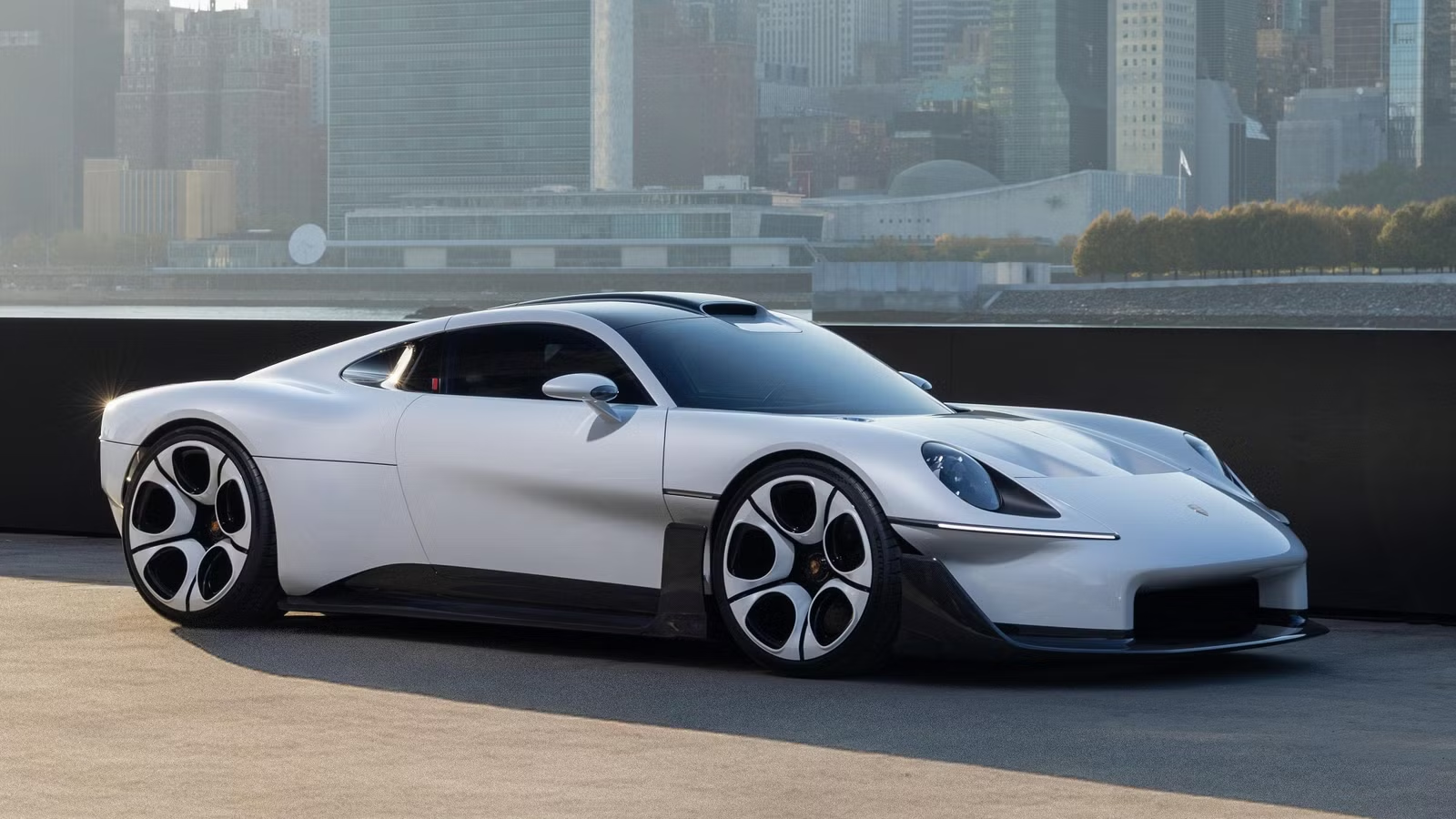
Porsche’s Mission S concept went from a phone call to a finished design in roughly eight months, a timeline that would be aggressive for a facelift, let alone a flagship mid-engine supercar meant to sit above the 911. Halo cars like the Carrera GT and 918 Spyder typically took Porsche three to five years to go from brief to reveal. The Mission S did it in less time than it takes some automakers to finalize a paint color.

The story behind that speed matters as much as the car itself. It starts with a phone call between CEO Michael Leiters and Tobias Sühlmann, the former McLaren design chief Leiters hired as Porsche’s head of design in February 2026. Leiters had one ask: a mid-engine supercar positioned above the 911, with a new design language to match. Eight months later, the Mission S debuted on a pier in Queens, New York, the same spot where Porsche delivered its first 550 Spyder to America in 1953.
New Design Chief Moved Fast Because He Knew Exactly What He Wanted
Sühlmann didn’t waste time workshopping competing concepts. In interviews after the reveal, he described being clear about the brief from day one: a super sports car, not a hypercar, built as a permanent model line rather than a limited-run special like the Carrera GT or 918 Spyder. “If you know what you want and you’re clear in what you want, you can develop something quickly,” Sühlmann said. That clarity, more than any shortcut in tooling or software, appears to be the real engine behind the eight-month turnaround.

Before sketching a single line, Sühlmann spent time in Porsche’s own museum, studying the cars that built the brand’s design identity. The Mission S borrows from the 911, 959, 928, and 911 GT1 without copying any of them outright. The rounded headlights and fender shut lines trace back to the 911 and its G-body predecessor. The flat nose comes from the GT1. The sloping roofline nods to the 959. Even the wheel design reinterprets the 928’s dial-style rims. It’s a mood board built from Porsche’s own back catalog, compressed into a single new shape.
Form And Function Were Developed Together, Not In Sequence

Sühlmann has said he rejects the old form-follows-function playbook. Instead, his team worked directly with Porsche’s engineering and aerodynamics groups while the design was still taking shape, pushing for specific layouts rather than styling around an existing package.
He’s described asking engineers to split cooling ducts or reposition radiators to serve a design idea, then adjusting the design when the answer was no. The dramatic torpedo fenders, the 1998 GT1-inspired “car-in-car” rear treatment, and the fan-style engine cooling borrowed from the 917 all had to clear that bar. Nothing on the Mission S is there just to look fast.
The Cabin Makes The Same Argument In Miniature

Inside, Porsche split the difference between nostalgia and modern function rather than picking a side. Five analog gauges sit behind the wheel, including a needle-driven tachometer that can physically shift position depending on drive mode, with digital displays layered behind them for depth. There’s no fixed center touchscreen; instead, a retractable MagSafe smartphone mount handles navigation duties. A physical ignition key sits to the left of the wheel, exactly where Porsche traditionalists expect it. It’s a deliberate statement from a design chief eight months into the job: the driver, not the dashboard, is the focus.
Porsche hasn’t confirmed what powers a production version of this platform, or when one might arrive. But an eight-month sprint from a single phone call to a fully realized design concept says plenty about how Sühlmann intends to run Porsche’s design studio. If this is the new normal, enthusiasts might not have to wait three to five years to see where he takes the brand next.

Related posts


Latest Post


No Comments