
The Cadillac Engine That Was America’s Largest Production V8 Ever
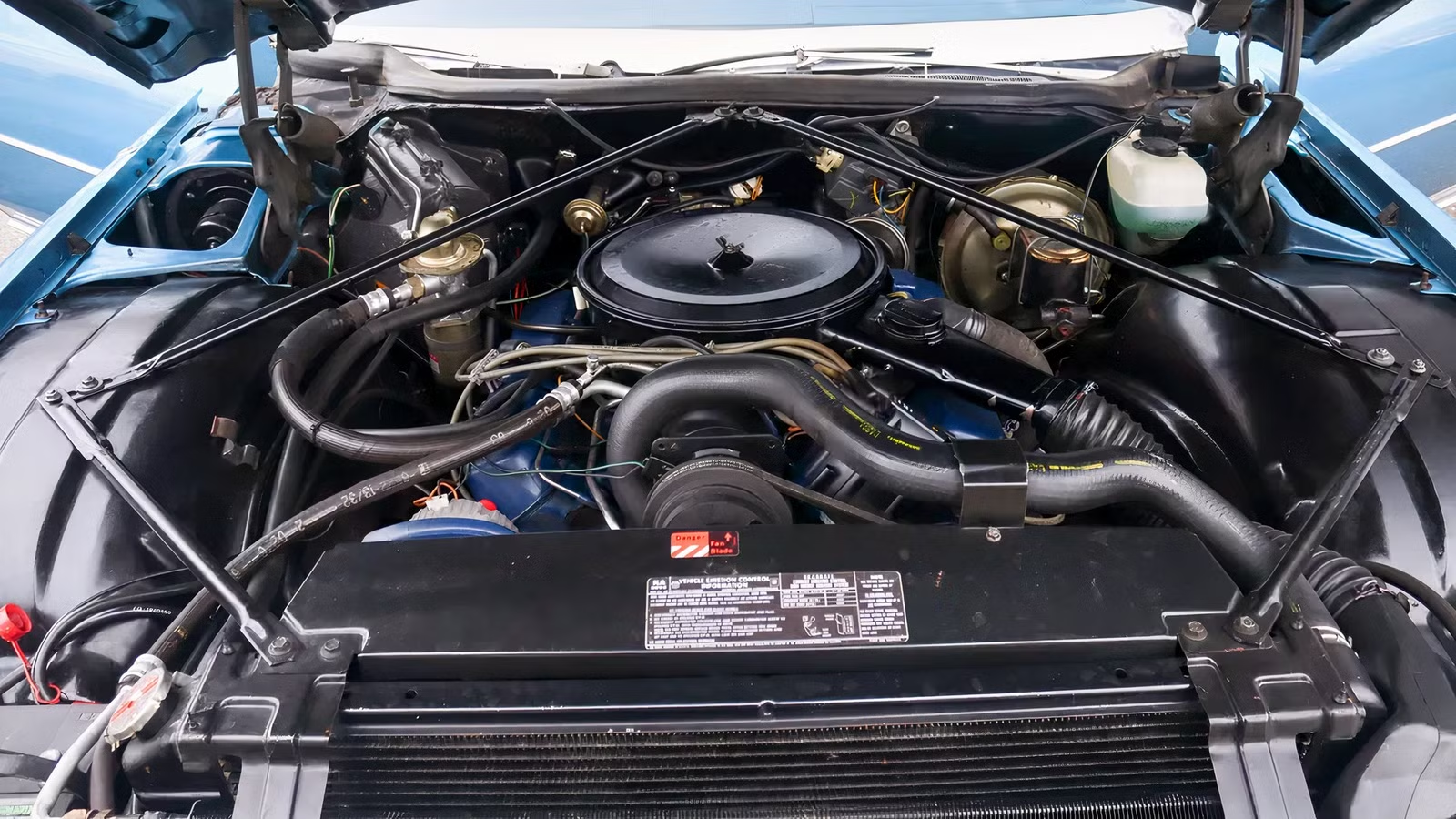
Picture nearly 2.5 tons of American luxury easing away from a stop with barely a murmur, propelled by low-rpm torque that makes speed feel almost like a clever by-product of what the engine was actually intended to do. This was back at a time when there was an engine so oversized that the number on the spec sheet sounded like an intern’s idea of a joke.

At the dawn of the 1970s, though, Cadillac still believed the surest way to prove you had reached the top was to put more engine in front of you than anybody else.
When Luxury Was Measured In Cubic Inches
Well before Luxury Cars competed over screens and software, Detroit had a simpler status symbol: engine size. Cadillac buyers expected effortless power, and the easiest way to deliver it was with a V8 large enough to make curb weight feel like somebody else’s problem.

Cadillac had already been scaling up for years. Its 390 V8 made 325 hp and 430 lb-ft in the early ’60s, but rivals such as Chrysler and Lincoln were playing with even larger engines. In the American luxury car market, displacement had become a blend of engineering prowess and social currency.
Cheap fuel made the arms race easier to justify. Gasoline cost roughly 36 cents per gallon when Cadillac’s biggest V8 arrived, and filling an Eldorado’s 22-gallon tank from empty could cost under $8. That kind of math made 500 cubic inches seem financially responsible enough.
Cadillac Was Already Running Out Of Room At 472 Cubic Inches

Cadillac’s 472 V8 arrived for 1968 with 375 hp gross and 525 lb-ft of torque. Peak torque came at just 3,000 rpm, which tells you almost everything about the engine’s job. It was built to move a very large car without asking the driver to wait around for revs.
The 472 used a 4.30-inch bore and a 4.06-inch stroke, but its basic architecture still had room to grow. Cadillac didn’t need to invent an entirely new V8 to chase a bigger number, though. Engineers simply had enough space in the existing design to lengthen the stroke.
Irrefutable Logic

That stroke grew to 4.304 inches, pushing displacement to 500.02 cubic inches while the bore stayed the same. It was a beautifully direct piece of Detroit engineering: take an already huge Cadillac V8, give the crank more reach, and arrive at a nice, round number.
This says plenty about where American luxury stood at the end of the ’60s. Cadillac still believed refinement could come from sheer mechanical abundance. Logically, if 472 cubic inches made a heavy luxury car feel effortless, 500 should make it feel even more so.
The Cadillac 500 Turned Displacement Into A Luxury Feature

The Cadillac 500 V8 debuted for 1970 in the Fleetwood Eldorado with a 10:1 compression ratio and 400 SAE gross hp at 4,400 rpm. More importantly for a Cadillac, it produced a stonking 550 lb-ft of torque at only 3,000 rpm. On paper, those numbers could’ve belonged to something wearing hood scoops and fat rear tires, yet Cadillac had an entirely different use for all that displacement.
The company wanted effortless thrust rather than the manic nature associated with ruthless Muscle Cars. The Eldorado was a huge front-wheel-drive luxury coupe, so the 500’s job was to move serious weight without making the driver feel as though the engine had suddenly developed something to prove. That 550 lb-ft figure was key because it arrived low enough in the rev range to make ordinary acceleration feel immediate and unhurried. Cadillac’s idea of performance was basically to make five thousand pounds behave as though somebody had quietly deleted a ton of it.
The way Cadillac got there is also worth noting. The 500 was a stroked evolution of the already enormous 472 rather than some exotic clean-sheet engine, which made its mission almost comically straightforward. More stroke brought more displacement, and more displacement brought the kind of low-speed torque Cadillac considered essential to luxury. The result became the largest production V8 ever fitted to an American passenger car (at the time), but Cadillac wasn’t waving that record around as the centerpiece of a street-performance campaign. Size itself was part of the luxury proposition.
Cadillac kept the 500 exclusive to the Eldorado until 1975, which helped give its flagship coupe an extra layer of mechanical distinction. Only then did the engine spread through most of Cadillac’s full-size range, including the DeVille, Fleetwood, and Calais. The timing was almost cruel, though. America’s biggest production V8 finally became more widely available just as emissions rules, fuel concerns, and changing expectations were dismantling the very philosophy that had made 500 cubic inches seem like a brilliantly sensible way to build a luxury car.
All 550 LB-FT Was There To Make 5,000 Pounds Feel Light

Lest we forget, a 1970 Eldorado weighed close to 5,000 pounds, yet the Cadillac 500 could push it to 60 mph in about 9.5 seconds and through the quarter-mile in 16.3 seconds. Obviously, those numbers won’t scare a modern family sedan, but they were never the real point of the exercise.
What was important was how easily the engine delivered its shove. Peak torque arrived at 3,000 rpm in 1970, and later 1975–76 versions made their peak at only 2,000 rpm. Cadillac kept the torque where owners could feel it during everyday driving, even while the horsepower figures became less flattering.
Effortless Shove

That low-speed character is why the Cadillac 500 deserves more credit than its record-setting displacement alone. Cadillac had effectively built a huge torque reserve into the car, allowing one of America’s heaviest luxury coupes to pull away with the effortlessness people expected from the Cadillac crest.
Cadillac even offered electronic fuel injection for 1975 and 1976. Fuel-injected versions were rated at 215 hp and 380 lb-ft, which helped provide sharper throttle response to the aging big V8. Giving America’s largest production engine a dose of modern electronics just before retirement feels very Cadillac, honestly.
Six Years Turned America’s Biggest V8 Into A Dead End

The 500’s decline started almost immediately. For 1971, compression dropped from 10:1 to 8.5:1 as General Motors prepared its engines for unleaded fuel, cutting output to 365 gross hp and 535 lb-ft of torque. Then the industry changed from SAE gross to SAE net horsepower ratings, making the headline numbers look even smaller.
The famous drop from 400 hp in 1970 to 190 hp in 1976 was not one continuous mechanical collapse, because the two figures were measured under different standards. The engine genuinely lost output as emissions rules tightened, but the new rating system made the fall look even more dramatic on paper.
The End Of An Era

By 1976, the standard Cadillac 500 made 190 net hp and 360 lb-ft. Fuel anxiety accelerated its downfall, while stricter emissions requirements made 500 cubic inches increasingly difficult to defend. Cadillac replaced it with a 425 V8 for 1977, and America’s luxury displacement race had effectively hit reverse.
All told, Cadillac’s 500 V8 is a vital part of American V8 history. It marked the point where sheer displacement stopped being the ultimate luxury flex in the USA. Modern Cadillacs can make far more power from much smaller engines, but no American luxury brand has returned to the idea that cubic inches themselves should define prestige.
Sources: Cadillac

Related posts



Latest Post


No Comments