
Ferrari Luce Render Shows What The Car Should Have Looked Like
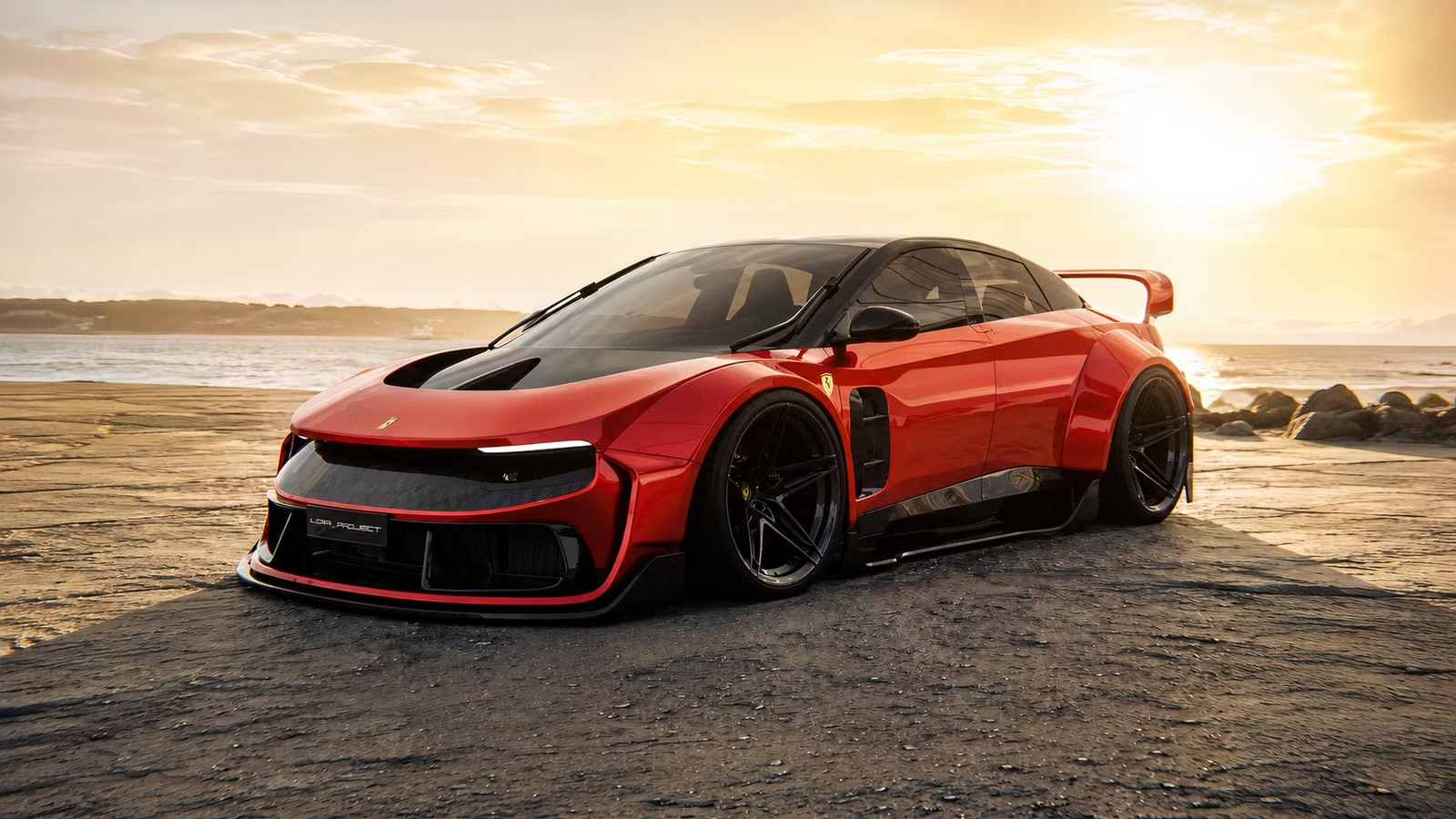
A render published on August 24 is doing what design critics have been trying to do in words since the Ferrari Luce debuted in May: showing, side by side, what the car could have looked like. The reimagined version lands at a charged moment — Luce Chassis 0 just crossed the block at RM Sotheby’s Monterey auction for $40 million, a record for any new car, yet the design controversy that erupted at the original reveal has never fully quieted.

The timing is deliberate, and it raises a question: if the Luce had originally looked like this, would it still be the laughing stock of the supercar industry? That framing alone tells you where community sentiment sits — and the reaction to the reimagined version suggests the answer is a hard no.
What the Render Actually Changes
The render targets the elements that drew the most criticism from the original reveal. Based on the framing of the piece, the redesign works on proportions first — the production Luce has been widely described as visually top-heavy, with a greenhouse and body relationship that reads more crossover than supercar. The render appears to address that by lowering the visual mass and sharpening the two-box silhouette, pulling the roofline down and tightening the rear haunches.

The front-end treatment gets particular attention. The production Luce’s face has polarized observers since May, with its wide, relatively soft fascia sitting uneasily against the performance brief. The reimagined version reportedly introduces a more assertive grille structure and slimmer lighting modules — a horizontal, technical treatment not unlike what Ferrari‘s own design studio achieved on the bespoke CZ26 one-off, which uses a full-width functional grille with ultra-slim lighting integrated into a single graphic band. Whether that comparison is coincidental or the render artist drew from it directly isn’t confirmed, but the direction is similar: cleaner, more purposeful, less decorative.
Body line discipline is the third axis. The production Luce carries surface complexity that some find busy and others find unresolved. The render appears to simplify those transitions, letting the wheel arches do more work and reducing the number of competing character lines across the door.
The render’s reception tells you more about the Luce’s design problem than any single critic’s take could. When a reimagined version of a car generates stronger enthusiasm than the production model — especially one that just sold for $40 million — that’s a signal worth taking seriously.
The Auto Spies comment section and broader enthusiast reaction has split along a familiar line: one camp argues the render proves the original design was a genuine misstep, a car that prioritized novelty over the proportional discipline Ferrari’s design history demands. The other camp holds that the Luce’s radicalism is intentional — that Ferrari is deliberately breaking from its combustion-era visual language to signal that an electric Ferrari is a categorically different object, not a rebodied Roma with a battery pack.
Both readings have merit. Former Ferrari chairman Luca Cordero di Montezemolo called the Luce a risk to the brand’s legend at its May reveal, and Ferrari’s share price dropped sharply in the immediate aftermath. That’s not the reaction a universally celebrated design generates. But the $40 million auction result — and reports that Ferrari’s 2026 production allocation is already sold out — complicates any clean narrative about failure.
What This Means for Ferrari’s EV Design Language

The deeper question the render raises isn’t whether this specific artist got the proportions right. It’s whether Ferrari’s EV design language has a coherent internal logic that enthusiasts can read and accept, or whether the Luce is an experiment in alienation — a car designed to feel unfamiliar by design.
The CZ26 one-off, revealed just days before the render dropped, offers an instructive contrast. That car — built on SF90 Stradale mechanicals for a single U.S. client — achieves exactly the kind of precision and restraint that the Luce render is reaching for: a horizontal graphic theme, clean surfaces, functional elements that emerge from the body rather than sitting on top of it. Ferrari’s own design studio clearly knows how to execute that language. The question is why the Luce, a far more public and consequential car, reads differently.
The honest answer may be that the Luce is doing something the CZ26 doesn’t have to: carrying the weight of being Ferrari’s first mass-production EV, a car that needs to look revolutionary enough to justify the category shift while remaining legible as a Ferrari. That’s a harder design brief than any one-off commission, and the render’s popularity suggests Ferrari may not have fully threaded that needle. Whether that’s a misstep or just a car ahead of its moment is a question the next few years of Luce ownership will answer.
The render won’t change what’s already built, and it won’t affect the 2026 allocation that’s already spoken for. But it has done something useful: it made the design argument concrete instead of abstract, and the community responded. For Ferrari, that’s worth paying attention to as the Luce’s EV design language inevitably shapes whatever comes next from Maranello.

Related posts





Latest Post


No Comments