
BMW S58 Vs Stellantis Hurricane: Differences Compared
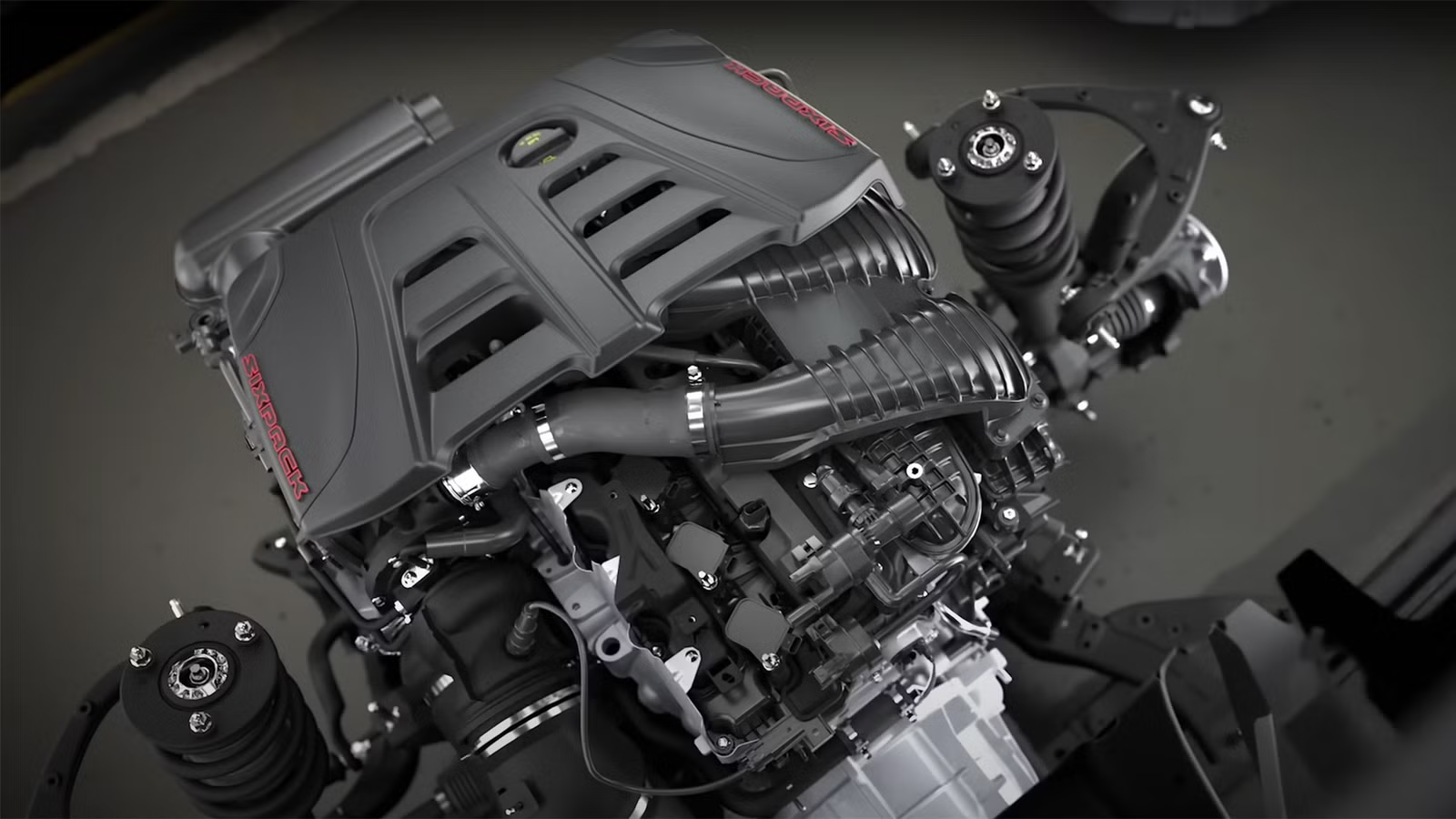
The straight-six engine is having a genuine renaissance, and two of the most compelling examples of the format are squaring off right here. Stellantis built its Hurricane twin-turbo inline-six from the ground up to succeed the legendary Hemi V8 — delivering cleaner emissions without sacrificing the performance muscle that made that engine iconic. It has already proven itself in the Ram TRX pickup and, more recently, the new-gen Dodge Charger, producing 540 hp and 521 lb-ft of torque in high-output form. Those are numbers that demand to be taken seriously.

Across the Atlantic, BMW’s S58 has spent the past several years quietly cementing its status as one of the finest inline-six engines ever built. The S58 is already a legend for its reliability and lends its forged internals and formidable performance to the current-gen M2, M3, and M4, among others.
The Stellantis Hurricane and the BMW S58 share the same displacement, both run twin turbos, and both deliver similar power figures. So how do they actually compare? They turn out to be more alike than you might expect — even accounting for their obvious differences.
The Hurricane Is More Similar To The S58 Than You May Think
Did Stellantis Follow A German Recipe This Time

With one of these engines being American and the other being German, you might expect a long list of differences between them. Surprisingly, the two share more common ground than most enthusiasts realize.
They’re Both All-Aluminum Engines
Like virtually all modern performance engines, the Stellantis Hurricane and the BMW S58 are both all-aluminum designs. Aluminum blocks and heads weigh less, dissipate heat more effectively, resist corrosion, and are easier to machine to tight tolerances. All of this translates to engines that are more efficient, simpler to mass-produce, and more flexible in their packaging. Given that both engines are deployed across a wide range of vehicles — from sports cars to full-size trucks — the all-aluminum construction is a logical and well-executed choice on both sides.
They Both Use Closed-Deck Cylinder Heads
A key design feature of both engines is that they have closed-deck cylinder heads. In these engines, the tops of the cylinders are mostly closed off by adding extra material. This creates a very rigid and very strong block that can handle much higher cylinder pressures and power levels. Engines with closed-deck cylinder heads are great if you want to turbocharge them, or if you want to tune them up to extreme levels for racing. Considering both the Hurricane and the S58 were designed for high-performance applications from the very start, them having closed-deck cylinder heads was possibly one of the best engineering decisions both companies made!
Core Mission: Replacing The V8

An interesting thing about both these engines that everyone definitely needs to know is that they were both designed to replace V8s. The Hurricane was designed to replace the beloved 5.7 Hemi V8, generating comparable power in a more efficient package. The BMW S58 was similarly conceived to deliver V8-level performance while meeting increasingly strict European emissions regulations. While they may exist for slightly different reasons, the aim of both is the same — to produce V8 power in a way that’s more suitable for today’s more sustainability-focused auto industry.
They Were Both Designed With Electrification In Mind

As you might expect from any engine designed for the 2010s or 2020s, the Stellantis Hurricane and the BMW S58 were both developed with electrification in mind. While neither has appeared in a full-hybrid setup, both have been paired with mild-hybrid technology. The Hurricane integrates a small battery to assist with acceleration, effectively functioning as a mild hybrid from the factory. Full hybrid pairings for both engines may still be on the horizon — and given the direction of emissions regulations on both sides of the Atlantic, that day may not be far off.
Where They’re Different

On the surface, it does seem like the Stellantis Hurricane and the BMW S58 are incredibly similar engines. But they were definitely both designed from different approaches, and that shows up in some meaningful differences between them.
The S58 Has A Less Powerful, Single-Turbo Variant – The Hurricane Doesn’t
The Stellantis Hurricane is a brand-new engine designed entirely from scratch. While its twin-turbocharged inline-six configuration is a tried-and-true formula, every component is 100% modern and purpose-built. The BMW S58, while equally modern in execution, has deeper roots than you might expect. It is a heavily re-engineered, motorsport-oriented evolution of the single-turbo B58 inline-six — a massively popular engine found in everything from the 3 Series to the 7 Series, and also in other brands’ models such as the Toyota Supra and the Ineos Grenadier off-road pickup truck.
The biggest differences between the B58 and the S58 are found in their turbocharging and internal design. The S58 uses two mono-scroll turbochargers instead of the B58’s single twin-scroll unit, and it features a larger bore, shorter stroke, lower compression ratio, and strengthened internals to handle much higher boost. It also revs higher, with a 7,200-rpm redline.
The Hurricane Has More Torque Than The S58

Perhaps one of the biggest differences between the Stellantis Hurricane and the BMW S58 is their outputs. The S58 is the more powerful engine of the two. Its most powerful variant is the 552 hp version used in the BMW 3.0 CSL, a limited-run, old-school-flavored variant of the BMW M4. The most powerful Hurricane produces 550 hp and is found in the Dodge Charger Scat Pack. However, the Hurricane has significantly more torque.

The highest torque output from any vehicle using the Hurricane is the 531 lb-ft produced by the Dodge Charger Scat Pack. Compared with the torquiest version of the S58 — which produces 479 lb-ft in the Competition and CSL variants of the BMW M3 and M4 — the Hurricane clearly wins out for anyone who prioritizes low-end pulling power.
Why would the Hurricane have more torque? It likely comes down to its American V8 replacement brief. American engines have traditionally emphasized torque over peak power, and that philosophy carries over here. Full-size pickup trucks — which need to tow and haul heavy loads — have long relied on petrol V8s as their top engine option, and the Hurricane was built to serve that same role.
The Hurricane Is Less Complex

American engines have always carried a reputation for being less complicated than their European counterparts, and that holds true even for the Hurricane. While the BMW S58 features both variable valve timing (VVT) and variable valve lift (VVL), the Stellantis Hurricane uses VVT only. There is a potential upside to that simplicity: fewer moving systems mean fewer potential failure points, which can translate to stronger long-term reliability. That said, the Hurricane is still relatively new, so comprehensive real-world reliability data is limited.
Sources: Alpina, BMW, Dodge, Ineos, Jeep, Morgan, Ram, Toyota

Related posts




Latest Post


No Comments