
The Designer-Badged Grocery Wagon That Hid A 245-HP V8
Imagine it’s 1973 and you’re idling at a stoplight in your fast new Chevy Nova when a little green station wagon pulls up beside you. You give it the “once-over.” Between the tacky fake gold fender badges and striped, puke-green interior, you can’t believe your eyes. This thing is like if Olive Garden’s unlimited breadsticks special were a car. Then the light changes, and it takes off, absolutely smoking you. That classic car was America’s first-ever designer brand special edition.
Lifestyle Brand Tie-In Special Editions Have Become Common Practice

Spend one day on the highway, and you’ll probably spot a lifestyle special edition of something. Pickup trucks and SUVs have worn outdoorsy brand names for decades, from Ford’s long-running Eddie Bauer Broncos, Explorers, and Expeditions to the L.L.Bean Subaru Outback, Orvis Jeep Grand Cherokee, Nautica Mercury Villager, and King Ranch editions of Ford’s F-Series pickups. More recently, Ford even teamed up with Carhartt for a special edition 2027 Super Duty package, proving that slapping a recognizable lifestyle logo on a rig is still a popular marketing strategy.
Fashion houses have also taken their turn behind the automotive drawing board, although usually on far more exclusive machinery. Lincoln’s Designer Series arrived in the mid-1970s with Bill Blass, Emilio Pucci, Hubert de Givenchy, and Cartier editions. Cadillac followed with a Gucci-trimmed Seville, while Europe’s automakers got in on the fun with the Peugeot 205 Lacoste in 1984, the Paul Smith Mini in 1998, the Fiat 500 by Gucci in 2011, and even a Lamborghini Murciélago dressed by Versace.

Of course, automakers haven’t limited themselves to clothing labels. Volkswagen offered a Fender Edition Beetle with a premium audio system inspired by the legendary guitar maker. Chrysler released a John Varvatos edition of the 300C, Chevrolet built a Hard Rock Cafe-themed SSR concept, and Harley-Davidson has lent its name to everything from Ford F-150s to Super Duty pickups. But before designer collaborations became automobile marketing 101, one forgotten American automaker beat everyone else to the punch.

AMC Needed To Set Its 1972 Lineup Apart

Imagine trying to compete against General Motors, Ford, and Chrysler with a fraction of their advertising budget and engineering staff. That was everyday life at American Motors Corporation, which survived by finding niches the Big Three overlooked. It championed compact cars before they were fashionable and wasn’t afraid to experiment with ideas larger automakers ignored. Later, it would famously jump into 4WD cars decades before the crossover became ubiquitous.
The 1970 Hornet platform was one of AMC’s most important weapons, giving buyers a smaller, cheaper alternative to Detroit’s traditional offerings. The Sportabout was a wagon built on the Hornet platform that arrived in 1971. It offered some extra cargo room to buyers who might not be able to afford a full-size wagon. Starting at roughly $2,500, it competed with economy liftbacks, such as the Ford Pinto and Chevrolet Vega. But AMC gave the Sportabout something those cars lacked: genuine performance potential.

Buyers could add the sporty Hornet X package and even order 304 or 360 cubic-inch V8 power. These options gave the humble grocery-getter a connection to AMC’s growing performance reputation.
But by 1972, it was clear AMC needed a way to make the Sportabout impossible to ignore. So the good folks from Kenosha took a little trip to Milan.
AMC’s 1972-73 Gucci Sportabout Invented The Designer Special Edition

The car AMC and Gucci came up with was the Gucci edition Sportabout compact wagon. It makes absolutely no objective sense on paper. But perhaps that’s why this AMC wagon is so darn cool. It’s the absolute pinnacle of mid-century Euro-kitsch. And I’m here for it.
First, this is a mid-size economy wagon. More mall-rack Armani than Gucci. But I digress.
Second, the color scheme. The true colors of the Italian flag are rich and resplendent. But for this special edition, Gucci chose an off-white cream interior with rusty-red stripes. Meanwhile, the rest of the plastic interior was a drab army green. Again, peak 1970s.
Finally, there’s the materials. By the early 1970s, Gucci had already become synonymous with beautifully handcrafted Italian leather goods such as its famous loafers and handbags. The Hornet Gucci Sportabout, meanwhile, greeted buyers with striped seats made of vinyl. I’m amazed they didn’t come plastic-wrapped like my grandmother’s “good” couch was for years.

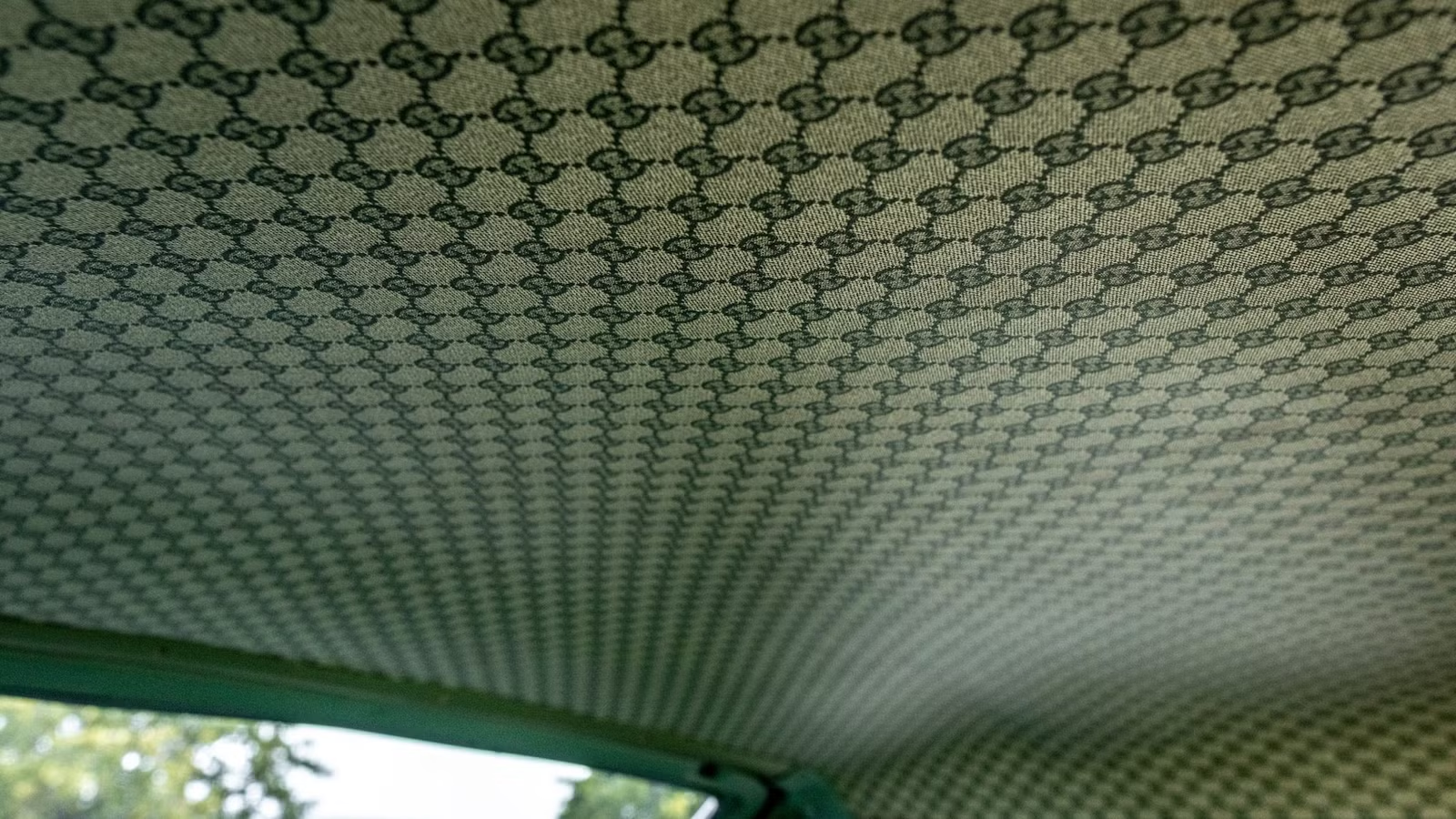
The most eye-catching feature of the Gucci Sportabout may be the headliner. The repeating, iconic double-G pattern looks like it could be borrowed from a mob boss’s wife’s handbag.
I’m a bit surprised at the restraint used in selecting exterior badges. AMC would likely have preferred a billboard-sized Gucci callout down the fenders. Milan insisted on a single (plastic) gold shield on the front fenders with the Gucci logo. Tasteful? It is so small you could blink and miss it.

The package was available with four exterior colors. Snow White, Yuca Tan, a pale Grasshopper Green, or Hunter Green, which is a nearly perfect match for the pale green plastic interior panels. The entire thing would set you back $150. That is a considerable premium on a car with a $2500 MSRP. But it was still a relatively cheap way to get the Gucci logo in your life.
The Sportabout Could Be Sporty

Most budget-minded Sportabout buyers likely opted for the base engine, an inline six-cylinder. But drivers had other options.
AMC’s motorsports program was already well on the way to its mid-1970s Trans-Am wins. The factory team specialized in mid-sized cars with bored-out small block V8s. You could order two of those V8s to make the Sportabout truly sporty. The first was a 304 cu-in (5.0-liter) rated for 210 hp at 4,400 rpm and 305 lb-ft at 2,800 rpm. The second was a 360 cu-in V8 (5.9-liter) that made 245 hp.
The X trim could make your V8 Sportabout look as quick as it was. It included “X” emblems, a three-spoke sport steering wheel, 14 x 6-inch slot-style steel wheels, and Polyglas Blackwell tires.

I know what you’re thinking: Yes, you could order a Gucci Sportabout X 360. Who would option a car this way? Imagine if Frank Sinatra had been a midwestern used-car salesman instead, who liked to spend his weekends drag racing at stoplights. That’s who.
“Americano Motor Corporation” Didn’t Last Long

AMC’s relationship with Gucci (we’ll call it “Americano Motor Corporation”) didn’t last long. But not for lack of trying on AMC’s part. The company wined and dined House Gucci as best it knew how. The team at AMC built a one-off Sportabout as a gift for Dr. Aldo Gucci. His car, of course, had the V8. The interior was upgraded with leather door panels, a leather cargo area, and leather front and rear armrests. It had custom bucket seats with red and green striped inserts. But its features went way beyond appearance.

AMC fitted Aldo Gucci’s Sportabout with a pull-out writing desk that extended from the instrument panel and over the driver’s seat. It even came with a sterling silver bamboo pen and a map light at the end of a flexible arm. The rear seat passengers had their own airplane seat-style compartments. One featured a snack and gaming table. The other had a liquor cabinet with four sterling silver tumblers and two decanters—all wearing enamel stripes in red and green.
None of these opulent features was enough to keep Gucci. The designer parted ways with AMC in favor of Cadillac. The new coupling would produce the Gucci-trimmed Seville. The Gucci Sportabout died after just two model years. But AMC landed on its feet, collaborating on a 1973 Javelin with Cardin, and a 1974 Matador with Cassini.

The Gucci Sportabout may not be for everyone. But it certainly has its share of fans. VIN A3A087H229709 isn’t a numbers-matching car, but it had a 360 V8 swapped in and it still sold on Bring a Trailer in 2023 for $22,000. VIN A2A087A124810 is finished in tan and sold on Hagerty in 2023 for $26,750. VIN A2A087A146098 still has its original I6 engine and sold on Bring a Trailer in 2026 for $26,750.
Source: Automotive History Preservation Society

Related posts


Latest Post


No Comments