
The Production Motorcycle That Terrified Riders In The ’80s
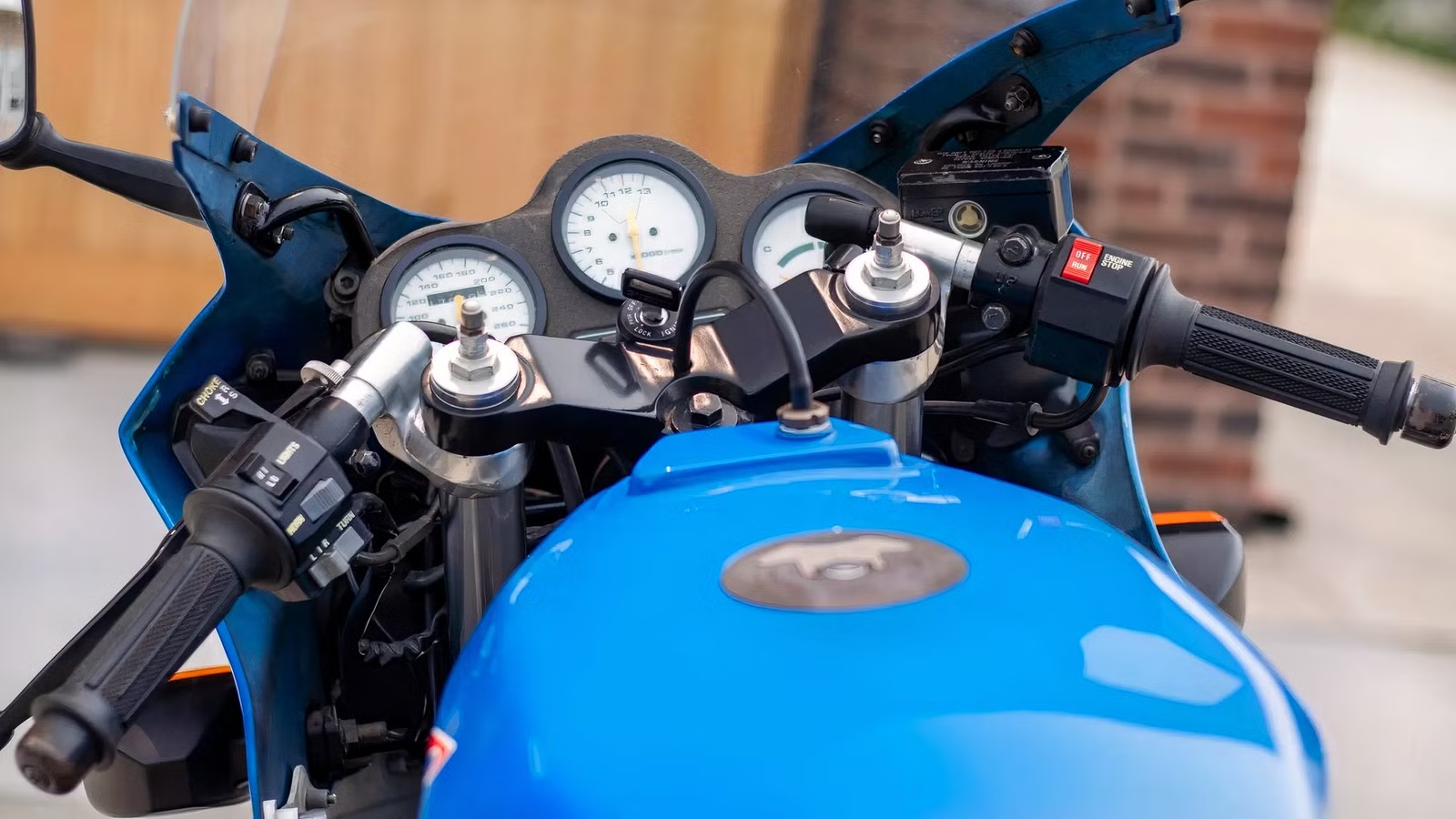
Long before advanced electronic assists made riding safer, motorcycles used to be far less forgiving. This was especially true for two-strokes, many of which have earned a fearsome reputation after terrifying those with just a little too much confidence in their abilities. A lot of big four-stroke machines managed to do the same, but folks were understandably more afraid of their distant two-stroke relatives in general. Heck, the Kawasaki H2 Mach IV was even dubbed the “Widowmaker” before that term became associated with the 930-gen Porsche 911 Turbo in the automotive realm. And in case you’re not sure why two-strokes were so unruly, we’ll be more than happy to shed some light on their nature.

What Made Powerful Two-Strokes So Unforgiving Back In The Day?

First, their engines had a much narrower powerband than that of four-strokes, where riders were suddenly met with a violent power surge that could easily catch them off-guard. There would be little to no clue of its potency at lower revs, then you’d get hit with all that peaky force all at once. And when you pair this with the flimsy frames, brakes, and suspension found on older bikes, bad things can happen sooner or later. These machines demanded respect from those who threw a leg over them, without hesitating to punish any mistakes made by unsuspecting riders. Aside from the aforementioned Kawi, other notorious two-strokes from the past include Yamaha’s RD500LC and RZV500R, as well as the earlier Kawasaki H1 Mach III.
GP Racing DNA For The Street

Suzuki had its fingers in the two-stroke pie, as well, and it was a force to be reckoned with in Grand Prix racing during the seventies and eighties. It won two consecutive world titles with Barry Sheene in ‘76 and ‘77, followed by Marco Lucchinelli in 1981 and Franco Uncini the following year. The bikes that made this possible went down in history as some of the greatest two-stroke racers to ever exist, and they were all part of the same lineup. Today we’re here to talk about the road-going incarnation of that lineage, launched in 1985 to bring some of that GP racing DNA onto public streets. In doing so, it arguably became the most feared two-stroke road bike of its decade, taking you just about as close to a genuine racing motorcycle as you could get outside the racetrack.
The Suzuki RG500 Gamma Was Basically A Street-Legal GP Racer

It is often said that no other two-stroke GP replica remained as close to its racing roots as the Suzuki RG500 Gamma. The bike came with a liquid-cooled 498cc square-four powerhouse — essentially two parallel-twins placed one behind the other. Inhaling took place via quad Mikuni carbs and rotary disc valves, while the engine’s compression ratio was rated at 7:1. It could produce up to 95 hp at 9,500 rpm and 53 lb-ft of torque a bit lower down the rev range, delivering all this force to the rear wheel by way of a six-speed transmission. The RG500 could thus finish the quarter-mile sprint somewhere in the low 11-second range, and its top speed exceeded 140 mph.
Now, the engine’s explosive power was just one part of the equation, because Suzuki’s two-stroke missile was also on the lighter side with a dry weight of just 343 pounds. The resulting power-to-weight ratio was genuinely wild for a road-going motorcycle from the eighties, and the RG demanded some serious finesse from the rider to be kept in check. It did reward precision in the best possible way, so long as you treated it with respect and knew how to make good use of its peaky powerband. As for the chassis, it was just about as solid as they came back in the 1980s for the most part, comprising an aluminum perimeter frame coupled with 1.5-inch anti-dive forks at the front and Suzuki’s proprietary Full-Floater suspension setup at the back.
Technical Specifications
|
Engine |
Two-Stroke Square-Four |
|
Displacement |
498cc |
|
Cooling |
Liquid-Cooled |
|
Induction |
Mikuni Carburetors |
|
Compression Ratio |
7:1 |
|
Horsepower |
95 HP |
|
Torque |
53 LB-FT |
|
Transmission |
6-Speed |
|
Quarter-Mile |
~11.2 Seconds |
|
Top Speed |
~142 MPH |
Stopping power came from dual discs with four-piston calipers up north and a single rotor bitten by a twin-piston caliper down south. A notable downside had to do with the Gamma’s footwear, though, more specifically its skinny tires measuring 100/90 at the front and 120/90 at the other end. These could be sketchy at times, for sure, while the motorcycle’s 56.1-inch wheelbase made it agile around corners but rather capricious at high straight-line speeds. And, of course, there were no such things as electronic aids to save you if you messed up, which wasn’t all that hard to do on a bike aiming to bring GP racing DNA onto public streets. Looking back, though, the RG500’s fearsome personality might just be an integral part of its appeal, as those who could tame it were in for quite a treat.
Gone As Quickly As It Arrived

Despite how sensational the Gamma was, it only stayed in production until 1987 with just over 9,000 units built by then. And the world never got anything else like it since, while other contemporary race replicas like the Honda NS400R didn’t come as close to that authentic 500GP spirit as the RG. Thus, Suzuki’s beast occupies a very special place among the world’s finest cult classic two-strokes, being one of the most remarkable examples money can buy. That said, let’s talk about what it would take to get your hands on one such specimen today, just in case you’d like to experience those old-school race replica thrills or simply add this legendary machine to your precious collection.
The RG500 Is What Collectors’ Dreams Are Made Of

For starters, these bikes aren’t always easy to come by on the second-hand market, so you’ll need to keep your eyes peeled in order to snatch the opportunity whenever it presents itself. And then there is the monetary aspect to take into consideration, because these vintage gems aren’t cheap by any stretch of the imagination. Well-kept examples will typically sell for around $25–30k, but then you’ve also got some outliers fetching a lot more. For instance, an impeccable 1986 model with just over 4,000 miles went under the hammer last year for approximately 50 grand on Iconic Motorbike Auctions. That is a considerable sum to spend on a motorcycle.
Clearly, the RG500 Gamma is far more than the sum of its parts, and it will only become more desirable as time goes by. It is thus regarded as a pretty good investment, too, now much more likely to be found in collections rather than out on the road. And although Suzuki in the eighties tends to be associated with the Gixxer nameplate, the two-stroke RG is arguably just as intriguing. Just be sure to never overestimate your skillset if you find yourself in its saddle, because it won’t hesitate to bite those who do. Now, something like the RG500 will probably never exist again, so it serves as a nice reminder of a different era in motorcycling as well as Suzuki’s success in Grand Prix racing.
Sources: Rider Magazine, Old Bike Australasia, Bennetts, Classic Motorcycle Mechanics, Iconic Motorbike Auctions, Bring a Trailer

Related posts


Latest Post


No Comments