
The First Car to Wear the Super Bee Name
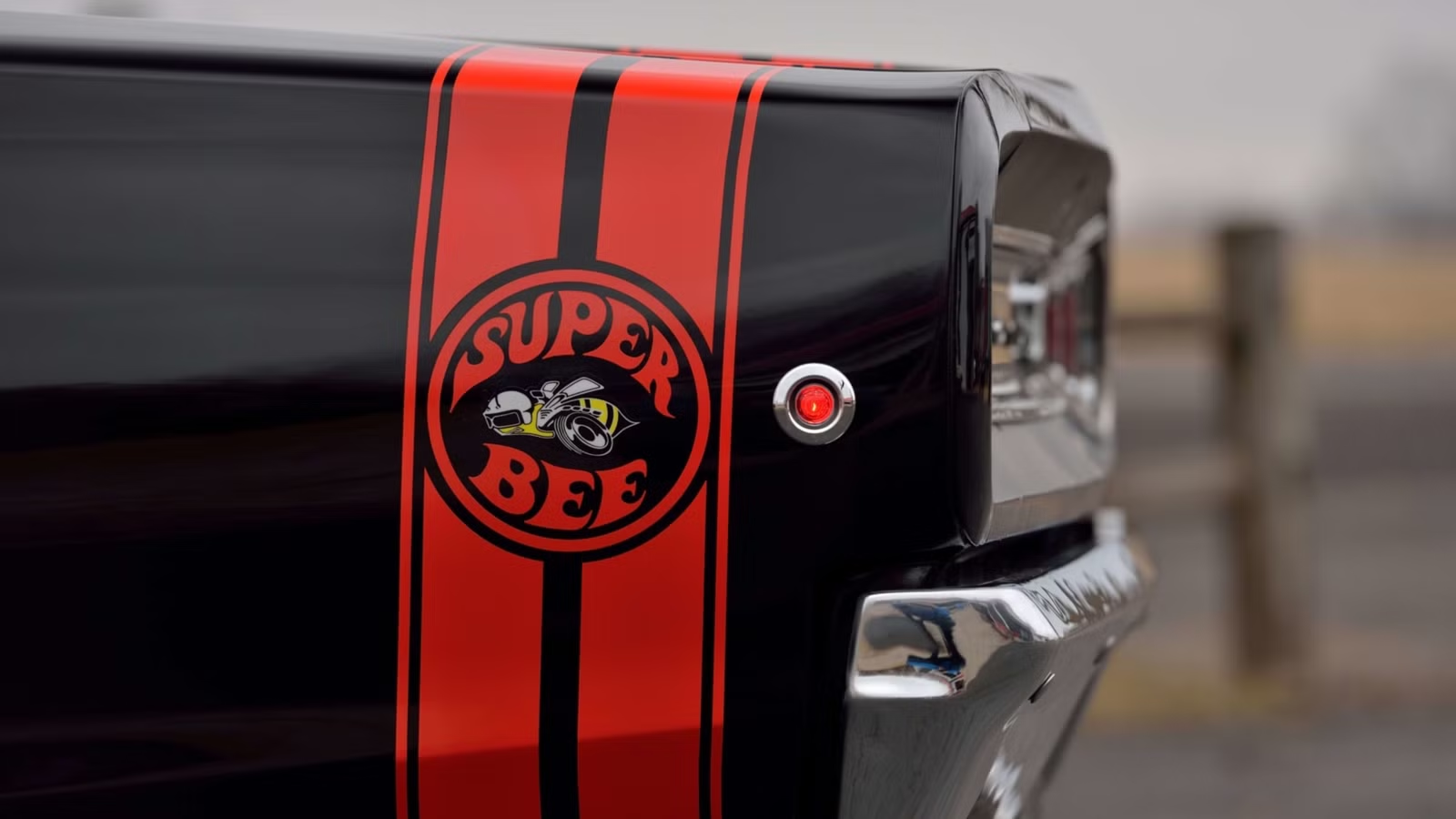
Dodge just built the most powerful Super Bee in history. The 2027 Charger Super Bee Launch Edition packs 600 horsepower, making it the quickest and hardest-hitting car ever to wear that name.

But the Super Bee badge itself didn’t start on a turbocharged Charger—it started nearly 60 years earlier, on a stripped-down muscle car built to undercut a rival on price. Here’s where the Super Bee name actually began, and how it got from a budget special to a 600-horsepower flagship.
Dodge Just Built The Most Powerful Super Bee Ever
Dodge revealed the 2027 Charger Super Bee Launch Edition on August 7, 2026, during the Charger’s 60th-anniversary celebration. It’s the most powerful Super Bee ever built, producing 600 hp and 531 lb-ft of torque from a twin-turbo 3.0-liter SIXPACK inline-six.

There’s no Hemi V8 under the hood, and Dodge knows that’s the first question. Instead, the company upsized the turbochargers from 54-mm to 56-mm units, retuned the engine computer, and reworked the cooling system, adding roughly 50 hp over the standard Charger Sixpack’s high-output six. Peak torque stays at 531 lb-ft, but the band now stretches from 3,000 rpm to 5,900 rpm instead of peaking narrowly at 3,500 rpm, so the power should feel more consistent through a run rather than arriving in one spot.

The Super Bee hits 60 mph in 3.6 seconds, which is 0.3 seconds quicker than the Sixpack Scat Pack, 0.1 seconds quicker than a Mustang Dark Horse, and 0.3 seconds behind the Daytona Scat Pack. It also breaks into the 11s in the quarter-mile at 11.8 seconds, the only combustion-powered Charger to manage that, trailing the Daytona Scat Pack by just 0.3 seconds.
The hardware backs up the numbers, too. It’s the first SIXPACK Charger fitted with 16-inch Brembo brakes and six-piston front calipers, and Dodge says the setup delivers triple the fade resistance of any other SIXPACK Charger. None of that happens without a nameplate Dodge trusted enough to bring back — and that badge didn’t start on a modern Charger at all.
The Original Super Bee From 1968 Was A Budget Muscle Car

The original Super Bee arrived mid-1968 as Dodge’s answer to the Plymouth Road Runner. The Road Runner had launched earlier that model year and undercut pricier muscle cars like the Plymouth GTX, but the Plymouth GTX’s $3,300 base price put it out of reach for a lot of younger buyers. Dodge needed something similarly affordable, and fast.
Its solution was the Coronet Super Bee, built on the Coronet 440’s pillared coupe body rather than the fancier hardtop. That stripped-down body style helped keep the package price low from the start. Standard power came from a 383-cubic-inch V8 rated at 335 hp, built using cylinder heads borrowed from the 440 and a stronger camshaft.

The Dodge Super Bee paired it with a heavy-duty four-speed manual and a Hurst “Competition-Plus” shifter as standard equipment, with a TorqueFlite automatic offered as an option. Dual exhaust, F70x14 tires, and Rallye Suspension rounded out the mechanical package. Despite the budget mission, it wasn’t as bare-bones as the Road Runner — carpeting, pleated vinyl seats, and a Charger-sourced dash gave it a slightly more finished feel inside.
The “Bumble Bee” tail stripes came standard at launch, though Dodge later offered a delete option for buyers who wanted a sleeper look. It was a formula built entirely around one goal: real muscle-car performance at a price that didn’t require a loaded options sheet to get there.
How To Get A Hemi On A Budget

The Super Bee didn’t come with a Hemi by default. Standard power was a 383-cubic-inch Magnum V8 rated at 335 hp, the same engine covered in the previous section, paired with a heavy-duty four-speed manual. The Hemi was strictly an option, and one most buyers skipped.
Dodge priced the 426 Hemi at just $712 over the base Super Bee, making it one of the most affordable ways to get factory Hemi power in any new car that year, muscle car or otherwise. Very few buyers took Dodge up on it. Only 166 Hemi Super Bees were built for the 1968 model year, split between four-speed and automatic cars, making them rare even by muscle-car standards today.

Hemi cars received a heavy-duty suspension package as part of the deal, though they couldn’t be ordered with air conditioning, a trade-off buyers accepted for the extra power. Braking still relied on heavy-duty 11-inch drums all around, since front disc brakes weren’t part of the formula the way they are on Dodge’s modern performance cars.
Inside, the seating stayed just as basic as the rest of the car, a vinyl bench in place of buckets, which contemporary reviewers described as feeling closer to a taxicab interior than anything resembling luxury. The pitch was simple and it worked: full-size muscle-car performance, with every convenience feature Dodge could strip out, at a price a younger buyer could actually afford.
Today, a 1968 model is worth an average of $51,625, while the later 1970 models fall in the $85,000 ballpark according to classic.com. However, values vary from model to model based on condition, mileage, options, and engine.
The Evolution Of Dodge’s Super Bee After 1968

The Super Bee gained a pillarless hardtop body option for 1969, alongside the original coupe. That year also brought a new engine exclusive to the Super Bee: the 440 Six-Pack, using three two-barrel carburetors to make 390 hp and 490 lb-ft of torque, an engine the R/T didn’t get. A standard fresh-air induction hood scoop system arrived on Hemi-equipped cars the same year.
The Coronet R/T received a new split-grille front end for 1970, but Super Bee numbers were already sliding as emissions regulations tightened. Jjust 36 Hemi Super Bees were built that year, down sharply from the car’s peak. After 1970, Dodge dropped the R/T and convertible Coronet body styles entirely, leaving the Coronet to sedan and wagon duty.

Rather than disappear, the Super Bee name moved to the Charger platform for 1971, since the Coronet no longer offered a coupe body to build it on. Dodge positioned it as the affordable alternative to the Charger R/T, priced at $3,271.
Production totaled 5,054 cars for the year, including just 22 with the Hemi and 30 with the 440 Six-Pack and a four-speed, making the ’71 Charger Super Bee one of the rarest versions of the nameplate. It was also the only year a small-block 340 V8 was offered in a Super Bee.

After 1971, the name went dormant in the U.S. for decades. That long gap is part of what makes Dodge’s modern revivals worth paying attention to, since the Super Bee isn’t a badge the company reuses casually.
From A Budget Options Package To A 600-HP Flagship

The 1968 original was built by deleting features to hit a price point. The 2027 Launch Edition takes the opposite approach, adding a purpose-built front fascia that increases airflow to the cooling stack by 30 percent and generates over 100 lbs of additional downforce at 150 mph compared to the standard Scat Pack.
The Launch Edition also gets its own visual identity, including a redesigned Super Bee logo inspired by a turbocharger spool. It’s offered in three colors: Sucker Punch, Shady, and Diamond Black. The car will be built at Dodge’s Windsor Assembly Plant in Ontario, with pricing and order details expected later in 2026.

Nearly 60 years later, the philosophy hasn’t really changed. Both cars exist to be the quickest, most track-capable Dodge you could buy without stepping up to that era’s flagship model. The badge started as Dodge’s cheap way to keep pace with a rival, and it’s ended up as the fastest thing wearing a Dodge grille.
Sources: Stellantis, Classic

Related posts



Latest Post


No Comments