
Aston Martin’s New Valen Is The Most Powerful Front-Engined Supercar Ever Built
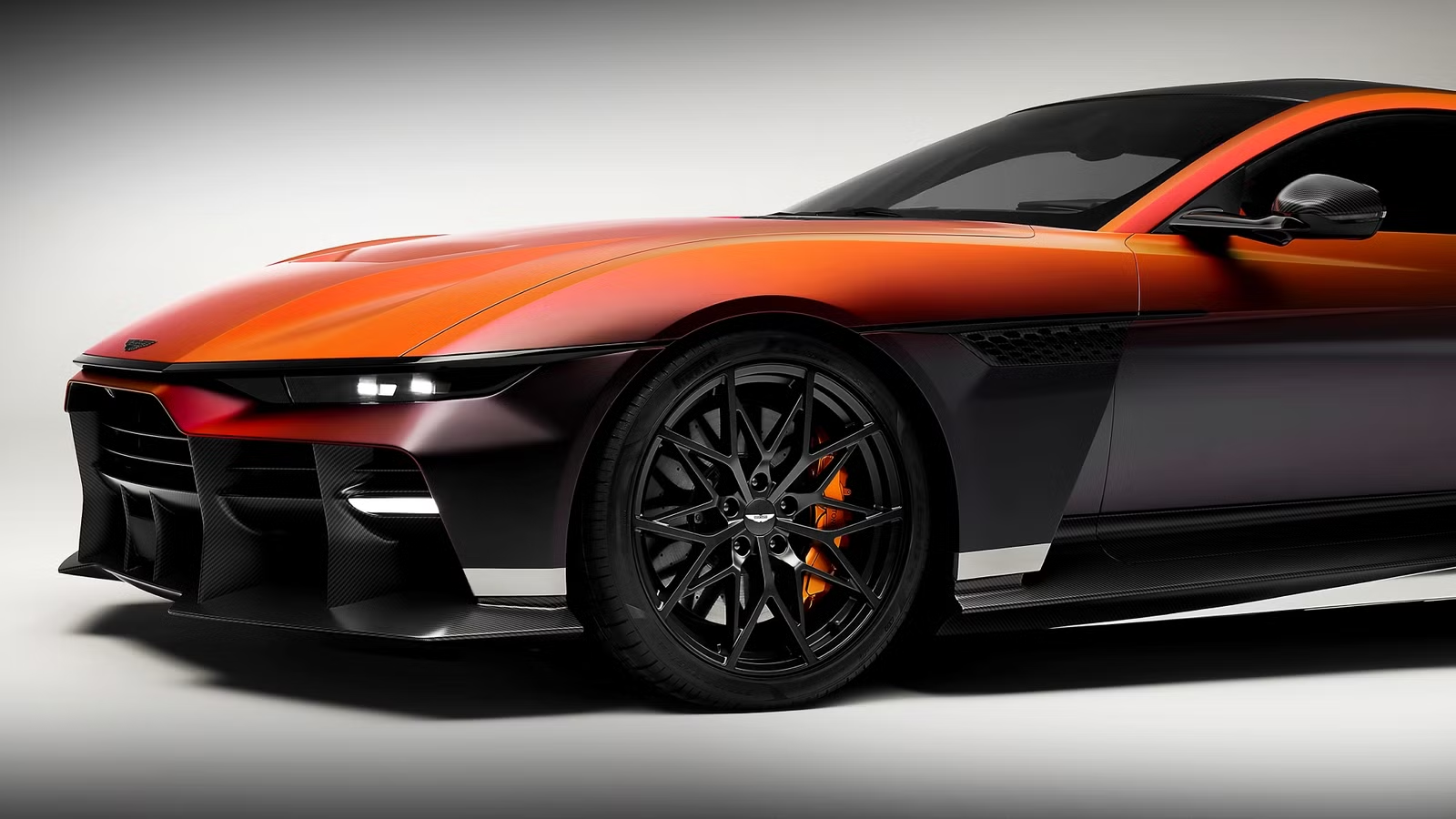
Aston Martin unveiled the Valen on Friday at Monterey, California — and the numbers are hard to argue with. Powered by an 850 PS, 1,000 Nm version of the brand’s 5.2-liter twin-turbocharged V12, the Valen claims the title of the world’s most powerful front-engined production car ever built, and the most powerful front-engined Aston Martin in the company’s 113-year history.

Limited to just 150 examples worldwide, with first deliveries scheduled for Q2 2027, the Valen is the latest creation from Q by Aston Martin’s newly formed Special Vehicle Operations department. It sits at the apex of a lineage that runs through the One-77, Vulcan, Victor, Valour, and Valiant — each one a statement about what a front-engined V12 can still do in an era increasingly dominated by mid-engine layouts and electrification.
850 PS From A Twin-Turbo V12 That Pulls From 2,500 RPM
The heart of the Valen is a heavily developed version of Aston Martin’s familiar 5.2-liter twin-turbo V12, now producing 850 PS (838 bhp / 625 kW) at 6,500 rpm and a full 1,000 Nm of torque available from just 2,500 rpm through to 5,000 rpm. The result is a claimed 0–60 mph time of 3.0 seconds and an electronically limited top speed of 214 mph.

Driving those outputs rearward is an 8-speed ZF automatic transmission mounted at the rear of the car, calibrated using shift strategies developed during Aston Martin’s Vantage GT4 race programme. The sharper, more aggressive shift logic is a direct contributor to the 3.0-second sprint time. An electronic rear limited-slip differential and a carbon-fiber propshaft complete the drivetrain package.

Three performance-focused drive modes — Sport, Sport+, and Track — shape throttle mapping, steering weight, and chassis behavior. In Sport and Sport+ the throttle map is deliberately short, delivering response early in pedal travel. Track mode switches to a longer, more progressive map for precision at the limit. A Wet mode and an Individual mode round out the five selectable settings.
240+ Pounds Saved Through Carbon, Magnesium, And Titanium

Aston Martin says the Valen sheds up to 110 kg (242.5 pounds) compared to the core V12 platform, achieved through extensive use of carbon fiber, aluminum, titanium, and magnesium throughout the structure and running gear. Standard 21-inch magnesium wheels reduce unsprung mass directly, sharpening steering response and wheel control.
An optional Lightweight Pack goes further, swapping in machined-from-solid aluminum suspension arms and knuckles alongside titanium chassis bolts — a combination that saves an additional 16.9 kg (37.3 pounds) on its own.

The chassis tuning reflects the weight reduction philosophy. Bilstein DTX semi-active adaptive dampers work alongside a solid-mounted rear subframe, model-specific springs, and helper springs. Front and rear lateral stiffness has been increased over the base V12 platform to sharpen response and reduce roll and pitch, while Aston Martin says the steering calibration is tuned to make the Valen feel shorter and lighter than its 4,830 mm length suggests.
Carbon ceramic brakes handle the stopping: 410 mm discs up front, 360 mm at the rear. Pirelli P Zero R tires — sized 275/35 ZR21 front and 325/30 ZR21 rear — were developed specifically for the Valen and integrate with Pirelli’s Cyber Tyre technology, which feeds real-time tire data to the ESP, ABS, and traction control systems via a Bosch Engineering co-developed hardware and software package.
A Full Carbon Body With A Solid Tailgate And 3D-Printed Exhaust Tips

Chief Creative Officer Marek Reichman describes the Valen as “a significant departure from what has gone before” — and the design details support that. The full carbon-fiber body features deeply recessed slimline headlamp units hooded beneath a sharply plunging bonnet line, a bold geometric mesh grille, and an acutely angled front splitter. The bonnet carries a single top vent with perforations at its trailing edge.
Along the flanks, the traditional Aston Martin side strake has been elongated and integrated into a large functional vent that extracts air from the wheel arch. Saw-tooth vortex generators on the sill trailing edges manage high-speed airflow beneath the car. At the rear, a conventional trunk lid and fixed rear window have been replaced entirely by a solid tailgate — its upper section houses an integrated aerodynamic wing that acts as a Gurney flap, generating downforce without a motorsport-style bolt-on wing. The tailgate opens to a 170-liter trunk.

The quad exhaust system places two upper and two lower tailpipes at the rear, with the upper outlets always open and the lower pair valved by drive mode. All four finishers are formed from 3D-printed titanium. Aston Martin says the system’s upper outlets are tuned like organ pipes to generate resonance at higher engine speeds — amplifying higher frequencies while reducing lower ones for a more focused, layered V12 soundtrack.
The show car wears Satin Andromeda Red, a Q Ultra paint that blends deep red with copper and golden highlights that shift to blue undertones using Chromaflair technology pigments. Customers can also specify fully exposed carbon fiber — including a herringbone weave running down the car’s centerline — in satin or gloss finish, with bespoke tinting available through Q by Aston Martin.
An Interior Built Around Visual Lightness And Driver Focus
Inside, the Valen’s cabin is organized around a slim 3D-printed center console angled toward the driver, incorporating the performance switchpack introduced on the Valhalla. Seat choice runs between newly developed Sports Plus seats — designed for support over long distances — and lightweight carbon-fiber performance seats for a more focused setup.
Upholstery is structured across five trim levels (Monotone, Duotone, Light Duotone, Tritone, and Driver Focused) in either Semi-Aniline Leather with Alcantara or full Semi-Aniline Leather. A Driver Focused option highlights the driver’s seat specifically; an accent pack adds contrast color detailing. The quilting treatment introduced for the Valen extends incrementally with each trim tier, from door panels only at the entry level to doors, seats, and headlining at the top specification.

CEO Adrian Hallmark framed the Valen’s ambition plainly: “With more power, less weight, and a spectacular soundtrack, the dramatic design is backed up by equally dramatic performance.”
Production of the Valen is capped at 150 cars globally, with first deliveries beginning Q2 2027. Configuration is open now at Aston Martin’s online configurator. For a marque that has spent more than a century refining what a front-engined grand tourer can be, the Valen reads as a deliberate, high-intensity argument that the V12 still has a defining role to play.

Related posts





Latest Post


No Comments