
The 1973 Honda That Ended European Motocross Dominance Overnight
In the early days of motocross, it was a given that a showroom receipt bought potential rather than a finished race bike. The rider still needed more money and a workshop capable of turning an expensive import into something fit for Sunday.

That routine survived because everyone accepted it as the cost of being competitive. It was simply the way it was. Then Honda sold a machine that could leave the dealership and embarrass carefully prepared European hardware before its first set of grips had worn in.
European Motocross Came With An Aftermarket Tax
Come the early ’70s, serious motocross machinery usually wore a European badge. CZ, Husqvarna, Maico, and Bultaco had the racing credibility, while bikes such as the Pursang and Stiletto supplied the performance American riders wanted. The catch was that buying one rarely completed the job. It merely gave the owner a promising collection of parts and a fresh maintenance schedule.

Racers replaced shocks, filters, rims, spokes, seals, and controls because stock equipment often wasn’t considered good enough for hard competition. Frames were reinforced, cylinders were ported, and suspension setups were reworked. One test at the time put the situation bluntly, declaring that “only a fool raced a Maico in stock trim”. A CZ demanded its own shopping list before anyone got serious.
That burden became an unofficial European aftermarket tax. The motorcycle’s purchase price covered admission, but reliability and competitiveness cost extra. What were the riders to do? They tolerated the ritual because there wasn’t a complete alternative. Being fast meant knowing how to ride and how to rebuild the thing you rode, ideally before Sunday morning practice. In effect, a racer with a modest budget could lose before the gate dropped simply because someone else had bought better shocks.
Honda Nearly Talked Itself Out Of The Answer

Honda should have been perfectly placed to fix the problem. It had enormous engineering resources and a rapidly expanding global presence, yet its founder remained deeply committed to four-stroke engines. Soichiro Honda had built the company’s reputation around them and resisted the smoky, noisy two-strokes taking over motocross.
The company initially tried to make its preferred formula work. Honda’s four-stroke motocross prototypes faced Suzuki two-strokes in Japanese test races and were soundly beaten. Motocross punished excess weight while rewarding compact power, leaving corporate philosophy several bike lengths behind by the finish.
The Dedicated Convert

Honda’s own research and development engineers had already pushed for a two-stroke racer, but conviction alone couldn’t overrule the boss. Competition finally did. Yamaha, Suzuki, and Kawasaki were moving deeper into the sport, while demand was growing in America and Europe. Sticking with an uncompetitive four-stroke would’ve been a very principled way to lose.
Development moved quickly once Honda accepted the obvious. A prototype was tested in Japan in 1971 and in California during 1972. Rather than adapting a street motorcycle, Honda designed a dedicated motocross machine from scratch. The company that had resisted two-strokes was about to build one with all the restraint of a convert who had just discovered horsepower.
The CR250M Elsinore Put A Works Bike In The Showroom

The answer was announced in October 1972 and reached American dealerships in March 1973 as the Honda CR250M Elsinore. It was Honda’s first production two-stroke motorcycle and its first purpose-built production motocrosser. Named after California’s Lake Elsinore Grand Prix, the CR250M turned a famous off-road race into one of motorcycling’s most important badges.
Its $1,145 price made the disruption impossible to dismiss. Yamaha’s YZ250 cost $1,836, leaving a $691 gap before the owner had purchased fuel or paid an entry fee. The Honda was cheaper, yet it arrived with the expensive hardware riders had been adding to European motorcycles after purchase. Suddenly, paying more and rebuilding immediately looked like a bad, unnecessary habit.
The Yamaha still had its strengths, but the crux of the matter was that the Elsinore didn’t need to flatten every rival in every category. It needed to get close to works-bike performance while costing hundreds less and demanding far less preparation. For an amateur racer balancing speed against a real-world budget, that equation was devastatingly persuasive.
Honda also understood that a revolutionary product still needed people to notice it. The company used promotional films featuring Steve McQueen, whose association with the Lake Elsinore Grand Prix gave the name instant dirt-bike credibility. The advertising brought riders into dealerships, but the Elsinore closed the sale.
Honda Had Already Installed The Expensive Parts

The 1973 Honda CR250M Elsinore used a 247.8cc air-cooled, piston-port two-stroke single with a five-speed close-ratio transmission. A 34mm Keihin carb fed an engine praised for a broad, usable spread of power. Riders learned that short-shifting worked better than chasing revs, and the motor could pull taller gears through corners like a much larger machine.
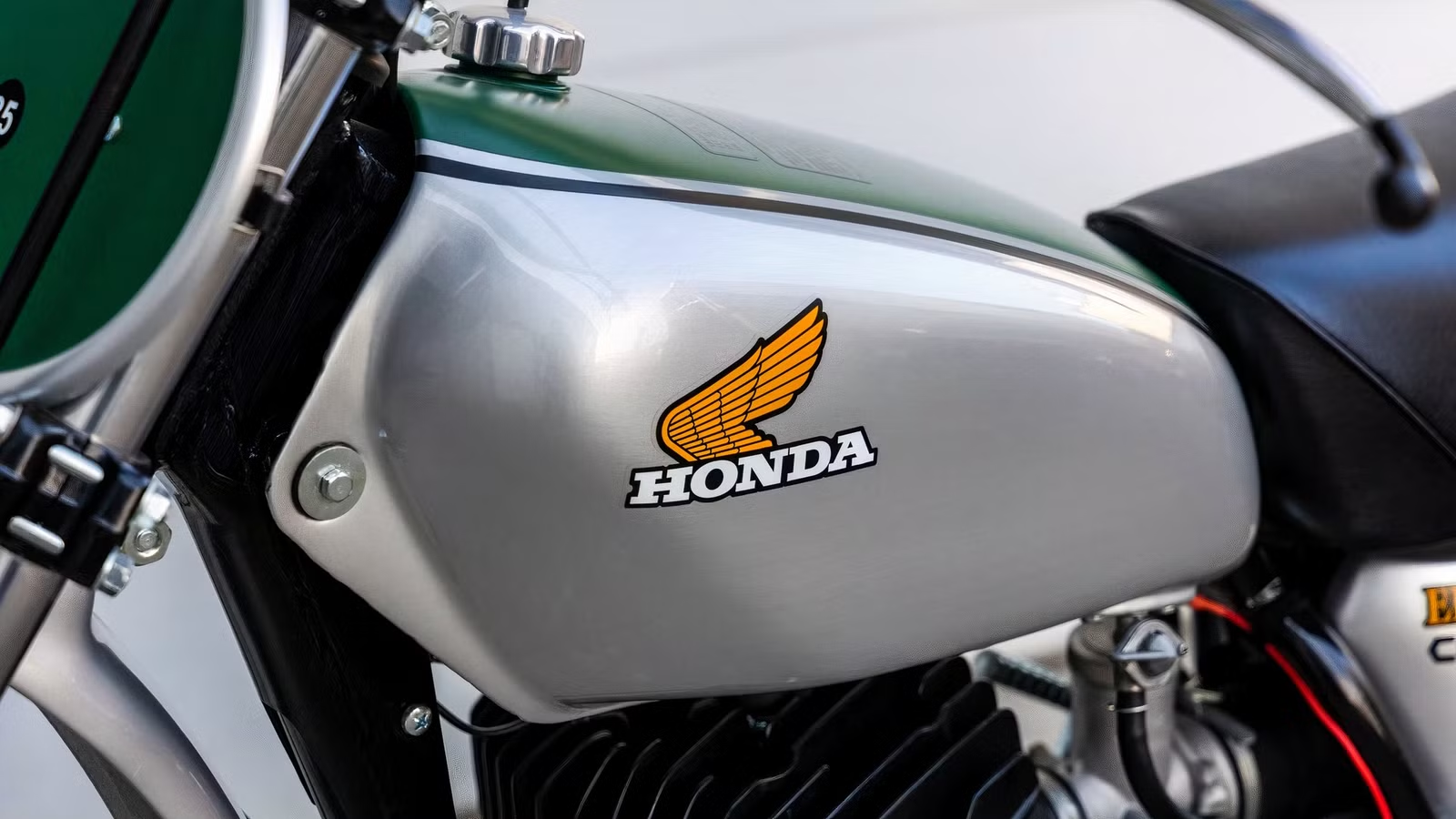
Honda’s weight-saving effort reached far beyond the engine tune. The fuel tank was aluminum, the engine side covers were magnesium, and the fenders were molded plastic. Its semi-double-cradle chromoly frame carried 21-inch and 18-inch wheels, with drum brakes at both ends. Depending on whether the figure was claimed or measured, specs place dry weight between roughly 213 and 229 pounds.
Imperfect Fun

The suspension also arrived ready for actual use. The telescopic fork offered about 7.1 inches of travel, while the twin rear shocks provided roughly 4.1 inches. Test riders found the fork less plush than the best Bultaco or Maico units, but it was entirely acceptable, and the rear shocks drew strong praise. Owners could change fork oil easily through side drain plugs instead of treating basic maintenance like an archaeological dig.
All of this added up to remove excuses. The alloy tank alone resembled an expensive accessory, while the bars, grips, controls, pegs, airbox, and filter were properly chosen from the factory. Even the ergonomics helped riders move around the motorcycle, which the quick-handling chassis demanded. The kickstarter could still threaten a rider’s dignity if it flopped at the bottom of its stroke, so perfection hadn’t completely spoiled the fun.
One Season Ended Motocross As A Cottage Industry

Honda backed the showroom promise with a factory racing program built around Gary Jones, his brother DeWayne, and Marty Tripes. The Jones family had already helped develop Yamaha machinery, making Honda’s recruitment especially sharp. Honda hired people who understood the rival YZ250, then gave them a motorcycle intended to beat it.
Gary Jones won the first AMA National Motocross event the new Elsinore entered on May 13, 1973, in Florida. He collected eight overall victories during the season and secured the 1973 AMA 250 National Championship. A production motocrosser had arrived, won immediately, and demonstrated that Honda’s customers weren’t buying a watered-down imitation of the race effort.
Resetting The Standard

The result reached far beyond one trophy. The CR250M sold quickly, and the smaller CR125M followed for the 1974 model year, putting even more Hondas on American starting lines. Rival manufacturers now had to compete on showroom readiness as seriously as they competed on performance. A race bike could no longer arrive half-finished and expect its reputation to cover the invoice.
Make no mistake: the CR250M didn’t make European engineering irrelevant overnight, but it destroyed the old expectation that a serious race bike had to be an expensive, temperamental project. For motocross, this was Honda’s CB750 moment: Japanese volume manufacturing collided with a specialist racing scene and reset the standard.
Sources: Motocross Action Mag, National Motorcycle Museum, Bike Bound, Motorcycle Classics, Honda

Related posts


Latest Post


No Comments