
5 Pre-War Classics Collectors Are Quietly Buying Now
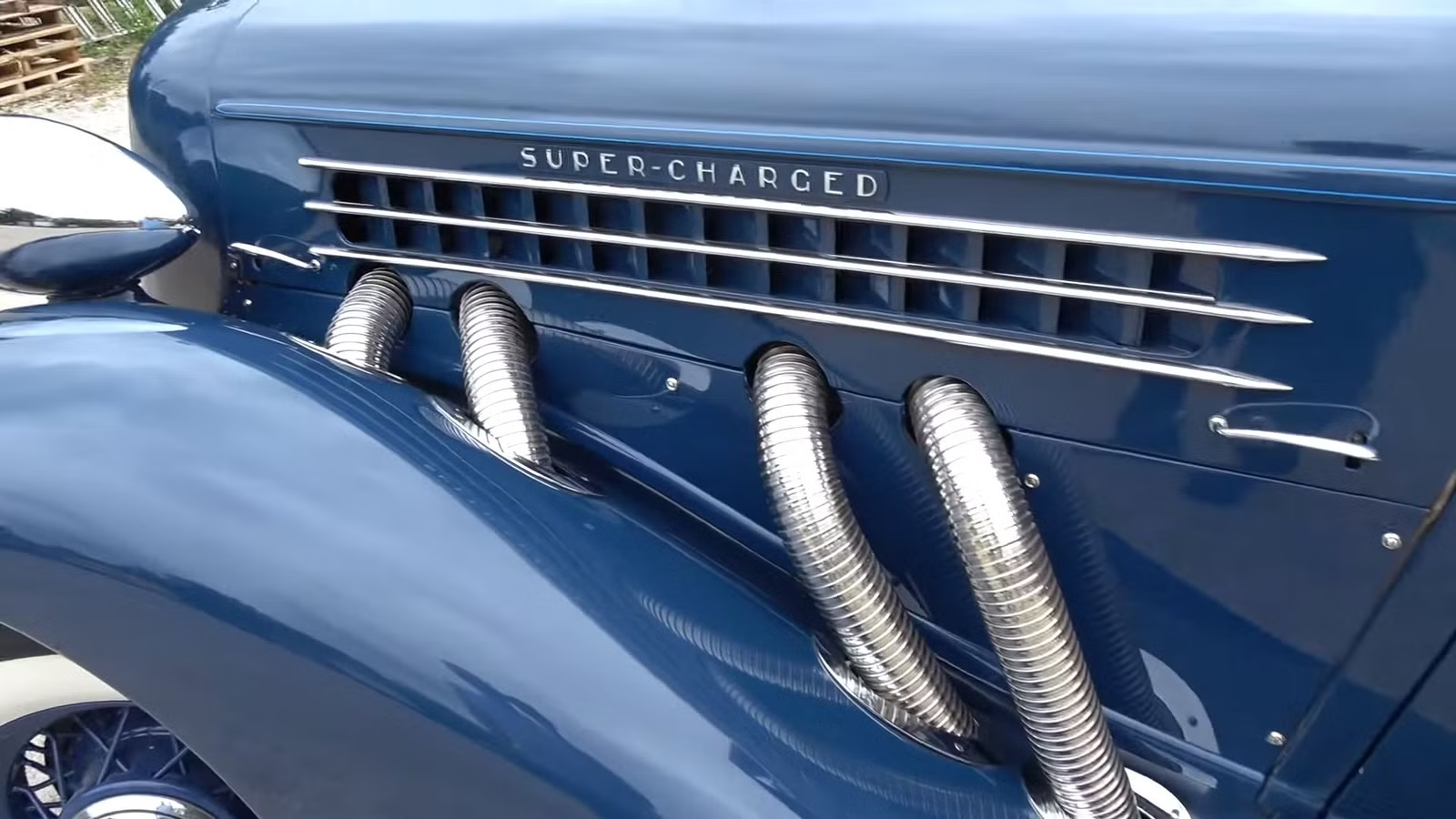
As modern cars grow ever more digital and driver-assisted, the appeal of a truly analog machine has never been stronger. A pre-war automobile isn’t simply a way to get from point A to point B — it’s an event in itself. But what exactly qualifies as a pre-war car? Collectors and enthusiasts generally use the term to describe classic cars built after the “brass era” (1896–1915) and before most automakers paused civilian production to support the World War II effort. That puts a “pre-war” car anywhere from the late 1910s through the early 1940s.

Obviously, many segments of automobiles were built during that span. But the American cars most popular with collectors today are the resplendent luxury rides you could imagine Jay Gatsby cruising around in. Fitzgerald put Gatsby in a bright yellow Rolls-Royce, and that car has come to symbolize the pre-war era. Pre-war Duesenbergs and Bugattis have also achieved a cult-like following. But these are not the only models worth collecting. From innovative Art Deco styling to customizable early hot rods, here are seven of our underrated favorites.
Packard 120
Production Years: 1935-1942
|
Engines |
 70 autotech 257-282 cu in (4.2-4.6L) L-head inline-8 |
|
Highest Horsepower |
120 hp (282-cu-in version) |
|
Highest Torque |
~225 lb-ft |
|
Current Value Range |
$20,000-$50,000 drivers; $100,000+ concours convertibles |
The Packard 120 was a proper Detroit cruiser available as a sedan, coupe, or convertible. Among enthusiasts, a Packard earns bonus points at car meets because it’s an orphan from a company that’s long since gone out of business. Packard (1899 to 1958) is still fondly remembered by many as the “other” Detroit automaker. The 120 also benefits from a straight-eight engine. Rather than a V-shaped eight or twelve, the inline-eight uses a single cylinder bank, which means a single head and valvetrain — fewer moving parts, and fewer components that can fail.

The Packard 120 remains a comparatively affordable pre-war luxury car, with clean drivers typically changing hands between $20,000 and $50,000. Note that convertibles often command a premium, with exceptional examples bidding up to six figures at auction.
Cord 810/812
Production Years: 1936-1937

|
Engines |
289-cu-in (4.7L) Lycoming V8 |
|
Highest Horsepower |
125 hp (1937 812) |
|
Highest Torque |
~260 lb-ft |
|
Current Value Range |
$100,000-$250,000; exceptional cars exceed $200,000 |
E.L. Cord owned the Stinson aircraft company, the Lycoming airplane engine company, and Auburn automobiles. In the mid-1930s he developed America’s first front-wheel-drive car and the first to hit 100 mph. With no driveshaft, it could sit lower to the ground than almost anything else on the road, with a sleek roofline just 5 feet above the pavement. It also featured sleek airplane-inspired styling, complete with pop-up headlights borrowed from a Stinson aircraft. The aluminum dashboard with its “engine turned” finish was yet another nod to aviation. It hit the market in 1936, not as an Auburn but as the “Cord 810.” When it received a supercharger for 1937, the company rebranded it the “Cord 812.”

With all the car’s aviation inspiration, it’s no surprise that Amelia Earhart proudly drove a Cord 812. Today, the Cord is often overshadowed by better-known pre-war cars. But collectors in the know — including Jay Leno — prize them for ingenuity that was far ahead of its time. Combined with low production numbers, that demand has pushed prices of the niche vehicle upward. A 1937 Cord 812 went for $209,000 at an RM Sotheby’s auction in October 2025, while most good examples now fetch $100,000–$250,000.
Studebaker Commander
Production Years: 1937–1939

|
Engines |
226-cu-in (3.7L) inline-six, 245-cu-in (4.0L) inline-six, and 221-cu-in (3.6L) inline-eight depending on year and trim |
|
Highest Power |
103 hp (221-cu-in Commander Eight) |
|
Highest Torque |
190 lb-ft (estimated for the 221-cu-in Commander Eight; factory torque figures were rarely published) |
|
Current Value Range |
$8,000–$20,000 for most sedans; $20,000–$35,000+ for well-preserved coupes and specialty body styles |
While many independent automakers disappeared or were absorbed into larger corporations, Studebaker held out longer than most, surviving until 1963. Studebaker was known for punching above its weight in both design and performance, which is why we’ve picked the Commander. After Studebaker retired the controversial Dictator name following the 1937 model year, the Commander became the company’s primary mid-priced offering. Like the Dictator and other Studebaker models of the era, the Commander earned a reputation for delivering high-end aesthetics — including iconic wing-shaped grilles, lower body lines, and more integrated fenders — at a fraction of the cost of an Auburn or Cord.

The late-1930s Studebaker Commander offers Raymond Loewy-inspired Art Deco styling, surprising usability, and genuine collector appeal at a fraction of the price of better-known pre-war icons. For enthusiasts seeking design pedigree without the auction-house premiums attached to Cords and Auburns, it may be one of the smartest entries into the pre-war hobby, with average prices still below $20,000 for highly original second-generation Commanders.
Ford Model A/B and Model 18
Production Years: 1928-1934

|
Engines |
201-cu-in (3.3L) I4 to 221-cu-in (3.6L) Flathead V8 |
|
Highest Power |
85 hp (1934 Model 40A/Model 18 V8) |
|
Highest Torque |
~140 lb-ft (1933-34 221-cu-in Flathead V8) |
|
Current Value Range |
$15,000-$35,000 (Model A); $35,000-$100,000+ (desirable V8 cars) |
Henry Ford revolutionized the auto industry, pioneered mass production, and introduced the Brass Era’s most famous car: the Model T. Then he sold essentially the same car for nineteen years. The Blue Oval finally debuted its first vehicle with modern driving controls and features in 1927: the four-cylinder Model A. When Chevy’s six-cylinder engine and the Great Depression conspired to sink Ford, the company’s founder figured out how to cast V8 engines as a single unit. Ford brought this high-end engine option to the masses with the “Model B” generation in 1932. The move saved Ford, charted Detroit’s course for decades, and created an automotive icon that hot-rodders still prize today (the often-modified ” deuce coupe“).

A growing number of enthusiasts are buying Ford Model A or Model B cars and keeping them stock. These cars represent a fascinating chapter in automotive history, and they are classic Fords that are relatively drivable on modern two-lane roads. With so many Model A and Model B cars produced, however, few are appreciating like true collector’s items. That keeps clean, stock Model A coupes attainable, with most changing hands for $15,000 to $35,000. A more desirable Model B-era car with the V8 — officially named the “Model 18” — can cost $35,000 or more, and unrestored examples in rare configurations sometimes sell for six figures.
Auburn Speedster
Production Years: 1928-1936

|
Engines |
245-cu-in I8 to 391-cu-in (6.4L) Lycoming V12 |
|
Highest Horsepower |
165 hp (12-165 V12 Speedster) |
|
Highest Torque |
~270 lb-ft |
|
Current Value Range |
$250,000-$700,000+; top boattails approach or exceed $1M |
Car salesman E.L. Cord bought the Auburn Automobile Company of Auburn, Indiana in 1924. Production had fallen to just six vehicles per day. Was his solution to cut costs and build a budget-friendly car? Heavens no. Cord rolled out the “Auburn Speedster” — a long-hooded, straight-eight-powered supercar. The powerful engine was courtesy of his Lycoming company. The car had no windows or interior door handles, and the roof was optional. Cord sent this early supercar to tracks around the country, where it shattered multiple speed records and was advertised as “tested to exceed 100 MPH.” Hollywood and the tycoons of the Roaring Twenties couldn’t get enough, and Auburn even briefly offered a V12-powered version.

Today, the Auburn Speedster — with its boattail design, certified speed rating, and carefree windowless configuration — has come to symbolize the Jazz Age. It’s no surprise that countless collectors want one. A 1935 Auburn 851 Super-Charged Boattail Speedster sold for $654,000 at Broad Arrow’s Monterey auction in 2025, while the finest concours-quality show cars can approach or exceed seven figures.
Buick Century
Production Years: 1936–1942

|
Engines |
320-cu-in (5.2L) OHV Dynaflash straight-eight |
|
Highest Power |
141 hp @ 3,600 rpm |
|
Highest Torque |
269 lb-ft @ 2,000 rpm |
|
Current Value Range |
$20,000–$35,000 for most sedans; $35,000–$60,000+ for desirable coupes and convertibles; exceptional restorations can exceed $60,000 |
From the 1970s to the early 2000s, the Century name belonged to a regular mid-size sedan that easily blended into everyday traffic — the kind of car you’d expect from Buick. But long before Buick earned a reputation for building boring “dentist cars,” the Century name belonged to one of the earliest banker’s hot rods ever created.
When the first-generation Century debuted in 1936, it adopted a simple, brutal formula: the shorter-wheelbase Buick Special body mated to the top-tier Roadmaster’s 320-cu-in straight-eight, which eventually produced as much as 141 horsepower. The result was one of the quickest American production cars of its era, capable of sustained speeds over 90 mph straight from the showroom floor — hence the banker’s hot rod nickname.

Collectors who want to actually drive their pre-war cars gravitate heavily toward the Century. It delivers the thundering straight-eight experience of a Duesenberg or high-end Packard while handling modern highway speeds with ease. The Century was produced in multiple body styles, and the more desirable coupes and convertibles have sold for $20,000 to $50,000 in recent years, with pristine examples crossing the $50,000 threshold.
Lincoln-Zephyr V12
Production Years: 1936-1942

|
Engines |
267-292 cu in (4.4-4.8L) Flathead V12 |
|
Highest Power |
124 hp (1940-1942 292-cu-in V12) |
|
Highest Torque |
~220 lb-ft |
|
Current Value Range |
$25,000-$60,000 sedans; $100,000-$300,000+ coupes and Continentals |
In the late 1920s, Chrysler engineers developed a theory: the cars of the day were so un-aerodynamic, they’d be faster going backwards. They consulted Orville Wright, built a wind tunnel, and designed the 1934 Chrysler Airflow — a revolutionary car with a face only a mother could love. And it flopped. Edsel Ford, Henry’s son, who had been instrumental in the Model B design, now headed Lincoln. He had a gift for incorporating the latest design elements of European exotics and luxury cars. You can probably guess how the story ends: Lincoln perfected an aerodynamic car that actually looked good with its 1936–1942 Zephyr line.

Edsel didn’t stop with Chrysler-inspired exterior design. He also gave the Lincoln-Zephyr a V12 engine, a clear homage to the top-of-the-line European cars of the day. Many enthusiasts consider the resulting car a high-water mark of pre-war design. Steinbeck felt compelled to call out the “silvery and low” design as unlike anything else on the road in his 1939 novel The Grapes of Wrath. Collectors prize the Lincoln-Zephyr for its place in automotive history, bridging car design of the 1930s and ’40s. Its Continental trim was especially historic, marking Lincoln’s first use of the famed badge. A 1938 Lincoln-Zephyr Coupe fetched $264,000 at Mecum Indy in May 2025, though the occasional solid driver-quality V12 sedan may still sell in the $25,000–$60,000 range.
Sources: The JBS Collection, The Simeone Museum, RM Sothebys, Broad Arrow Auctions, and Classic.com

Related posts
Latest Post


No Comments