
The 2,000-Pound American Sports Special That Humiliated Factory Corvettes On SCCA Grids
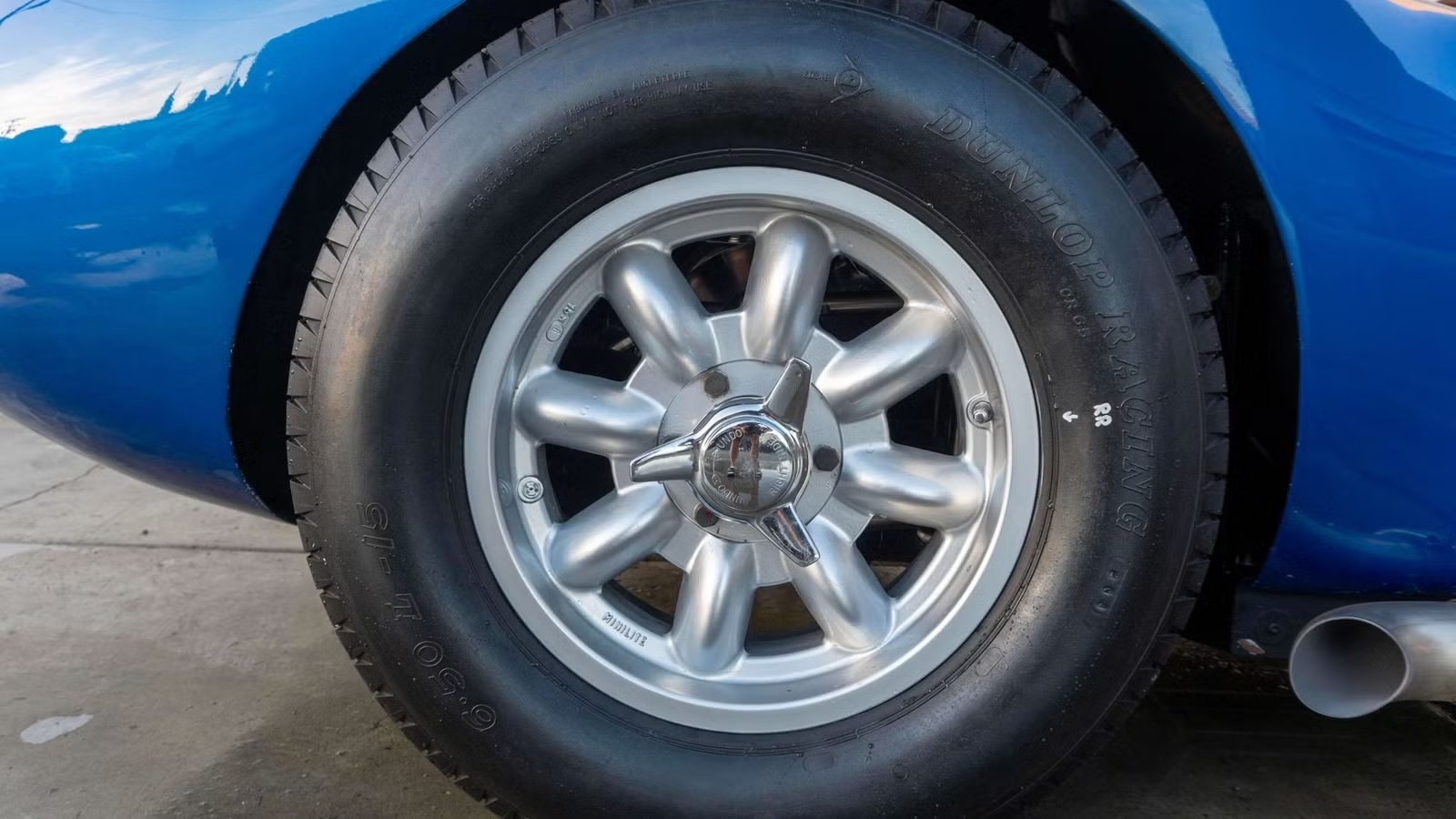
Imagine this: A time machine drops you by the side of a race track in 1958. You watch as the classic cars circle the road course. The familiar silhouette of a British-style roadster passes a Corvette, playing tag with the Ferraris and Porsches. You hear the rumble of an American V8 echoing from its exhaust and assume it’s a Shelby Cobra. Then you remember the Shelby Cobra won’t hit the market for four years. You’re looking at the pioneering boutique American sports car that perfected the Cobra’s formula half a decade earlier, before being forgotten by time.
In Pursuit Of A Superior Power-To-Weight Ratio

Carroll Shelby was famous for marrying a lightweight British roadster body with a powerful American V8. In fact, the vast majority of Mk1 “Shelby Cobra” cars began as a full body and chassis–complete with suspension and axles–assembled by AC Cars in Derby, England. AC shipped them to Shelby American in Venice, California. Shelby’s team then installed engines and transmissions and painted the vehicles.

By the end of the Mk1 run, the Cobra had graduated from Ford’s 4.3-liter V8 to a 4.7-liter engine. The resulting 2,355-pound roadster made 271 horsepower at 6,000 rpm and 314 lb-ft at 3,400 rpm, and could hit 60 mph in 5.8 seconds. But Shelby didn’t invent this formula. One American sports car was humiliating factory Corvettes on SCCA grids four years before the Cobra was released.
This is the story of the car that surpassed the Cobra’s benchmarks, years earlier. By all rights it should still be considered sports car royalty today. The men behind it didn’t do anything wrong: they had every claim to the crown Carroll Shelby eventually won instead. But history isn’t always fair.

Bill Devin Drove Advances In Sports Car Performance

Bill Devin was born in Oklahoma in 1915. His father was a mechanic and Devin showed the same talent early. He even built his little brother a go cart fashioned from an old metal sign and powered by the motor from a gasoline-driven washing machine.
He became a gas-welder, working on oil rigs and farm equipment to make ends meet. Then the Dust Bowl era drove his family out of Oklahoma. Devin was 23 when his family was forced to set out for California and build a new life.

Devin landed a job assembling Douglas airplanes. He ended up building and maintaining the jigs the workers used to shape the airplane bodies. He eventually became crew chief on the A-20 Havoc bomber line before joining the Navy. For nearly three years of WWII he was a mechanic, maintaining landing craft.
When he returned to the U.S., he opened a car dealership and got involved in auto racing, both modifying and driving his own vehicles. Devin saved up and ordered a Ferrari to drive at the 24 Hours of Le Mans. But when he arrived in Marnello, he was told his car wouldn’t be ready in time for that year’s race. He tried to get into the luxury car business and later built up and sold several race cars. But it would be his knowledge maintaining the jigs to shape airplane bodies that proved most useful.

Devin’s major breakthrough came when he got his hands on an Italian car called an Ermini 357 which had a very efficient and beautiful body built by Scaglietti. He assembled a series of jigs and taught himself to pour lightweight fiberglass replicas of the Italian car’s metal body. He ended up building 50 varying sections of molds. He could join different ones together and pour a body to fit almost any chassis, whatever the track width, wheelbase, and engine size. Devin Enterprises rapidly became the world’s most successful manufacturer of fiberglass bodies. He decided he wanted to build a sports car. And he knew that in the 1950s, he’d need to go to the U.K. to get the best chassis.
The Devin SS Hit 60 MPH In 4.8 Seconds—In 1958

Devin partnered with Noel HIllis and Malcom MacGregor of Northern Ireland when the pair contacted him about a custom body for a chassis they’d designed. He traveled to Ireland to take a drive in said chassis, sans body.
The men had designed a ground-up chassis with a 92-inch wheelbase, a de Dion rear axle with a limited-slip differential, Girling disc brakes at all four corners, and independent suspension at all four corners. It had DMC-built rack and pinion steering and dampers borrowed from motorcycles.

This thing was a race car, barely street legal. Devin knew it could beat almost anything on an American road, so he struck a deal. The Irish builders shipped them to Southern California where Bill Devin finished them with one of his fiberglass bodis, a BorgWaner 4-speed transmission, and a Chevy small-block. Devin also contributed components such as a finned aluminum cover to keep the differential cool and a custom intake manifold. The resulting 1958 “Devin Super-Sport” weighed about 2,000 pounds. It appears Devin sold some with a pair of Carter carbs which were rated at 220 horsepower, while other cars may have had the full Corvette engine tune with Rochester fuel injection for 290 horsepower. But were they fast?
The “Enzo Ferrari Of Okie Flats” Was Certainly Fast

Car and Driver nicknamed Bill Devin “The Enzo Ferrari of Okie Flats” even calling him “crazy like a fox.” It was a cheap shot, the “Okie” slur especially. But results speak louder than words. Sports Car Illustrated tested the Devin SS time to 60 mph at 4.8 seconds. That’s a full second faster than the Cobra. And it did it four years earlier.
According to the Racing Sports Cars website, the Devin SS did quite well. In its short racing history, the car racked up at least seven class wins and three podium finishes. It also took “several” overall victories, according to Hagerty. The car’s power-to-weight ratio was especially helpful during hill climbs. Ak Miller won the unlimited sports car division at Pikes Peak six times in his Devin SS, between 1958 and 1966.
Production ended almost as soon as it had started. By 1959, Devin Enterprises went bankrupt.

Devin debuted the factory-assembled SS with a price tag of $5,950. But by the end of the run, he was asking $10k. Obviously, he’d been overly optimistic about the profit he’d see from each vehicle. Material suppliers such as PPG demanded bulk orders. Component delivery delays made it impossible for Devin to finish cars on time. He couldn’t even pay for the final shipment of chassis, which remained in Europe.
Perhaps Devin’s rolodex just wasn’t loaded enough to secure the pre-orders he’d need for the business to survive. Perhaps he didn’t get the attention from racing wins that he needed during his first year of produciton. Or perhaps hand building a boutique car out of the very best components available on the planet was a doomed business venture from the start. Whatever the reason, the Devin SS was dead after just two model years.
“Devin Special” Re-Bodied Cars Muddy The Market

So how many Devin SS cars were built? We may never know the exact number. Bill Devin sold some cars as complete vehicles, others as kits which are difficult to track. The Irish builders kept careful records and we know they shipped sixteen chassis to the U.S.—including the prototype. But at least one of the complete chassis that Devin couldn’t afford to buy made its way to the U.S. anyway, where it’s now on display.
The waters get even muddier when you consider just how many fiberglass bodies, of various configurations Bill Devin sold. Recently, a Devin-bodied Crosley, Triumph TR3, MG TD, MG-A, and Volkswagen have all sold. In addition, fans put replica Devin SS bodies on custom chassis with a variety of engines.

Devin reportedly bounced back from bankruptcy, reverse-engineered the SS chassis, and attempted to build more cars himself. First, he released the Devin D which he offered with either a Volkswagen or Porsche engine. When he adapted his chassis for the Chevy Corsair engine, he badged it as the Devin C. Finally, when he engineered a premium hard-top version he badged it as the Devin GT.
Sources disagree on the number of true Devin SS cars in existence. Estimates range from 15 to 30. When a genuine Devin SS does pop up for sale, it command a premium price. Chassis SR4-1 from 1958 (pictured) sold on Bring a Trailer in 2025 for $260,000.
Bill Devins Walked So Carroll Shelby Could Fly

Carroll Shelby delivered his first Mk1 Cobra to Pittsburg-based racing driver Ed Hugus in July 1962. It must have turned heads blasting down Pennsylvania roads. Few Americans had seen anything like it, with its sleek roadster body and Detroit V8 rumble. But a few racing enthusiasts had seen something similiar–with better performance numbers to boot.
Through clever advertising and relentless racing efforts, Shelby American would reshape the sports car industry in the U.S.A. Carroll Shelby certainly earned his chapter in the history books.

When Carroll Shelby returned to the 24 Hours of Le Mans, Bill Devins stayed in Southern California to build and sell sports cars to continue to carve out a life for his wife and five children. He might have just been the “Enzo Ferrari of Okie Flats.” But he built a run of cars that could outperform the Mk1 Shelby Cobra and go toe-to-toe with anything on the road. His is one of the most uniquely American stories to ever have been forgotten by history.
Sources: Devin Sports Cars LLC, Bring a Trailer, Racing Sports Cars, Hagerty

Related posts

Latest Post


No Comments