
The Harley-Davidson Engine That Gets Better After 50,000 Miles
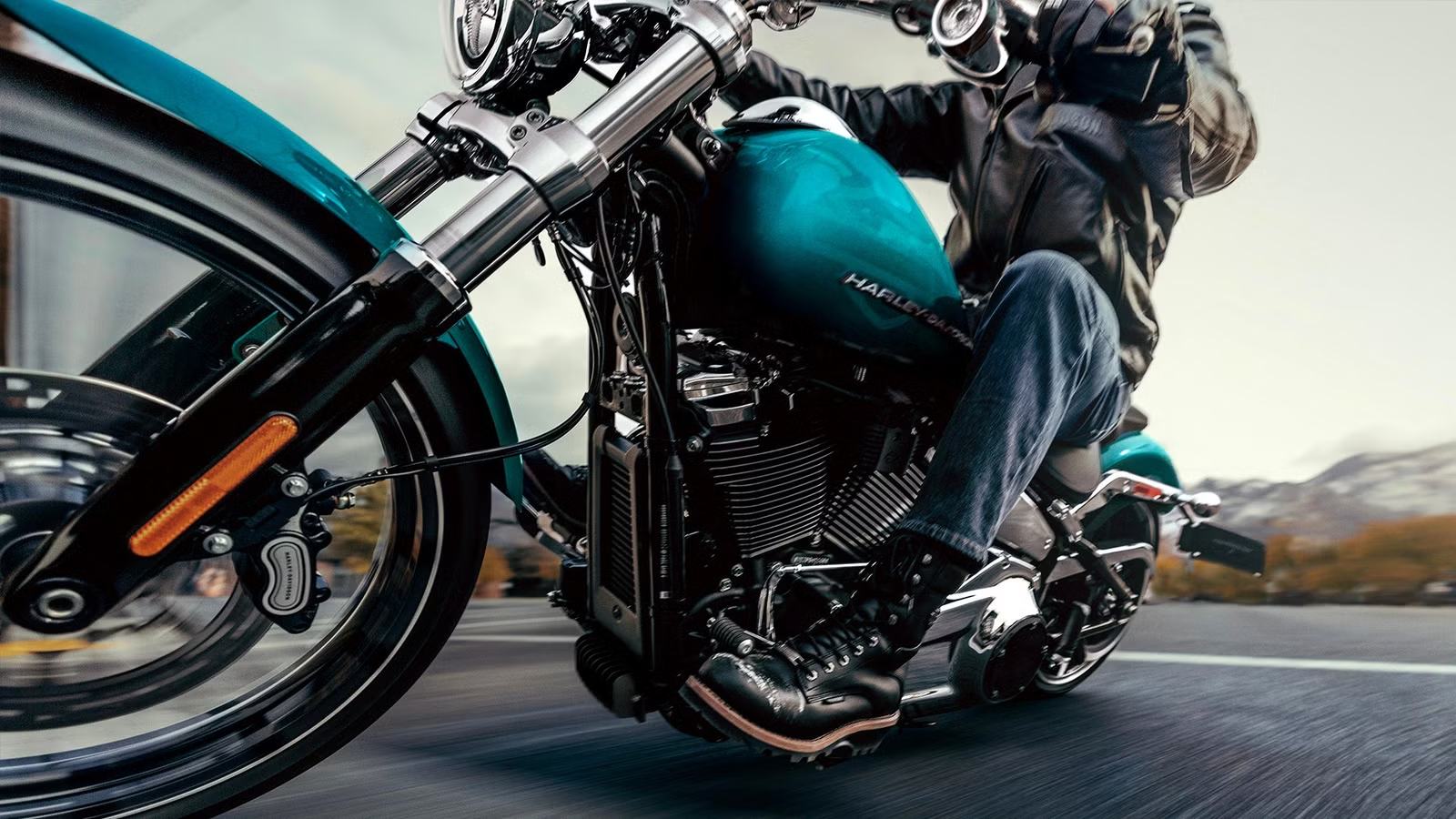
Gone are the days when Harley-Davidson cruisers were unreliable, leaked oil everywhere you parked them, and required you to get your hands greasy before a long ride. In fact, that time has long gone, as Harleys from recent decades have proven to be quite reliable. However, there’s one Harley engine that stands out for being dependable for years. It bears the Milwaukee-Eight badge and has been a reliable V-twin powerhouse since its arrival a few years ago.
Motorcycle Engines Usually Get Worse After 50k Miles

Motorcycle engines are complex machines, and eventually, components wear out, and things start breaking. That’s why motorcycle engines don’t last a long time. In fact, given the engine’s small dimensions and high performance compared to car engines, that wear-and-tear occurs a lot faster. Run a motorcycle engine for over 50,000 miles, and you’re nearing the end of its life.

What happens to high-mileage engines? That’s hard to predict, but the engine starts deteriorating in different ways. It’s not like the engine will suddenly grenade itself (that happens, too, sometimes), but as it racks up more miles, you’ll start noticing the deterioration: compression loss, oil burning, performance drop, poor fuel economy, noisy valves, leaks, and much more. Eventually, the engine will be too unreliable to run, or it will die.

Yes, there are plenty of motorcycles that still rack up six-digit mileage with just routine maintenance. That privilege is usually reserved for bikes with a Honda or a Suzuki badge, not Harley-Davidson. To some extent, the motor company’s AMF-era reputation still haunts it, but Harley-Davidson has come a long way today. Modern Harley cruisers and tourers feature an engine that does not get worse after 50k miles, but keeps running for a very, very long time. It’s the Milwaukee-Eight 117 V-twin.

The Milwaukee-Eight 117 Is The Most Reliable Harley-Davidson V-Twin Ever Made

We’ve all heard the joke that Harleys like to mark their territory with oil stains, but Harley-Davidson has made some very reliable engines in the past, including the Evolution and post-Project Rushmore Twin Cam units. However, the company’s current-generation big twin engine, the Milwaukee-Eight 117, takes things up a notch in terms of reliability. It does that by using modern technology, innovative cooling solutions, maintenance-free valvetrain, and counterbalances.

As a result, the engine is widely considered to be highly dependable. Sure, earlier M8 units did face oil sumping issues (oil transferring to the crankcase), but Harley-Davidson has corrected it with upgraded oil pumps and redesigned engine components. The company essentially updated the oil pump by shifting from a 60-40 split between the crank and cam cases to a 50-50 setup that fixed the sumping issue. After that, the Milwaukee-Eight engines have been pretty reliable.

What made the M8 117 engines even more reliable is the update introduced in 2024. That brought better cooling and revised cam chests, which made the engine more durable and cooler in traffic. It’s these things that make the Milwaukee-Eight 117 objectively the best big twin engine the motor company has ever produced. Ownership forums also show plenty of high-mileage examples, with many owners reporting six-digit figures on their M8 117-powered Harleys.

How does it get better after 50k miles, you ask? It’s not like the engine produces more power or sips less fuel after 50k miles, but it does not worry you with a huge repair bill looming over your head. What makes it better is that it gives you peace of mind that, despite high mileage, the engine won’t turn into a deadweight or throw tantrums any time you look at it wrong. Few engines can do this, and Milwaukee-Eight 117 is now part of that very exclusive club that is otherwise dominated by the likes of the Suzuki SV650, Kawasaki Ninja 650, and Honda Shadow Phantom.
The Makings Of A Reliable Harley-Davidson Big Twin Engine

When developing the successor to the Twin Cam Big Twin, Harley reportedly conducted interviews across 7 cities, asking over 1,000 motorcyclists what they wanted to see in the next line of tourers. The responses were largely about more power, less heat, and less vibration. The Milwaukee-Eight V-twin was built to meet those expectations.
Introduced in 2016, the M8 became the ninth generation of the MoCo’s Big Twin engine family. Over the years, its displacement has grown from 107 to 114 and now 117. And this is used across the company’s non-CVO touring and Softail lineup. You might as well call it the staple engine for the brand today.
One of the biggest differences that the Milwaukee-Eight brought over other traditional Harley Big Twin engines was the presence of four valves per cylinder, totaling eight valves. Hence the name, by the way. Compared to the Twin Cam, Harley says the extra valves improve intake and exhaust flow capacity by 50 percent and add a 10 horsepower benefit, at least on the older M8 107 unit. At the same time, the oval intake ports and low-profile intake valve seats are said to improve performance and fuel economy.

More efficient performance doesn’t just look good on the spec sheet or while going fast. It ensures the engine feels more relaxed at highway speeds, even with the full load of a tourer with luggage. Plus, the valve train requires no adjustment ever, as the rocker arm design enables valve lash to be set at the factory for life. In other words, you don’t have to worry about expensive valve adjustments or wrong valve settings ruining the engine’s performance.
Improved Thermal Management With Cooled Cylinder Heads

The Milwaukee-Eight 117 also features a precision cooling strategy based on the engine model’s specific demands, where it gets either oil or liquid coolant around the hottest areas of the cylinder heads. On the Softail models, the M8 117 models get oil cooling, which improves the engine’s thermal stamina without requiring coolant system maintenance. On the touring models, the engine features Twin Cooling, which uses liquid-cooled heads and a center-mounted radiator.

Complementing this cooling system is the repositioned rear exhaust pipe and catalytic converters, along with a lower idle speed of 850 RPM compared to the previous 1,000 RPM. The result is an engine that stays cooler during hot summer days or in traffic, which not only improves the bike’s comfort but also its life. More stable engine temperatures prevent hot spots and metal warping, while drastically reducing material fatigue and premature wear across the engine.
The Other Small Bits That Add To The Engine’s Reliability

The Milwaukee-Eight engine also marked the return to the single-camshaft configuration as used on previous Big Twin engines from 1936 to 1999. This is lighter, mechanically less complex, and creates less friction and noise, which adds to the engine’s durability in the long run. Meanwhile, primary vibrations from the big pistons are handled by counterbalances, resulting in smoother engine operation and less material fatigue. The M8 engines also feature dual spark plugs in each cylinder, which are said to improve efficiency.
The Milwaukee-Eight 117 Is At The Heart Of The Softail And Grand American Tourers

The Milwaukee-Eight 117 is present across all Softail cruisers and non-CVO Grand American Tourers, making it the lifeline of Harley’s Big Twin models. Here, the Softail cruisers are powered by one of three M8 117 engines, each tuned to match the personality of a specific cruiser. Performance is tuned through differences in intake and exhaust schemes and ride modes.

The base engine for the Softail lineup is the M8 117 Classic, which focuses on smooth, consistent power and a flat torque curve. It produces 120 pound-feet of torque at 2,500 RPM and 98 horsepower at 4,600 RPM, while returning an estimated 47 miles per gallon. The engine is present on the Street Bob, Super Glide, Deadwood, and Heritage Classic.

Moving up is the M8 117 Custom, which focuses on torquey acceleration. It produces 126 pound-feet of torque at 3,000 RPM and 103 horsepower at 4,800 RPM, while returning 47 to 49 miles per gallon. This engine is present on the Fat Boy and Breakout.

At the top of the Softail lineup is the M8 117 High Output motor, a high-performance engine tuned for an aggressive sound profile and high-revving power. To that end, it produces 128 pound-feet of torque at 4,000 RPM and 114 horsepower at 5,000 RPM. It powers the Low Rider S and Low Rider ST models.

We then move to the non-CVO Grand American Tourers, which are powered by one of two Milwaukee-Eight 117 engines. The standard here is the M8 117, producing 130 pound-feet of torque at 3,250 RPM and 105 horsepower at 4,600 RPM, with a fuel economy of 44 miles per gallon. This engine is present on the base Street Glide and Road Glide.

The highest-variant of the M8 117 is the M8 VVT 117, which features variable-valve technology for a more versatile performance. This engine produces 131 pound-feet of torque at 3,250 RPM and 106 horsepower at 4,600 RPM, while returning 45 miles per gallon. It powers the full-dresser Street Glide Limited and Road Glide Limited.
Source: Harley-Davidson, onwership forums

Related posts




Latest Post


No Comments