
The Forgotten Kawasaki That Invented The 600cc Supersport Class
The 750cc class is mostly gone from the motorcycling landscape in our day and age, but there was a time when it filled an important place between the heavyweights and smaller machines. That role has been reassigned to 600s as the best middle-of-the-road options for the most part, powerful enough to feel exciting but without being as heavy or demanding as your typical liter-bike. Most people forget where the template for modern middleweights first appeared, though, and it is older than some of you might realize. The motorcycle credited with establishing it is often overshadowed by its bigger and more popular sibling, which is a big part of the reason why it’s not talked about more often.
Kawasaki Created A Legend In the Mid-Eighties

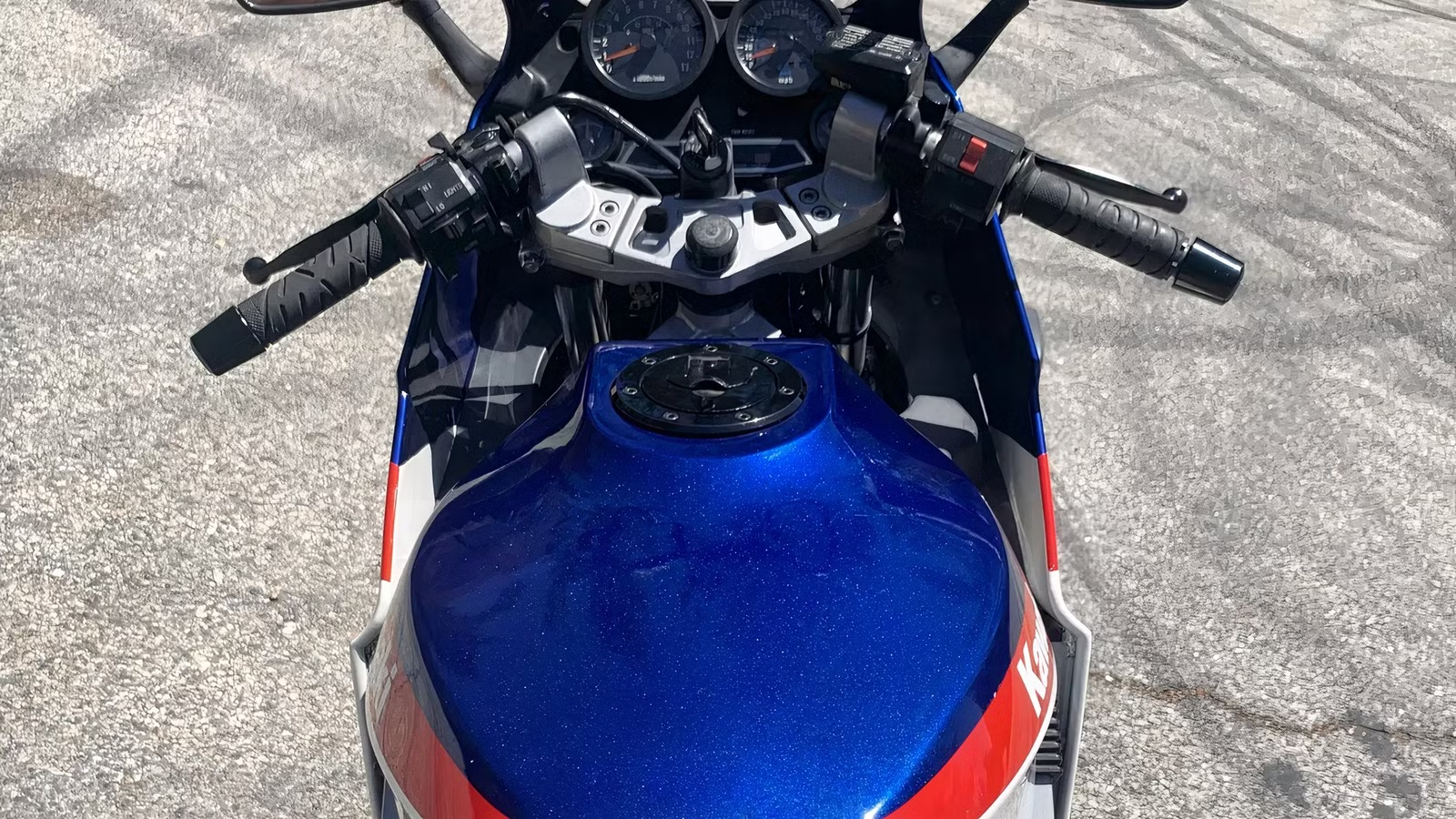
1986 Kawasaki GPZ600R fuel tank and seat
Kawasaki’s fabled GPZ900R Ninja debuted as a 1984 model, setting a new standard for all sport bikes to chase and becoming the world’s fastest production motorcycle at launch. It came with a liquid-cooled 908cc inline-four capable of delivering up to 115 horsepower, which translated into a quarter-mile time of just under 11 seconds and a top speed north of 150 mph. In fact, the GPZ was the world’s first motorcycle to break the 150-mph barrier, and its popularity was further enhanced by Hollywood. After making an appearance in Top Gun starring Tom Cruise, the original Ninja became a true pop culture icon as opposed to just a great motorcycle, and it is nowadays remembered as one of Kawasaki’s most significant milestones.
The GPZ Name Wasn’t Reserved For Just One Model

As great as the GPZ900R was, though, we would argue that its downsized, lesser-known relative deserves just as much attention for different reasons. It didn’t become a Hollywood superstar nor was it the fastest machine out on the road, but it still punched well above its weight while quietly creating the blueprint for future 600cc sport bikes. And although it faded into obscurity and had a much shorter lifespan than the larger Kawi, it was still a very solid piece of machinery with much of its tech borrowed straight from the full-size GPZ. Performance was outstanding, handling felt nimble, and the riding experience delivered most of the thrills you’d get from the GPZ900R. So, clearly, Kawasaki’s forgotten Ninja warrants a closer look.
Kawasaki GPZ600R: The Original Mid-Sized Supersport

The GPZ600R (known as the Ninja 600R in the U.S.) arrived one year after the bigger Ninja as a 1985 model, aiming to give buyers a more approachable entry point into the supersport category. Many bits and pieces trickled down from Kawasaki’s flagship, and the similarities between the two began in the powertrain sector. Just like the 900, its inline-four engine came equipped with liquid cooling, dual overhead camshafts and a total of 16 valves. It only displaced 592cc, though, while its peak power output was rated at a respectable 75 hp with an 11,000-rpm redline. The engine’s powerband is said to have been rather uninspiring below 8,000 revs, but things got pretty exciting from that point on. According to period testing, the GPZ600R could hit a top speed of 135 mph — very commendable for something in its class.

Moreover, the bike’s quarter-mile time sat in the low 12-second range, and its four-cylinder engine was housed in a perimeter-style steel frame somewhat similar to that of the GPZ900. Front-end suspension duties were assigned to anti-dive forks slightly thinner than the 900’s at 37 millimeters (1.45 inches). On the other hand, the rear was perched on Kawasaki’s proprietary Uni-Trak progressive setup linking an air-assisted monoshock to an aluminum box-section swingarm, while the footwear department housed 16-inch wheels fore and aft. These made the 600R more agile and responsive, while its front and rear disc brakes provided ample stopping power to get the job done. Before any fluids were added, the Japanese middleweight tipped the scales at 430 pounds — hefty by today’s standards, yet far lighter than the GPZ900R.
Visually, both bikes were cut from the same cloth, characterized by a full fairing for improved aerodynamics and a more cohesive look. The front end carried a rectangular headlight in both cases, but the 600 had a slightly more rounded appearance in that area. If you squinted and looked at them side-by-side from afar, you’d have a hard time telling them apart if it weren’t for their different color schemes. Their ergonomic packages were equally sporty, too, comprising clip-on handlebars and rear-mounted foot pegs for an aggressive riding stance. And with an initial MSRP of $3,299 in the States, the mid-sized Ninja was considerably cheaper than its big brother, which commanded $4,399 at launch according to Cycle World. But if the 600R was so enticing, then why does it so often slip from people’s memory today?
Historical Significance Doesn’t Always Guarantee Widespread Recognition

Aside from the obvious fact that its impact was eclipsed by the 900, the GPZ600R’s reign was also cut short by fierce competition and even one of Kawasaki’s own later models. Come 1987, Honda responded with the CBR600F, considerably lighter and more powerful than the Ninja with 85 hp at its disposal. It was more stable, too, thanks to a pair of 17-inch wheels offering the best of both worlds between high-speed composure and maneuverability. Then there was the Kawasaki GPX600R, launched in 1988, producing 84 hp and a dry weight of just under 400 pounds. So even though the GPZ may have started the whole 600cc supersport movement, it was quickly rendered obsolete by machines that refined the formula even further.
Nevertheless, its contribution to the motorcycle scene cannot be denied, because the template it laid out is still very much the norm to this day. Liquid-cooled 600s with full fairings and deep connections to their liter-bike relatives are everywhere and more popular than ever, so it really is worth remembering the model which started it all more than four decades back. Some might even say its influence was more lasting than the GPZ900’s, and there is certainly a lot of weight to that claim despite how bold it sounds. No matter how impactful the 600R might’ve been, though, it seems doomed to live in the 900’s shadow at least for the foreseeable future.
Market Values Reflect The Model’s Underrated Nature

You’d think that a motorcycle as influential as the Kawasaki GPZ600R would be a cult classic icon today, but prices on the second-hand market don’t reflect this in the slightest. And although finding one for sale isn’t always easy, we came across a listing on Bring a Trailer from 2023, when a 1986 variant in excellent condition was sold for a mere $2,800. People’s interest appears to be a bit more lively across the big pond, because another ‘86 model is currently up for grabs in Italy for €5,800 (about $6,600), as stated by Car & Classic. Still, that’s nowhere close to the legendary tier occupied by other historically significant motorcycles, and we’re not sure if the 600R will ever get there.
On the bright side, this means you can live the original 600cc supersport experience without paying a massive premium for the privilege, so keep an eye on the classifieds to potentially snatch the next example that pops up. Even though the GPZ won’t keep up with modern-day middleweights, it’s worth considering for true aficionados who value history as much as they do performance. The Ninja 600R was discontinued as early as 1990, but its relevance persists even if people don’t acknowledge it outright. Every successful 600 currently on the market owes a little something to the old, underappreciated Kawi from the eighties, which is why it should never be dismissed as just another mid-sized Japanese supersport from a bygone era.
Sources: Kawasaki, Bring a Trailer

Related posts


Latest Post


No Comments