
Lincoln’s Forgotten Mid-Engine V6 Concept Was Supposed To Rival Ferrari
Concept cars exist in a space where engineering ambition and design fantasy collide — where budgets are secondary and imagination leads. Some of the most influential machines ever built started life as concepts: the Lancia HF Zero that seeded the DNA of the Stratos, or the Audi Le Mans Quattro that evolved directly into the R8. These are the projects we return to again and again, because they show us what’s possible when a brand dares to dream out loud.

But the most compelling concept cars are often the ones that come from unexpected places. Lancia and Audi chasing supercar glory makes sense. What doesn’t — at least on paper — is when Lincoln decides to do the same. A stately luxury sedan? Sure. A plush convertible? Maybe. But a mid-engine, Ferrari-fighting concept with Italian coachwork and a gated shifter? That’s exactly what Lincoln built 40 years ago, and it remains one of the strangest, most fascinating left-field swings in American automotive history — aimed squarely at the heart of Ferrari.
Why The Lincoln Quicksilver Was Built

Lincoln has built its reputation on playing it safe. For more than a century, Ford’s luxury division has served a straightforward purpose: capture affluent buyers who wanted something beyond a standard Ford but hadn’t yet committed to European imports. The formula was simple — offer premium features at premium prices to customers with deeper pockets.
This conservative strategy has proven remarkably durable. While competitors like Mercury and Pontiac have vanished from the automotive landscape, Lincoln continues operating today, a testament to its steady, risk-averse approach.
Yet there was a fascinating moment in the 1980s when Lincoln appeared ready to abandon this cautious playbook entirely. The preceding decade had been brutal for American performance cars. Federal emissions standards and fuel economy concerns had neutered once-mighty machines — the Mustang had been reduced to a Pinto-based econobox, while the Dodge Charger had essentially become a rebadged Chrysler Cordoba. Enthusiasts who remembered the golden age of 1960s muscle cars were deeply frustrated with these compromised, malaise-era vehicles.
Those buyers, now established professionals with real disposable income, were hungry for genuine performance and excitement. Increasingly, they looked overseas to brands like Ferrari, which still embodied automotive passion and engineering excellence. Facing this exodus of enthusiast buyers to exotic European marques, Ford and Lincoln recognized they needed to prove they could still build something truly special.
The Quicksilver Is Born

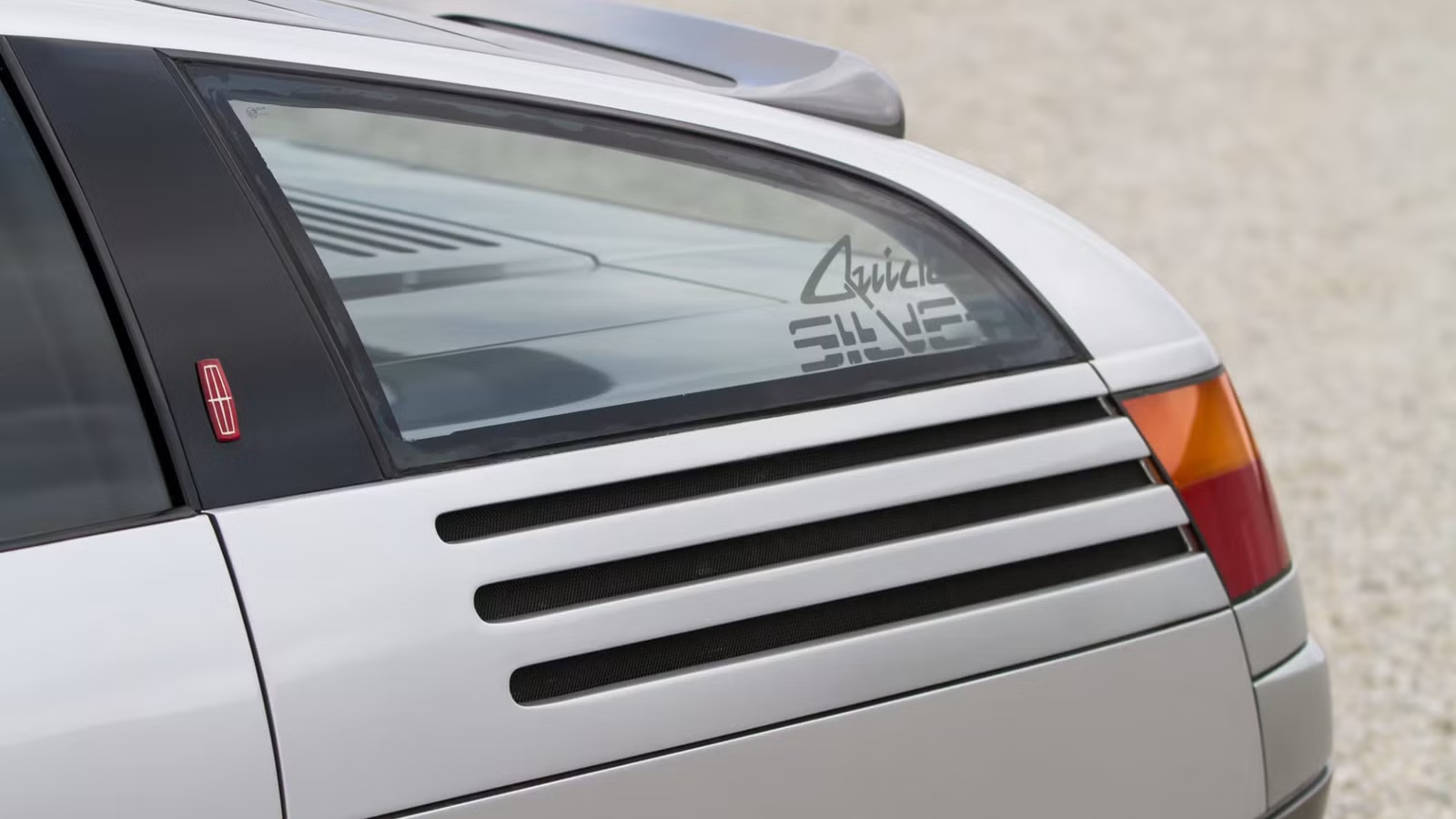
Enter the Quicksilver — one of the wildest concept cars ever produced by an American manufacturer. Ford tapped its Italian subsidiary, Carrozzeria Ghia, to create this attention-grabbing design during a period of heavy aerodynamic experimentation. Wind tunnel testing yielded an impressive 0.30 drag coefficient, but the resulting shape was genuinely bizarre: part Citroën wagon, part insect, with an elongated greenhouse resembling a queen bee’s abdomen wrapped in sheetmetal. The monochromatic interior continued the otherworldly theme with radial, aircraft-inspired elements straight out of a science-fiction film.
While too radical for production, the Quicksilver’s aerodynamic lessons directly influenced the Ford Probe, which would achieve commercial success. Yet the wild bodywork was only half the story — what lay beneath proved equally fascinating.
What’s Underneath The Lincoln Quicksilver’s Skin

Concept cars typically aren’t built from scratch. They often utilize chassis components from existing vehicles that suit the basic dimensions of what the designers are going for. In the case of the Quicksilver, Ghia leveraged Ford’s close relationship with British manufacturer AC to source the chassis from the 3000ME.
That chassis was stretched by 11 inches so the interior could comfortably accommodate five passengers — and an engine mounted in the middle. That’s right: the Quicksilver’s engine bay sits just ahead of the rear wheels, which almost certainly explains why the car’s rear half looks so bulbous. And since the engine wasn’t under the front hood, it’s presumed that the cooling components live up front, drawing cool air through the grilles and vents.

You might expect a flashy engine to match the insane exterior, but Lincoln kept it simple with a 2.8-liter V6 — after all, it was just a concept, and the V6’s main job was probably moving it in and out of trailers and into event venues. Built in 1983, the engine was likely a Ford Cologne V6, similar to the unit used in the Ranger at the time, suggesting output somewhere in the range of 115 to around 150 horsepower.
The highlight of the powertrain, though, was the transmission — a five-speed manual unit that, if you look closely at the interior photos, featured a gated shifter bezel: yet another distinctly Italian touch.
What Happened To The Quicksilver

The Quicksilver represented one of Ford’s earliest fully streamlined concepts, embracing futuristic design principles even before the groundbreaking first-generation Ford Taurus reshaped American automotive styling. Yet when the 1983 Geneva Motor Show arrived — a venue known for showcasing radical experimental vehicles — Ford mysteriously kept the Quicksilver hidden. According to Mecum, executives deemed the design too extreme even for an audience accustomed to cutting-edge concepts.
Ford finally unveiled the Quicksilver to the public in 1986, strategically timing the reveal after the Taurus had already debuted and demonstrated that aerodynamic design could succeed in the marketplace. However, this three-year delay proved fatal to the concept’s prospects. Any possibility of production development had evaporated during the wait. The vehicle, officially designated the Quicksilver Ghia, quietly slipped into automotive obscurity — another ambitious concept consigned to the archives rather than the assembly line.

After its public debut in the mid-1980s, the car embarked on an extended tour of Europe, attending events and showcasing the design language Ford had by then brought to its production lineup. It remained in Ford’s concept car collection for years until it was auctioned off to a private buyer in 2002, selling for $45,825.
It’s especially rare to see concept cars — ones not approved for legal road use, it should be noted — sold to the public at all. When it does happen, these cars typically disappear into collector warehouses and private storage. Evidently, this owner had other ideas. According to Autoweek and Mecum, the Quicksilver made a further pair of appearances: at the Concours d’Elegance at Cranbrook in 2004, and again at the Greenwich edition of the same event in 2005, where it was displayed alongside other 1980s concept cars.
But arguably its highest-profile moment came in 2014, when it crossed the block once more at Mecum’s Kissimmee auction. Understandably, the Mecum crowd wasn’t particularly interested in a car you can’t register, and it sold for what feels like an insultingly low $27,000. That was the last public appearance we could find of the Quicksilver — but here’s hoping it surfaces again someday, smooth lines and all.

Related posts





Latest Post


No Comments