The 350-HP German V8 Seven-Seater Selling For Used Camry Money
8 minutes reading
Wednesday, 16 Sep 2026 17:30 0 6 autotech
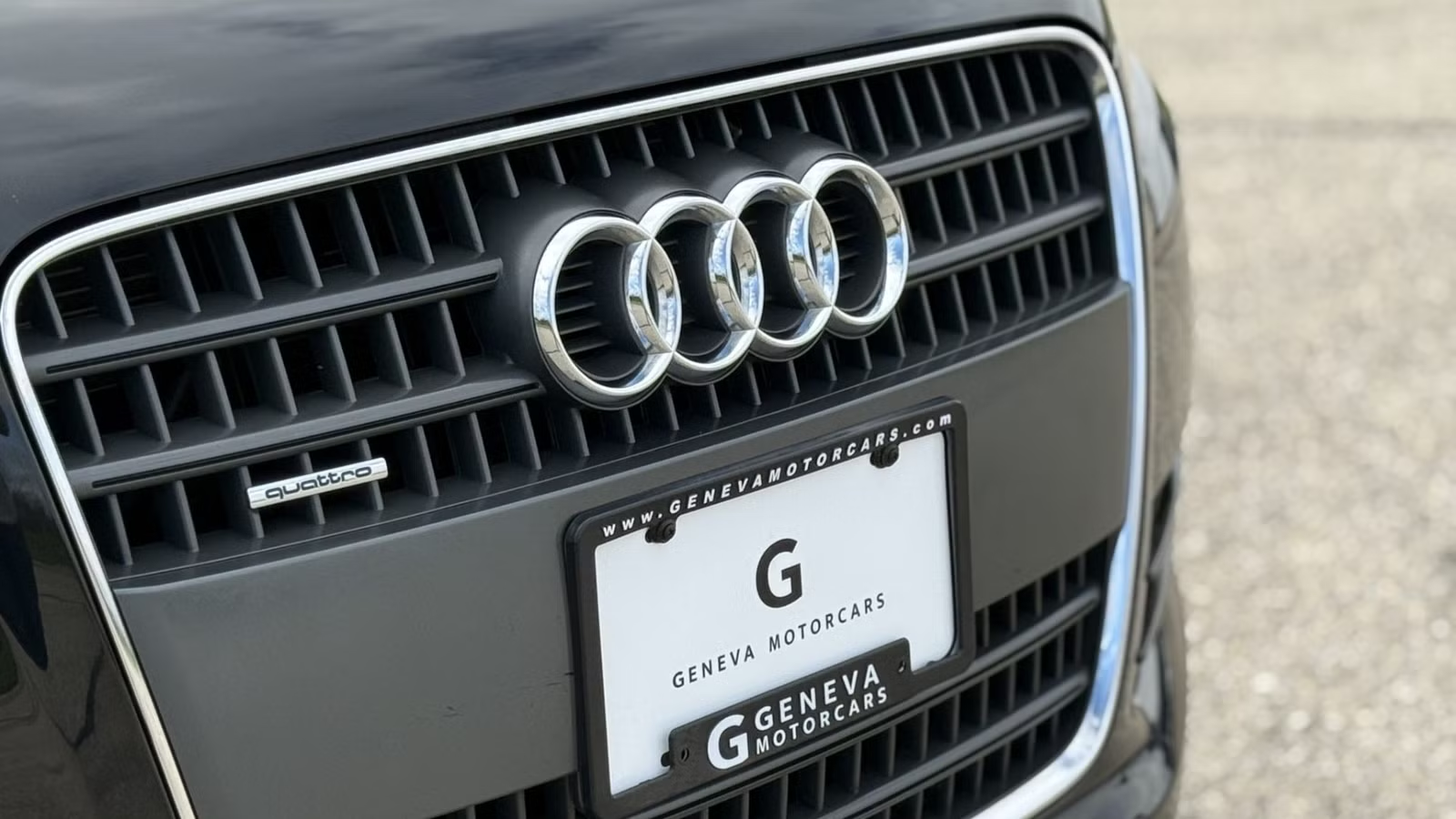
There’s a sort of cognitive dissonance that happens when you decide to buy a German-made seven-seater powered by a V8 engine for the same price as a high-mileage economy car. This isn’t just a hypothetical, either. On July 28th, 2025, somebody purchased a 2008 Audi Q7 with 43,000 miles for $15,251. It’s powered by a 4.2-liter V8 and, by all 83-plus pictures, seems like it was in pretty good condition at the time of sale.
To be completely honest, nobody is cross-shopping a nearly 20-year-old three-row luxury-sport family SUV with a used Toyota Camry. Then again, you could be! This also goes to show that there’s an entire generation of luxury SUVs that have fallen off the market and come in at an affordable rate. The first-generation Audi Q7 isn’t perfect by any means, but it just goes to show that you can find a bargain anywhere if you’re really looking for it.
A $15,000 German V8 With 43,000 Miles: The Case Against The Safe Choice
A front 3/4 shot of a blue 2026 Hyundai Venue parked insie a hangarHyundai
The price tag of $15,000 used to be able to get you a brand-new car. Now, there aren’t many cars under $20,000 anymore, if any. The closest you can get is a Hyundai Venue. At this point, $15,000 is a sweet spot for the used market. You can either get a higher-end subcompact SUV, a middle-tier SUV, or a well-outfitted Camry for that kind of money. That’s why the price of this Audi is so incredible. According to Kelley Blue Book, you could even pick up one for a fair purchase price of $5,350.
The first-generation Audi Q7 came with two different powertrains that look a lot different from today’s base four-cylinder and top-of-the-line V6. The first engine is a naturally aspirated 3.6-liter V6 that produces 280 horsepower. We’re not here for that engine, however, because the real steal is the much brawnier, naturally aspirated 4.2-liter V8 FSI engine. This engine produces 350 horsepower and 325 pound-feet of torque. According to Edmunds, it gets up to 60 MPH in seven to 7.4 seconds. It has a rear-wheel-drive-biased Quattro all-wheel-drive drivetrain and a six-speed automatic transmission. With upgrades, it can tow up to 6,600 pounds.
Audi is best known for its engines and its drivetrains. The brand used to put unapologetically large V8s and even straight-five cylinders in its cars. Not diminishing their engines of today, but there were some big players back then. This new generation brought changes not only to the body itself, but also to the engine. Audi switched from port injection to direct fuel injection.
Again, not a new concept, but a more efficient one. This engine also prioritized low-end torque for heavier duty SUVs like the Audi Q7. FSI stands for Fuel Stratified Injection and features four valves per cylinder. Spraying fuel directly into the cylinder dramatically increases the compression ratio to 12.5:1.
A 43,000-Mile Auction Sale Proves These Deals Are Real
2008 Audi Q7 Front 3/4 angleBring a Trailer
Nobody really wants to touch first-generation luxury cars, especially if they are the first or second model year. It basically makes these cars invisible on the market. The $15,251 deal on Bring a Trailer isn’t an anomaly either. Do a search for an Audi Q7 on Google, and you’ll find that they really do range from $5,000 up to $15,000, depending on varying factors.
This is considered the “hidden in plain sight” theory. It’s not a fashion symbol, and it’s not trendy. It doesn’t have the nostalgia piece to balloon the pricing like a Ford Bronco, for example. What it does have is a robust powertrain and decent tech for the time. But if these deals are real, why aren’t more people jumping on them? The answer starts with what nearly 20 years of German complexity does to a car — and your wallet.
How A $96,000 SUV Became A $15,000 Buy
2008 Audi Q7 Back 3/4 angleBring a Trailer
Of course, this generation Audi Q7 is most definitely not without its faults. Half, if not the main, reason this is selling for well under what it originally cost (about $96,000 in today’s money) is its faults. First and foremost, anything that is technologically complicated and closing in on 20 years old is going to have a myriad of system failures, whether mechanical or otherwise. There are also some market forces at play, like the oversaturation of luxury or near-luxury SUVs, and with so many of them available for sale right now, there’s just not that much demand.
Timing Chains, Oil Consumption, And The Hidden Costs Of German Complexity
2008 Audi Q7 InteriorBring a Trailer
The Audi Q7 has a number of issues, including timing chains and tensioners that need to be replaced, which are almost impossible to service yourself due to their location. Not to mention, both the V6 and the V8 FSI are known to consume not only gas but also oil, especially when coupled with vacuum leaks. There are also battery, electrical, and air suspension problems, not to mention the poor fuel economy, with 12 MPG in the city and 17 MPG on the highway. The depreciation of the Audi Q7 goes from 57.2 percent in about five years, with it dropping even more significantly within 10 to 13 years by an average of 80 or more percentage points.
A New Q7 Starts At $63,000 — That’s A $48,000 Case For The Used Market
2008 Audi Q7 HeadlightBring a Trailer
The 2027 Audi Q7 is entering an all-new generation with an all-new look. A brand-new 2026 Audi Q7 has a starting MSRP of $63,395 and can get up to $83,790. That’s a nearly $48,000 difference between the turbocharged four-cylinder base model of the current generation and the much more powerful V8 from 2008. Sure, you might end up spending a lot in terms of maintaining it, but if you’re okay with having older tech, you’re not going to end up spending $48,000 in fixes, and that, at least, might make the decision easier.
The Features That Still Make The First-Gen Q7 Worth Considering Today
2008 Audi Q7 Back head onBring a Trailer
Yes, 2008 was almost 20 years ago. We can’t believe it either, but just because these vehicles are almost 20 years old doesn’t mean their technology should be discounted. Audi engineers at the time loved to overengineer the Q7 and provided it (especially the top-of-the-line trims) with ample features.
The 4.2 Premium specifically had a seven-inch display with DVD navigation, a 14-speaker Bose sound system, and Sirius XM satellite radio. It also came with a power liftgate, a four-zone automatic climate control system, and an adaptive air suspension. Although not entirely new at the time, these features were at least incredibly advanced: adaptive cruise control, a backup camera, and blind-spot monitoring.
Looks That Could Kill (Pricing)
2008 Audi Q7 Side ProfileBring a Trailer
The current generation Audi Q7 looks pretty good objectively. It has more defined lines inside and out, and looks sharp. The next generation, coming out in 2027, is going to be the best and most distinctive it has ever looked, with its squared-off front end and ultra-luxurious interior (even though it has been compared to the last-generation Hyundai Santa Fe). The first-generation Audi Q7, on the other hand, looks very much like any ordinary crossover SUV. It’s round, it’s unassuming, and it’s just there. The fact that it doesn’t have anything trendy or noticeable, and doesn’t carry as much clout, has helped keep its pricing low.
What Your Playbook Should Be
2008 Audi Q7 Front 3/4 angle close upBring a Trailer
Would we suggest buying these? Yes and no. It’s really dependent on what you can handle, not only from a financial standpoint, but also mechanical. Interestingly, J.D. Power does stretch back to the 2008 model and gave the Audi Q7 a fairly average score: 77 out of 100 overall and 75 out of 100 for quality and reliability. That’s on par with some luxury crossover SUVs currently. Your best bet would be to spend a bit more money on something that has lower mileage, but that goes without saying for any used car.
What Does $15,000 Actually Get You?
2008 Audi Q7 WheelBring a Trailer
In all honesty, you would be better off buying a $15,000 Toyota Camry. They’re far more reliable and will last you much longer. However, if you want something luxurious, need to haul five or more people, and potentially tow more than 4,000 pounds, then definitely go for it. Just be forewarned that the average annual cost of maintenance, according to RepairPal, is $879. Furthermore, the likelihood of something catastrophically failing is much higher the older they get. If you can look past these issues, then don’t let us stop you.











No Comments