
Volkswagen Gave Its Biggest Two-Row SUV The Engine Tune It Always Needed
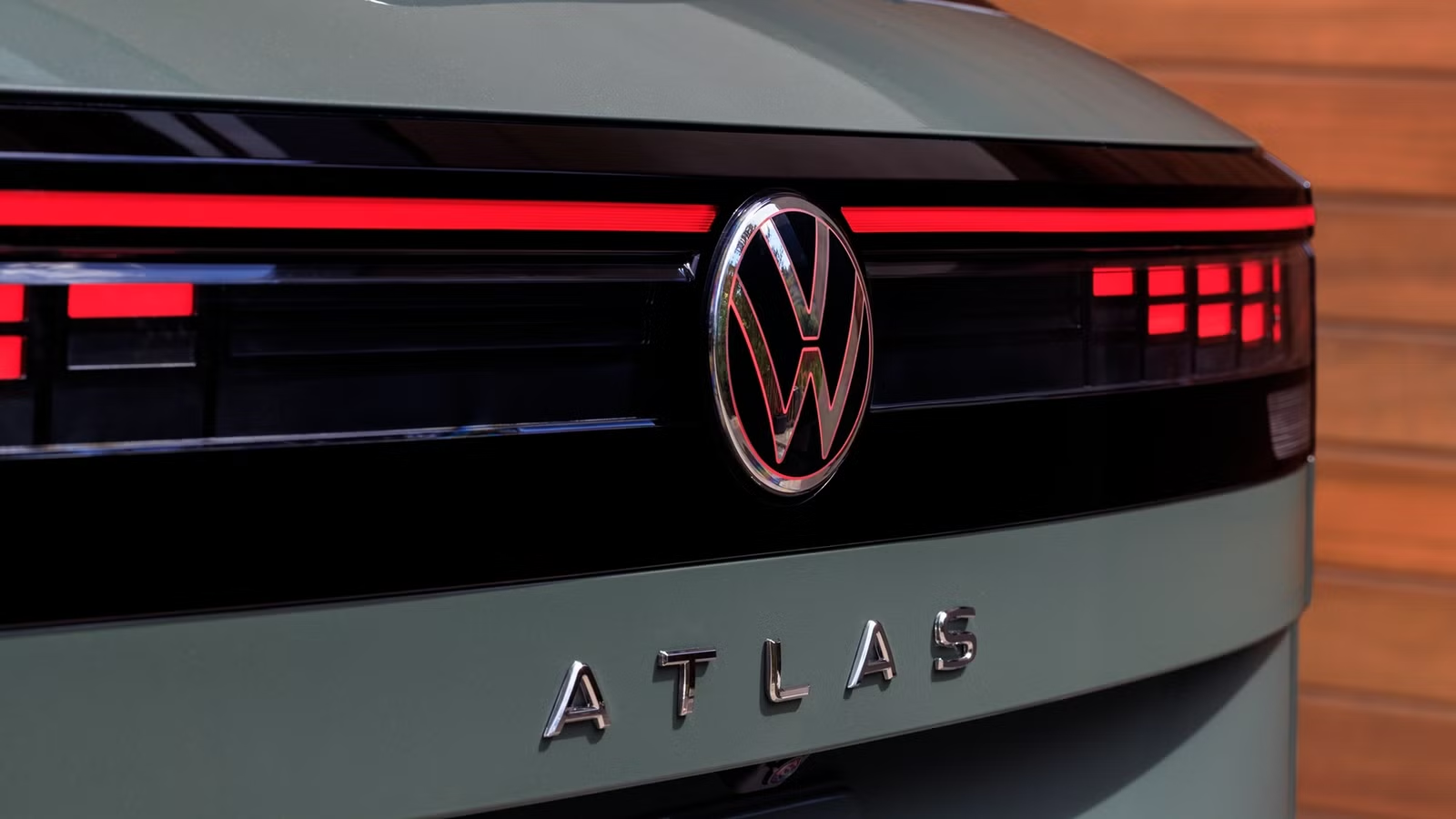
The midsize two-row crossover segment is a unique compromise, yet buyers are often forced to choose between two extremes: boxy appliances that deliver no driver engagement or car-styled SUVs with underpowered engines and heavy curb weight.

Volkswagen’s flagship two-row crossover has sat right on the threshold of segment leadership, with aggressive proportions and lots of second-row space. The only thing holding it back was performance, but that will change soon, as Volkswagen has announced a drastic change for the 2027 model year.
The Right SUV With The Wrong Heart
When Volkswagen first launched its two-row SUV, the overall package felt impressive. It was built on the long 117.3-inch wheelbase it shared with its three-row cousin, giving it an aggressive, wide-track stance. The MQB Evo chassis had a multi-link suspension layout with the classic firm damping German cars are known for.

On paper, the car sounded fine, but once you got out on the road, the story changed: the powertrain calibration didn’t match the chassis’ dynamic ability. The issue wasn’t a lack of power or torque, but how the electronic throttle mapping and transmission software managed the power delivery.
The factory throttle curve had a noticeable dead-pedal zone at the start of pedal travel. When the driver pressed the accelerator, nothing happened for a brief moment, which led the driver to press the throttle even deeper. The engine control unit interpreted that delayed input as a demand for maximum power, forcing the eight-speed automatic gearbox to drop two or three gears at once. The result was a jerky, unrefined surge of high-rpm noise and unwanted acceleration, which made daily driving frustrating.
The Problem Of Lag In A Modern Turbocharged SUV

Daily commuting became a chore, which is supposed to be the main purpose of an SUV like this: Maintaining highway speeds required constant throttle modulation. Because the engine’s torque curve peaked late, the transmission kept searching for a gear, which made the experience unpleasant.
To solve this problem for the upcoming 2027 model year update, Volkswagen targeted the root cause—turbo lag—by allowing instant access to low-RPM boost, instead of increasing the fuel rail pressure or adding a larger fixed-geometry turbocharger. Volkswagen even replaced the outgoing power unit with a 5th-generation EA888 evo5 architecture.
With the new engine block, engineers rewrote the transmission control unit, shift software, and electronic throttle response curves. By eliminating artificial dead pedal travel right off the line, the new calibration lets the 8-speed automatic hold higher gears and ride early torque curves rather than downshifting under mild accelerator inputs, providing a smoother driving experience.
The 2027 Volkswagen Atlas Cross Sport Finally Gets It Right

Scheduled to hit the roads in early 2027, the second-generation Volkswagen Atlas Cross Sport focuses on addressing its historical weaknesses with the 5th-generation EA888 evo5 turbocharged 2.0-liter inline-four engine, equipped with a variable-geometry turbocharger.
This upgrade increases output to 282 horsepower at 5,000 rpm, a 13 hp bump over the outgoing model, and a strong 258 lb-ft of torque available from 1,600 to 4,500 rpm. This power is delivered through an 8-speed automatic transmission to the all-wheel drive system; the SUV retains a robust 5,000 pounds of maximum towing capacity.

The variable-geometry turbocharger is a key mechanical advancement. This setup uses movable internal vanes inside the turbine housing that can greatly alter exhaust gas velocity to spool the turbo instantly; the vanes can open and close to provide linear power throughout the rev range, all the way to the redline.
The mechanical evolution of the Atlas Cross Sport is paired with an equally modern interior layout, delivering a comfortable, refined cabin experience. Notably, the gear selector has moved to a column-mounted stalk, freeing up center-console space for dual wireless phone chargers with magnetic grippers, cupholders, and a multi-function Driver Experience dial for audio controls and drive modes. Standard equipment includes a 10.25-inch Digital Cockpit Pro instrument cluster and a standard 12.9-inch center touchscreen.
Real-World Usability Replaces Daily Frustration

While official media drives will begin closer to the SUV’s early 2027 release date, the hardware and software revisions point to a fundamental shift in the SUV’s dynamic execution. Now, stepping on the accelerator should be smoother, without the dead zone or sudden surge that concerned owners in previous models.
A linear pull with the right throttle input and access to all 258 lb-ft of torque at 1,600 rpm, without abrupt gear changes, should make every day pull-aways feel effortless. Out on the highway, things should be improved as well; the 30-to-60 mph roll-on acceleration should no longer require you to bury the throttle to the floor to get going. The TCU is specially programmed to hold higher gears during highway incline climbs and ride the torque wave rather than hunting for lower gears.
The new 2027 Atlas Cross Sport also promises improved cabin acoustic isolation, as lower operating speeds eliminate harsh high-rpm powertrain noise. The acoustic glass should also effectively block out ambient wind and road noise.

At the back, space is plentiful, as the Atlas Cross Sport shares the same wheelbase as the full-size three-row Atlas, minus the last row. Pushing the 60/40 split-folding rear bench all the way back yields an extra 40.4 inches of legroom, giving passengers genuine stretch-out space. Despite a slight slope to the fastback roofline, the seats are positioned to provide almost 38 inches of headroom.
Even in the cargo compartment, the Atlas delivers impressive utility for active lifestyles. The cargo area provides over 40 cubic-feet of dedicated space with the rear seats upright, easily accommodating full-size luggage. Folding the 60/40 bench expands the total capacity to 77.6 cubic feet. An easy-open, hands-free power liftgate further enhances daily usability.
The New Benchmark For Two-Row Crossovers

The Atlas will be available in four primary trims: SE, SE with Technology, SEL R-Line, and SEL Premium R-Line. The upgrades to performance and interior give the Atlas Cross Sport new life in the midsize two-row segment. Rivals like the Honda Passport still have a naturally aspirated engine.
Other competitors use a fixed-geometry turbocharger, making the 2027 Atlas Cross Sport a step ahead in power delivery. Instead of chasing horsepower numbers with a larger, laggy turbocharged experience, Volkswagen has invested in refining and solving a long-standing drivability flaw.
By aligning the SUV’s mechanical traits with its aggressive design, Volkswagen is poised to take on the competition with an uncompromised package and a starting MSRP of $41,610. The 2027 Atlas Cross Sport aims to set a high standard for the two-row crossover when it hits the roads, with deliveries beginning in early 2027.
Source: Volkswagen

Related posts






Latest Post


No Comments