
The Plastic-Doored IH Oddball That Out-Hardcored The Jeep CJ And Won Baja
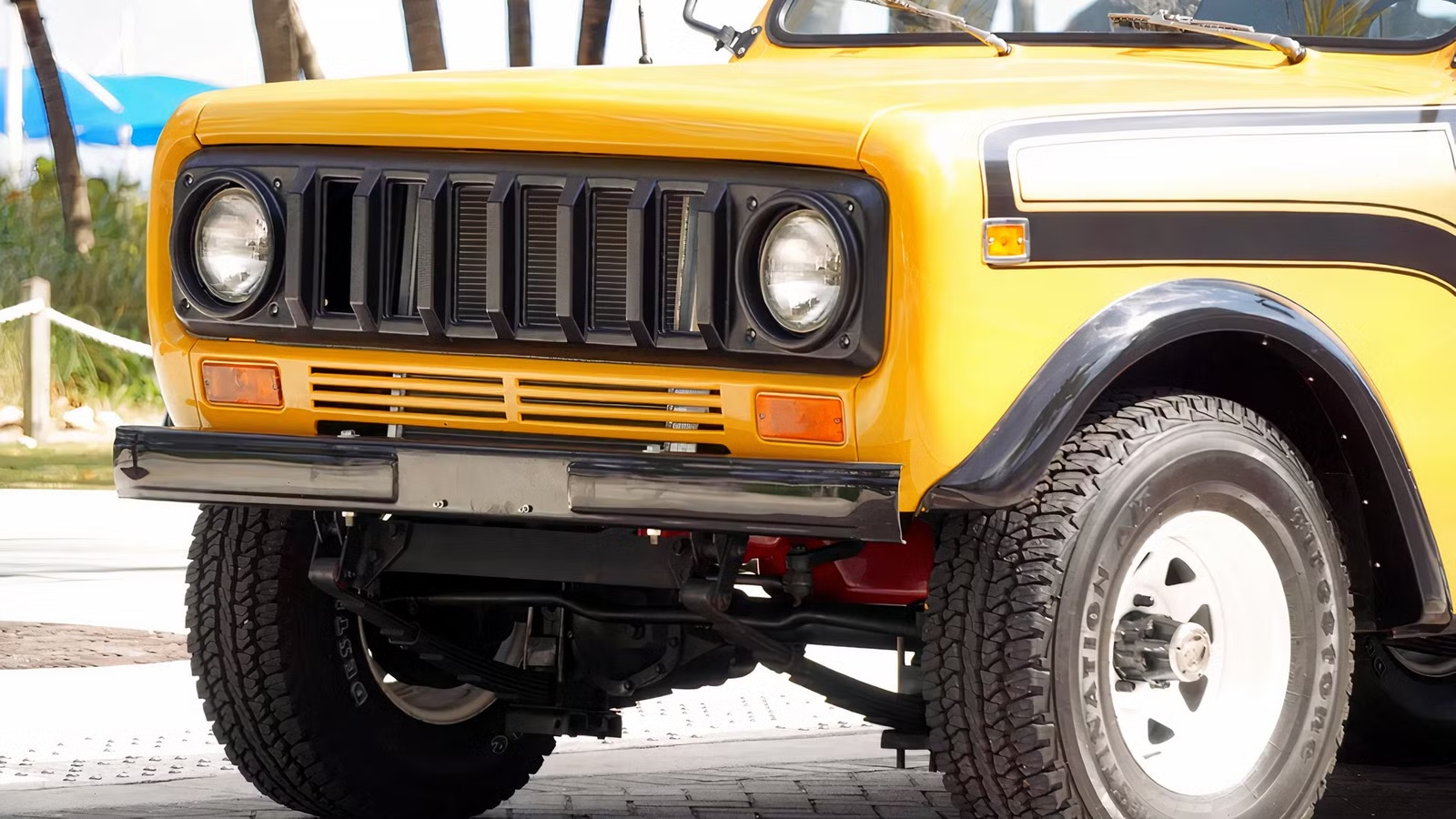
Joy of joys, the classic International Harvester Scout of legend is coming back from the dead. Well, not quite, it’s actually a VW IP now, and powered by electric motors, with or without a gas range extender, at that. Looking at what Volkswagen has done to the new and improved Scout Motors brand, you’d be forgiven for forgetting what kind of roots the first incarnation had. In the beginning, the Scout brand was anything but sophisticated, and that made it exceptionally capable at doing truck work. Even then, some classic Scouts, and particularly the larger Scout IIs, were more special than others.
The Scout II: A Different Breed of Off-Roader

Let’s paint the scene: it’s roughly the mid-to-late 1970s, the American 4×4 market is saturated with Jeeps, Broncos, and K5 Blazers from monolithic automakers so massive they influence the national GDP. You’d think there wasn’t room for competition in a market segment that was so overtly saturated. Instead, International Harvester practically thrived in this environment. Using a 100-inch wheelbase shared between the Scout II and the original Scout 80/800, International Harvester was able to cover vast amounts of ground within the larger off-roader segment.
With International Harvester’s relatively small footprint from its Chicago headquarters, the company simply couldn’t survive a head-to-head slugfest with Detroit’s Big 3 OEMs. But what they could indeed do with its rugged body-on-frame chassis, heavy-duty axles, and beefy leaf-spring suspension was build something considerably tougher than the competition. In short, it was an agricultural vehicle disguised as a rough facsimile of a full-size SUV. Out of their factory in Fort Wayne, Indiana, the Scout II left the floor with everything from an AMC straight-six to 4- and 6-cylinder gas engines of their own design, plus the same Nissan diesels you’d find in the tough-as-nails Patrol.
In effect, the Scout II was everything a Jeep CJ-5 was, but with an entirely different mechanical makeup. On the subject of the old Jeep CJ, they were often best served without doors, a rag-top roof, and with as little weight to lug around as possible. It was a formula International Harvester was eager to replicate, but in a way that distinguished itself from Jeep in a meaningful way. To do that, International Harvester had to get smart and get creative. Without the backing of a giant OEM behind them, they really didn’t have a choice.

Taking the Scout II Up a Couple of Notches

Knowing the Jeep CJ owners couldn’t care less about tinsel and luxuries, International Harvester was free to go in an equal and opposite direction with a jazzed-up Scout II. With this in mind, IH designer Dick Hatch decided the best approach was to strip as much weight as possible and market the updated vehicle to serious off-road enthusiasts. Working under the prototype designations “Mountaineer” and “Sidekick,” Hatch and his team took the heavy steel doors of a standard Scout II and deleted them outright.
In their place was a set of door inserts made from injection molded ABS plastic. A marvel of post-war developments in consumer plastics, ABS is still popular today in consumer electronics like keyboards and power tools. With serviceable resistance to minor dings and scratches, the first automobile to use ABS body panels was actually the Citroën Méhari utility vehicle. Now, International Harvester was about to use the same tech to shed hundreds of pounds of weight off the Scout II.
In lieu of a metal roof, a rag-top and roll-bar arrangement was integrated into the Scout II’s body. Gone were the carpets, replaced by an easy hose-off vinyl floor and water-resistant bucket seats. The same heavy-duty suspension and rugged four-wheel-drive system was still intact, just as potent and capable as a Jeep or Bronco. Except this time, the Scout II had hardly any weight to lug around. It was as pure an off-roader as existed in the late ’70s, and it was about to hit dealership floors with a bang. Well, at least at first it did.
The Scout II Super Scout II: A Hardcore Off-Roader

Compared to the standard fare at the average IH dealership, the Scout II SS II (Super Scout II) was visually very different indeed. With a base MSRP of just over $5,000, the larger Scout II was still priced competitively compared to the equivalent stripped out Jeep. Under the hood, IH still offered commuter-spec four-pot engines at the entry level. Even so, the company heavily incentivized a 304-cubic-inch V8 making 144 horsepower and massive amounts of torque. Further up the range, the flagship 345-cubic-inch V8 produced 163 hp and nearly 300 lb-ft of torque.
In the post-oil-crisis years, that was actually quite decent power. With Dana transfer cases and solid axles, the Super Scout II arguably had even worse road characteristics than the base vehicle. Suffice it to say, all that sacrifice paid dividends out in the sticks. Over seven inches of ground clearance on stock tires was pretty darn impressive, even if the number doesn’t jump off the page nowadays. It beat out the equivalent CJ-7 by over half an inch, no small margin when you’re traversing rutted hills or navigating rocks and boulders.
Not to be outdone by themselves, International Harvester teamed up with Hurst, the same team behind some of the most famous classic Mustangs, to make the Super Scout II even more impressive. Dubbed the Shawnee Scout prototype, it featured a custom targa roof and special graphics packages. Elsewhere, intimidating options package names like “Brush Buster,” “Rancher Special,” and “Baja Cruiser” were about as aggressively named as you could get in those days. On the subject of Baja racing, the Super Scout II was a master of the discipline, as was showcased in one of the most intense off-road races on any calendar.
Blitzing the Baja 1000 Like a Champ

In a proverbial sea of performance off-roaders from across the spectrum, International Harvester sought to test its mettle in the 1977 running of the famous Baja 1000 race in Mexico. With off-road racing legend Jerry Boone behind the wheel, the SSII went toe to toe with factory-backed Jeeps, Broncos, and K5 Blazers in the SCORE-sanctioned race. With Boone at the helm, the Super Scout II absolutely blitzed the competition, finishing first in its class and beating out the second place Jeep CJ-7 by a scarcely believable two hours plus.
At a time when International Harvester was beginning to lose the fight against the Big 3 on the road-vehicle side of things, Boone’s victory proved there was still room for one more in the fold. Moving forward, International Harvester would see its influence in the market wane even further. The Scout line that birthed the Super Scout II in the first place ended production in 1980, along with the rest of the brand’s passenger vehicles, in an effort to restructure its business model.
The whole operation would be defunct by 1985, reorganized as Navistar International Corporation, makers of everything from long-haul trucks to coach buses, school buses, and military vehicles. Today, the company operates under International Motors, far removed from what it was all those years ago when the Super Scout II was in its prime.
Let This be a Lesson for Scout Motors

The Super Scout II couldn’t be more removed from its spiritual successor of the 2020s, even if one tried. Out of its all-new production facility in South Carolina, Scout Motors claims it can build up to 200,000 vehicles per year, or around 40 an hour. Assuming the math is correct, it means they could build the Super Scout II’s entire production run of 4,000 vehicles in roughly a week at scale.
Nowadays, totally untouched, numbers-matching Super Scout IIs are collector’s items worth anywhere from $19,000 to $40,000, depending on the specifics. For some context, the new Scout Traveler SUV is set to run you around $60,000 for a base model. Now that right there is economic inflation in a nutshell, seen through the lens of the humble off-roader.
Source: Bring a Trailer, Scout Motors

Related posts


Latest Post


No Comments