
The 448-Unit Ferrari V12 Roadster Collectors Are Still Sleeping On
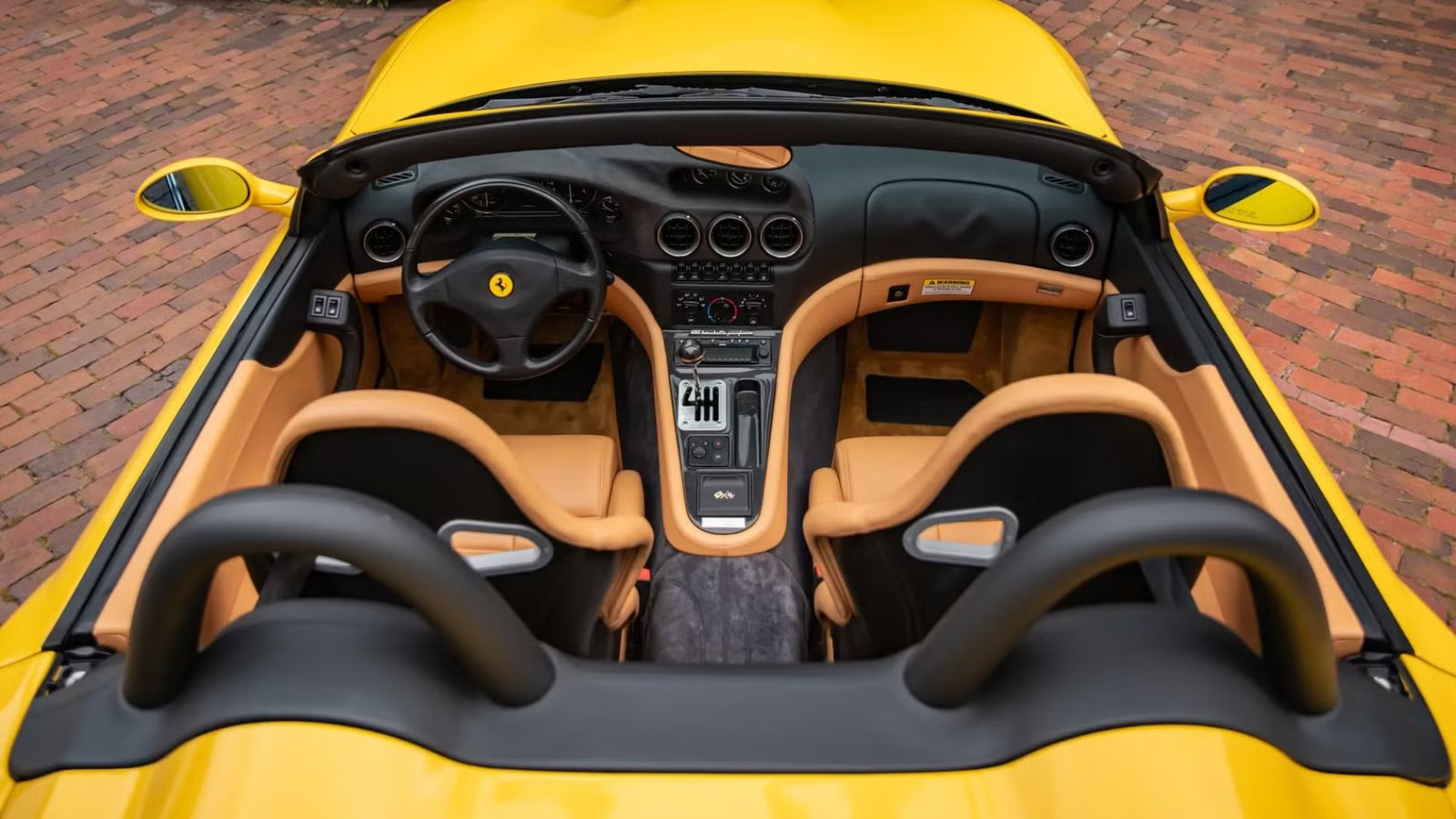
Picture yourself at 100 mph with nothing but a shortened windscreen between you and the sky. Your right hand rests on a chrome gated shifter, and twelve naturally aspirated cylinders sit ahead of the firewall, pulling hard toward a 7,000 rpm redline. There is no roof above you, and there is no roof stored anywhere in the car either.

This is the last Ferrari to combine a front-mounted V12, rear-wheel drive, and a true mechanical open-gate manual in a factory roadster. Fewer than 450 were ever built. Yet somehow, the auction spotlight keeps landing on other cars.
Three Ingredients Ferrari Will Never Combine Again
Three ingredients define this roadster: a naturally aspirated V12 mounted up front, drive sent only to the rear wheels, and a six-speed manual with an exposed metal gate connected to the gearbox by actual mechanical linkage. Ferrari just reminded everyone how extinct that combination is with the new 12Cilindri Manuale, a 1,499-unit special whose gated shifter and clutch pedal are electronic simulations wired to a dual-clutch automatic. Maranello can imitate the experience now, but it no longer builds the real thing.


The lineage here matters as much as the hardware. This was the first open-air, front-engined V12 Ferrari since the 365 GTS/4 Daytona went out of production in the 1970s. That makes it the direct heir to one of the most celebrated bloodlines in the company’s history, revived after a gap of nearly three decades.
Ferrari knew exactly how special the formula was, and it never offered the car to the public. Like every limited edition Ferrari, every single example was spoken for before the first one rolled off the assembly line, with allocations reserved for Ferrari’s most endeared clients. Here is the strange part, though: this car’s defining flaw is exactly what makes it so collectible today, and it involves the roof it barely has.
The Ferrari 550 Barchetta Pininfarina Was Born Of A Superstition

The car is the Ferrari 550 Barchetta Pininfarina, unveiled at the 2000 Paris Motor Show. Ferrari built it to celebrate the 70th anniversary of Pininfarina, the styling house behind nearly every great road car the company had produced since the 1950s. Production was strictly limited to 448 numbered examples, and the last one left the factory in December 2001.

That 448 figure comes with the best piece of trivia in the car’s entire story. Ferrari originally planned to build 444 units, but the number four is considered deeply unlucky in Japan, one of the brand’s most important markets. Rather than risk offending superstitious customers, the factory simply added four more cars to the run.
Ferrari described the Barchetta as a deliberate and provocative departure from the rest of its lineup at the time. The design echoed the company’s open-top legends, drawing inspiration from the 166 MM, the 250 GT California, and the 365 GTS4 Daytona. Every car received an individually numbered interior plaque signed by Sergio Pininfarina himself.

The changes from the 550 Maranello coupe went well beyond a missing roof. The windscreen was cut down by roughly four inches, giving the car its distinctive low-slung profile, while twin fairings rose behind the seats. The Barchetta also gained two-piece alloy wheels, an aluminum fuel-filler door, racing seats as standard equipment, and a restyled trunk that was actually larger than the coupe’s.
The Factory Roof Was Never Meant To Be Used

Ferrari shipped every Barchetta with a manual cloth top, but calling it a roof is generous. It was a temporary cover meant only to protect the interior from rain, and Ferrari did not consider it safe to use above roughly 70 mph. Owners reported that it takes two people and considerable patience to install, which explains why many examples have never worn it at all.
The useless top was actually a deliberate engineering choice. By skipping a proper folding roof mechanism, Ferrari offset the weight of the additional chassis bracing the open body required. The result was a curb weight identical to the 550 Maranello coupe’s.

Owners who wanted to drive their cars year-round eventually took matters into their own hands. German firm Michalak developed a replacement soft top with metal components produced by a Ferrari-approved workshop in Modena, rated for far more usable speeds.
Separately, original owner Helmut Nossek commissioned a TÜV-approved carbon-fiber hardtop that fits the car without any modification, simply because he wanted to use his Barchetta in all weather.
That cottage industry has now become part of the car’s collector identity. Specialist listings routinely advertise the factory soft top and a Michalak roof together as selling points, treating the aftermarket fix as essential provenance rather than an admission of failure.
The Barchetta Kept Every Ounce Of The Coupe’s Performance

Mechanically, the Barchetta gave up nothing to its closed roof sibling. The 5.5-liter naturally aspirated V12 carries over unchanged, producing roughly 480 horsepower at 7,000 rpm and 419 lb-ft of torque at 5,000 rpm. The engine received the F133C code purely to differentiate it from the coupe’s unit, not because anything inside was altered.
Power reaches the rear wheels through a six-speed manual transaxle topped by Ferrari’s signature exposed metal gate. The Barchetta arrived during the final days of the open-gate manual, making it one of the last Ferraris where every shift ends with that unmistakable metallic click.
Because the emergency-only roof kept weight identical to the coupe, straight-line performance survived intact. The Barchetta hits 62 mph from a standstill in 4.4 seconds, matching the Maranello exactly and proving the chassis reinforcement came free of any performance penalty.

Top speed is a different story, and it reveals everything about Ferrari’s attitude toward this car. The coupe runs to 199 mph, while the roofless Barchetta tops out at 186 mph. Ferrari made no attempt to claw those miles per hour back with active aero or clever wind management, because the engineers simply chopped the windscreen, deleted the roof, and let physics handle the rest.
Why A $519,316 Ferrari Still Counts As Overlooked

Let’s be honest about the money first. Classic.com puts the average sale price at $519,316, which is serious wealth by any sane measure. But in the world of limited-production V12 Ferraris, that figure represents the entry tier, and that is precisely what makes this car interesting.
Consider the first half of the value equation. The Barchetta is more than 20 times rarer than the roughly 10,000-unit California that dominates used Ferrari convertible listings, and it already commands about 2.5 times the price of an equivalent-condition 550 Maranello, per Hagerty’s valuation data. The market clearly recognizes something special here.

Now consider the other half. The Barchetta still trails far behind Ferrari’s modern limited roadsters like the Monza SP1 and SP2, which trade in multi-million-dollar territory. Yet those cars can only imitate the front-V12, gated-manual, open-top formula that the Barchetta represents as a genuine final chapter.
The 2026 results suggest the gap is closing. A pristine example set a record of $1,265,000 at Mecum Kissimmee in January, followed by sales of roughly $640,000 at RM Sotheby’s Monaco in April and roughly $835,000 at Broad Arrow’s Villa d’Este auction in May.
Cars this mechanically unrepeatable rarely stay overlooked twice. The market’s hesitation is the opportunity, not the verdict.
Source: Ferrari, Classic, Hagerty, Mecum, RM Sotheby’s

Related posts



Latest Post


No Comments