
What Nissan’s VQ35 Proves About Old-School V6 Longevity
These days, due to ever-stricter emissions regulations and the constant need for improved performance with each passing generation, vehicle drivetrains have become a lot more complicated. No longer are you simply dealing with an internal combustion engine (ICE), but you’re also dealing with forced induction through turbocharging, supercharging, or both. And when you thought things were already complex, electrification suddenly comes into the picture. To be fair, many Japanese hybrid systems are mechanically simple, while there are manufacturers that make extremely complex hybrids, but that’s a story for another day.

Today, we’re going to be focusing on one of the most reliable ICEs of all time—the Nissan VQ35DE engine. This engine has a long history of awards and a strong reputation for durability. It is also known for its performance. The VQ35DE is part of the VQ family of engines with displacements ranging from 2.0 to 4.0 liters. The VQ35DE is one of the most popular of them all, and we’re here to explain why that’s the case and what it proves in today’s turbocharged and electrified world.
Nissan’s VQ35 History
The Nissan VQ35 series comes in two distinct families—VQ35DE and VQ35HR. For simplicity’s sake, let’s simply call the former the DE and the latter the HR. This article focuses mainly on the DE, but we’ll also briefly touch upon the HR. Beyond the letters, what exactly do they represent with these engines?
The VQ35DE Started It All


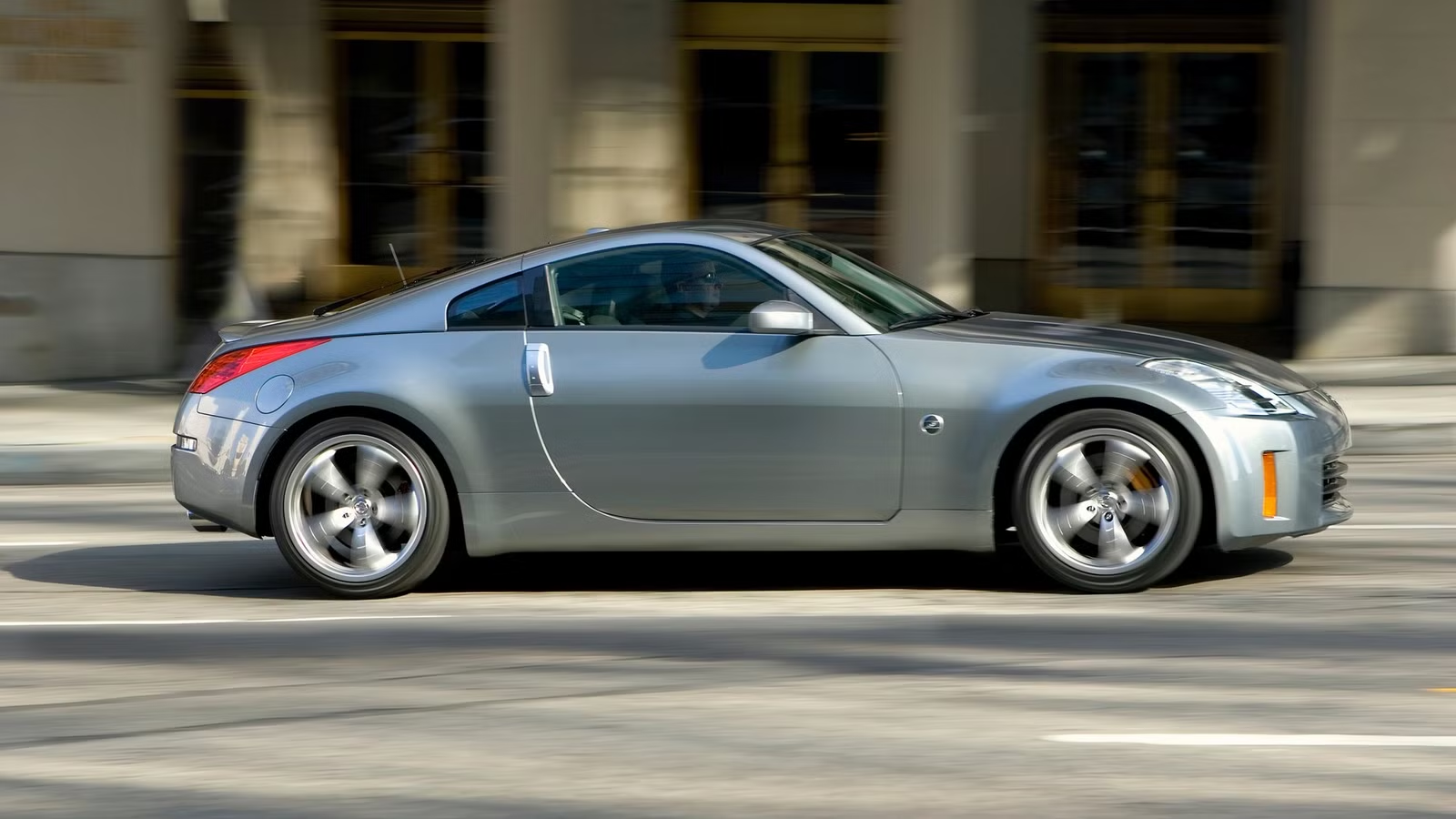
The Nissan VQ engine family was born in 1994, with the VQ35DE coming out in 2000. It’s the first in the VQ family to feature a 3.5-liter displacement. The VQ35DE was part of Ward’s 10 Best Engines from 2002 to 2006, highlighting the engine’s excellence. The VQ35DE rose to fame with the debut of the Nissan 350Z. The 350Z’s distinct growl that becomes raspy as the revs build up easily stood out from other V-6 engines, and still does today. The distinct engine sound is thanks to Nissan’s designated firing order for each of the six cylinders, along with its exhaust manifold and intake design.
Though it became famous due to the 350Z, it was used in countless other Nissan and Infiniti models, mostly in rear-wheel drive (RWD) configuration and a few front-wheel drive (FWD) and all-wheel drive (AWD) vehicles. These include the Nissan Murano, Pathfinder, Altima, and Maxima, along with the Infiniti G35, M (renamed to Q70), FX, and JX (renamed to QX60), just to name a few. The DE also has two subtypes, the Non-Rev-Up (until 2004) and the Rev-Up (2005-2006). Why this matters is that they feature different exhaust cams, primarily because the Rev-Up gets Nissan’s Continuous Variable Timing Control (CVTC) on both intake and exhaust cams.
The VQ35HR Built On Its Strengths

After the DE’s debut, it was succeeded by the HR. Around 80 percent of the HR’s components are new compared to the DE, and this allowed the engine to rev up to 7,600 rpm. This engine succeeds the DE in many vehicles, most of which are RWD or with a performance orientation. The HR engine also gets the Nissan Direct Injection system (NDIS) and CVTC. It was also used in hybrid applications, specifically the Infiniti Q50 Hybrid.
As you would expect, this engine was also part of Ward’s 10 Best Engines, wherein it received the award in 2007. The closely related VQ37HR with a 3.7-liter displacement also joined the list in 2008, though the 14-year streak that the VQ engine family enjoyed in the award would end with that engine until it reappeared in 2016.
What The VQ35DE Established In The 2000s

In the 2000s, almost every manufacturer was involved in designing a V-6. Those that were made by Japanese brands in particular had solid and even bulletproof reliability, and the VQ35DE was one of those engines known for robust reliability.
Design Choices That Built A Legacy

The VQ35DE’s reliability is attributed mostly to its construction choices. The VQ35DE didn’t just rise to fame solely for its reliability. As it powered an iconic sports car, the engine proved its performance credentials, too. That’s because the engine itself is incredibly tough, which is why it can support a host of modifications. The stock engine block, according to ThreePiece.us, is capable of handling substantial power gains when properly supported with other modifications. Furthermore, the VQ35DE also features three timing chains, which undeniably last far longer than timing belts.
As noted earlier, the VQ engine family was part of Ward’s 10 Best Engines for 14 consecutive years. Well, five of those 14 consecutive years (2002-2006) were for the VQ35DE. At the time, it first appeared in the then-new Nissan Altima. Bill Visnic, senior technical editor of Ward’s Auto World, says: “After driving the all-new Altima with the 3.5-liter VQ engine, we confidently say that the 3.5-liter VQ V6 improves on the attributes that made the 3.0-liter VQ one of the best V6 engine designs of all time.”
Real-World Longevity Beyond 200,000 Miles

With the engine already in existence since the early 2000s, we already have real-world data on how the engine has fared over the years. Indeed, this engine has already proven to last beyond 200,000 miles with just routine maintenance. Within that mileage, the VQ35DE can reach those numbers with just regular oil changes, keeping the cooling system in check, and monitoring the timing chain tensioner’s health.
Just to further illustrate the VQ35DE’s longevity, there’s a Reddit thread claiming to have the highest-mileage Z at 257,241 miles. Furthermore, here’s a Facebook thread showcasing owners of Nissans with the VQ35DE with very high mileage, and it’s pretty common to see G35s and 350Zs exceeding the 300,000-mile mark, too. Are you part of the high mileage club of owners of Nissans with a VQ35DE engine? Let us know in the comments.
Robust Power Versus Turbo Complexity

The VQ35DE is the perfect case study for making an engine that produces meaty and reliable power from a big displacement. As a result, this engine barely has any weak points, especially when you compare it to what Nissan has created that features turbocharging and downsizing.
The VQ35DE’s Minimal Weak Points

The VQ35DE doesn’t have a lot of mechanical problems—owing to its robust construction. Oil consumption is a known concern for these engines once they start hitting the 80,000-mile mark. The oil consumption can be due to an external leak or a clogged Positive Crankcase Ventilation (PCV) valve. The former may be due to worn out gaskets or seals, while the latter causes excessive oil vapor to be sucked into the manifold through the valve cover gaskets, spark plug tube seals, or any other part of the engine.
Other problems can include wear on the timing chain tensioner, as well as cooling system leaks and camshaft cover oil leaks. Furthermore, the crankshaft position sensor can also fail. As you’ll notice, none of these issues are catastrophic, and all of them are easy fixes, especially when caught very early. Just to set your expectations, RepairPal has determined that the Nissan 350Z may experience around $452 in annual repair costs on average. That’s low for any car, period, meaning that this engine is inexpensive and easy to maintain, whether in sports car or mainstream car applications.
The Complexity Of Achieving More With Smaller

As I always say in many of my articles here at TopSpeed, the simpler the vehicle, the more likely it is to last long. A turbocharger forces compressed air into the engine, which means more air in each cylinder, and this leads to more combustion in the cylinder. Automakers do this because it’s a cost-effective way to add power while improving fuel efficiency—at least relative to the bigger engines they’re replacing. On the upside, a smaller displacement turbo engine provides lower-end torque, making them feel punchier from a standstill.
So a smaller displacement turbocharged engine can be more efficient than the bigger engines they replace, but is the added complexity worth it? Well, a perfect case study for a reliable turbo four-cylinder would be Honda’s K20C1—a 2.0-liter four-cylinder with incredible durability. In Nissan’s case, the VQ35DE was indirectly replaced by the KR20DDET, a 2.0-liter turbo four-cylinder with variable compression. The engine was touted as an engineering marvel due to its variable compression, even earning Ward’s 10 Best Engines recognition in 2019 and 2022.

Unfortunately, as the engine aged and was fitted to more cars, its reliability was being questioned due to cases of engine failures. Perhaps the complex variable compression technology was a primary driver of this, but it brings to light how a simpler engine with a bigger displacement is easier to develop and more reliable.
Sources: Nissan, iSeeCars, Ward’s Auto

Related posts




Latest Post


No Comments