
The Last Analog V8 Luxury Sedan Hiding In Plain Sight
Modern luxury cars have never been more capable, nor more complicated. Today’s luxury sedans compete as much on processing power as they do on horsepower, with digital dashboards, AI-powered assistants, touch-sensitive controls, and connected features and services. Many of the physical controls that once defined the premium driving experience have been replaced by electronics and technology. Even engines, one of the few remaining mechanical systems on a modern vehicle, are now continuously tuned for optimum performance and efficiency.

For many luxury buyers, those technologies are welcome and sometimes necessary conveniences, and though they do create quieter cabins and safer driving experiences, they also make luxury cars feel increasingly like consumer electronics. Gone are the days of the bullet-proof “analog” vehicle—the one you could fiddle with in the driveway. But for some, the idea of smooth power delivery and tactile luxury lives on, and for them, there are cars such as this V-8-powered luxury sedan that delivers luxury the traditional way.
Why V-8 Analog Luxury Sedans Are Basically Extinct
For well on a hundred years, luxury has been about craftsmanship, comfort and effortless performance that goes beyond what basic transportation delivers. For the past decade, though, many premium vehicles have defined luxury through increasing technology and greater computer control. The luxury sedan itself faces an uncertain future as more buyers find they can get the same feel and more practicality from an SUV. And with their propensity for chugging fuel, smaller sixes and larger fours are finding under-hood priority over V-8s.


Meanwhile, cabins are being fitted with large and often multiple displays, controlling basic functions through touch and even motion, and expanding software control over some basic functions. In all fairness, many of these features are meant to enhance driving safety by minimizing driving distractions, but they also add a level of complexity to simple functions that make some buyers feel disconnected from vehicle control.
Serene Flagship Space Overrun By Digital Overload

Not many younger buyers remember a time when they had to turn a dial to tune in a radio signal, or slide a lever to change a gear. There are certain advantages to flipping switches and turning dials, instead of swiping menus and tapping buttons, with intuitiveness being the main one. Push-button transmissions already inhabit many center consoles, and there are concepts exploring the idea of doing away with the last vestiges of vehicle control—pedals and the steering wheel. The last tactile luxury car may have already been discontinued, as certain as an entry-level model with a V-8.

Historically, “analog” sedans were designed during a period when luxury models competed primarily on ride quality and seat comfort, rather than screen size and technological convenience. The traditional hallmarks of flagship sedans are thickly padded seats, isolationist insulation, and understated interior presentation, but today those take a back seat to elaborate, configurable lighting, sweeping digital displays, and electronic oversight.
Less Complexity Helps Lower Ownership Costs

A quiet cabin, supportive seating, high-quality materials and intuitive controls contribute daily to the luxury experience, and age gracefully, whereas digital overreach tends to need replacement often, either regularly fine-tuned over the air or periodically overhauled to retain its cutting edge. Every added sensor, camera, electronic module or display represents another component that requires maintenance and potentially requires repair or replacement, and their service requirements are more specialized and expensive.
Though mechanical simplicity does not eliminate maintenance, it can reduce the number of expensive variables that come with long-term ownership. Older luxury sedans built around naturally aspirated V-8s, conventional automatics and straightforward drivetrains rely on quality engineering proven by real-world reliability, and their user systems perform fewer functions and place less strain on their less sophisticated electronics. Luxury cars have rarely been inexpensive to maintain, but relative simplicity means fewer things adding to ownership costs.
The Infiniti Q70 5.6 Is A Forgotten Traditional, Tech-Simple Flagship Sedan
A Mix Of Contemporary And Traditional Luxury Lost In The Luxury SUV Stampede

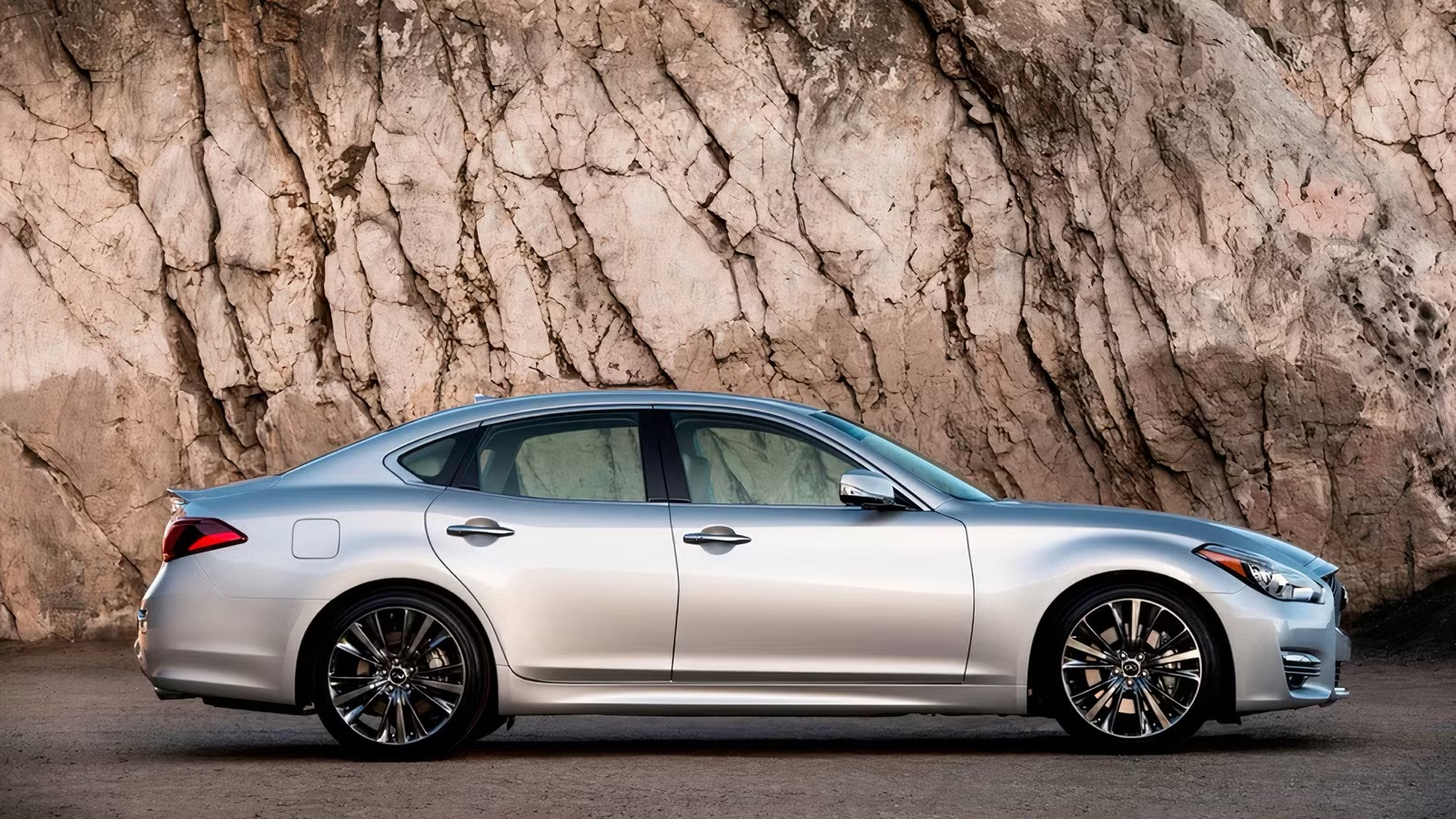
The Infiniti Q70 rose to prominence when Infiniti rebranded its product lines in 2013, as essentially a mid-cycle refresh to the M-Series (at the time M37, M35h, and M56). A lengthened Q70L arrived in 2015 as a spiritual successor to the famed Q45 flagship, which had been discontinued in 2006. So, from the start, the Q70 was Infiniti’s flagship sedan, and remained that way until its discontinuation in 2019 as Infiniti began to transition to an SUV-only lineup (fully realized in 2024, when the Q50 ceased production, but may be resurrected with a new Q50 in the near future).
Were the Infiniti Q70 around today, it would undoubtedly be a completely different beast, with all the state-of-the-art technology of current luxury sedans, and powered by the type of smaller turbocharged engine that preserves its power and improves its efficiency. Not that the single-generation Q70 (2014–2019) was underpowered or inefficient; far from it, as you’ll read later on. And it was also one of the more tech-forward, traditionally styled cars of its time, with cutting-edge driving aids, but with a mix of nostalgic features to make it a memorable luxury sedan.
How The 2019 Infiniti Q70 Today Delivers Traditional Luxury

Traditional luxury relies on creating a luxury experience, rather than dazzling with hurricane-force power and the latest tech. The underrated Infiniti Q70 falls below the “prestige” label defined by big power and cutting-edge technology, and today attracts buyers with the things it does best—top-notch natural materials, driving technologies that remain first-rate, and superior comfort. That all three facets have held up fairly well over the past seven years is a testament to how it was positioned and marketed, and why it remains a worthy alternative to today’s technology-intensive flagship sedans.

The 2019 Infiniti Q70 5.6 emphasizes smooth, immediate power from its naturally aspirated 5.6-liter V-8, rather than the urgent efficiency of the turbocharged six-cylinder engines that were then gaining favor and have since taken over all but the most performance-focused luxury sedans. Inside, the philosophy was restraint, with physical buttons for the most frequently used functions standing in stark contrast to today’s touchscreen controls buried in stacked menu levels, while the relaxed flagship environment provides a serenity not usually found with heavily bolstered, upright seats.
Infiniti Q70 Purchase Prices And Ownership Costs

Perhaps because it was part of the nouveau riche, the Infiniti Q70 never depended on its badge, nor the reputation of its predecessors, to attract luxury buyers. It earned its appeal through thoughtful engineering, generous standard equipment, and refined comfort, and a reputation for reliability that has aged well in the used-car ranks. Like most luxury sedans, depreciation came fast and furiously for the Infiniti Q70 over its early years, attracting today’s buyers with a purchase price in the $6,525–$26,900 range, depending on year, model and condition.

That prices the Q70 competitively against its German rivals of the time, according to Kelley Blue Book, and at nearly half that of current equivalents. And then better still, long-term maintenance and repair costs estimated at $683 per year (according to RepairPal) remain more manageable than its German luxury contemporaries (about $1,000 for the BMW 5 Series, and $1,300 for the Mercedes S-Class), despite still rolling on premium tires, carrying premium fuel and commanding premium maintenance routines.
How The Two Infiniti Q70 5.6 Sizes Wedge Into German Luxury Sedan Lineups

Like its Lexus compatriot that arrived almost simultaneously in the 1990s, the Infiniti Q45 targeted German luxury flagships, and when it went away in 2006, it left Infiniti without a true flagship sedan. It earmarked its midsize juggernaut (the Infiniti M56) for that role, but it was still more of an executive sedan, meant to rival established German counterparts—the Audi A6, BMW 5 Series, and Mercedes-Benz E-Class—so it was a stretch for the Q70 to challenge German flagship sedans.

And stretch is just what Infiniti did, with the arrival of the long-wheelbase Q70L in 2015. It was still shorter than the German flagships (Audi A8, BMW 7 Series, and Mercedes-Benz S-Class), leaving both sizes of Q70 sitting in the gap between the two classes of German luxury sedans (both larger than the E-segment but smaller than the F-segment). But it allowed the Infiniti Q70 to compete more effectively because it already had the edge in rear seat room and comfort.
How The 2019 Infiniti Q70 5.6 Luxe Compares To Luxury German Contemporaries

The Infiniti Q70 only lasted one generation in the U.S., as Nissan scaled back its sedan production worldwide, but it did compete effectively with a broad swath of reliable German luxury sedans in that short time, and probably deserved more attention than it received. It entered at a price point that reflected its flagship ambitions, and today presents a favorable comparison to its German contemporaries, especially in the top-tier, top-power 5.6 V-8 model.
2019 Infiniti Q70 5.6 Luxe Vs. 2019 BMW 540i


Compared to its BMW rival at the time, the 2019 Infiniti Q70 5.6 Luxe started at a higher price but offered the simplicity and smooth power delivery of a naturally aspirated V-8. The 2019 BMW 5 Series had a broader model lineup, with power supplied by turbocharged 4-, 6-, and 8-cylinder engines, and even offering a plug-in hybrid. The two were also comparable in available tech, though the Infiniti would probably get the nod in its interior presentation, overall room and ergonomics.
2019 Infiniti Q70L 5.6 Luxe Vs. 2019 Mercedes-Benz S 560


The Infiniti Q70 comparison becomes even more striking against a global benchmark like the Mercedes-Benz S-Class. The 2019 Infiniti Q70L 5.6 Luxe undercuts the V-8-powered 2019 Mercedes-Benz S 560 by $40,000 then and $9,000 now, though the larger S-Class is probably cheaper to maintain than the Infiniti—a testament to its engineering quality—even though it is a more complex sedan than the Q70, with its cutting-edge driving technologies of the day, sophisticated electronic architecture, and systems like an adaptive suspension.
How The 2019 Infiniti Q70 5.6 Luxe Compares To Current German Luxury Sedans

The Infiniti Q70’s physical dimensions occupy a sweet spot that has become increasingly rare in today’s luxury market. It offers comparatively more cabin space than many midsize executive sedans without feeling as massive overall as traditional long-wheelbase flagships. That balance is well suited to buyers who spend long hours in the car, particularly when passengers are thrown into the mix. Against today’s luxury sedans, the Q70’s interior design doesn’t emphasize dramatic digital displays but prioritizes airiness, uncluttered controls, and comfortable seating.
2019 Infiniti Q70 5.6 Luxe vs. 2027 BMW 540i xDrive


Befitting their relative eras, the 2019 Infiniti Q70 5.6 Luxe and 2027 BMW 540i xDrive reflect how buyer priorities have evolved over the past decade. The Q70 embraces a traditional formula centered on a naturally aspirated V-8, effortless power delivery, and a smoother overall driving experience, while the new 5 Series uses a smaller, electrified powertrain to meet today’s stricter efficiency and emissions expectations. Inside, the Q70 favors an understated, driver-focused interior with conventional controls and a straightforward layout, while the Bimmer asks the driver to learn expansive displays and software-driven technologies.
2019 Infiniti Q70L 5.6 Luxe vs. 2026 Mercedes-Benz S 500 4Matic


As with the smaller 2019 Infiniti Q70, the stretched Q70L 5.6 Luxe attacks flagship luxury from a different perspective than the 2026 Mercedes-Benz S 500 4Matic. Separated by nearly a decade of technological evolution, the Infiniti relies on traditional, naturally derived power and materials to provide an effortless and serene luxury ambiance, whereas the S-Class depends on its technological advancements (as it always has) to deliver a complex powertrain and pristine cabin. Both excel on long highway drives, though the Infiniti returns a warmer, simpler, and more understated experience compared to the Mercedes’ innovative, sophisticated, and pampering cabin.
The Infiniti Q70 5.6 Luxe Is An Analog Luxury Sedan Worth Rediscovering

The Infiniti Q70 5.6 Luxe never enjoyed the prestige of a Mercedes-Benz S-Class or the sporting reputation of a BMW 5 Series, and that may be precisely why it deserves a look today. It arrived during a period when luxury buyers were beginning to prioritize technology and ever-expanding feature lists, leaving its quieter strengths largely overlooked. Seven years later, those strengths may be easier to appreciate.

As a used luxury purchase, the Q70 delivers a compelling blend of traditional craftsmanship, spacious accommodations, smooth and progressive V-8 performance, and relatively reasonable ownership costs. In an era dominated by screens, subscriptions and electrification, its physical controls, straightforward engineering and solid highway ride provide an ownership experience that feels increasingly uncommon in modern luxury cars that have embraced software-defined driving.

In the Infiniti Q70, buyers give up some cutting-edge technology and the cachet associated with Europe’s most recognizable luxury badges, but gain a luxury sedan that prioritizes comfort over complexity, refinement over novelty, and proven engineering over digital innovation. The Infiniti Q70 5.6 Luxe may be one of the used market’s best-kept secrets, demonstrating that “analog” does not mean obsolete.
Sources: Infiniti, Kelley Blue Book, RepairPal, CarEdge

Related posts





Latest Post


No Comments