
The Adventure Bike That Handles Long Distances Without Feeling Huge
There’s a familiar trade-off in the adventure bike world: the machines built to cross huge distances often arrive with huge physical dimensions, too. More engine, fuel, suspension travel, and equipment can mean better highway stability, but it can also mean more weight to manage at a gas station or a sloped parking spot. That has pushed plenty of riders toward the middleweight end of the ADV market. The appeal is simple: keep the wind protection, electronics, range and comfort, but lose some of the intimidation. One road-focused triple makes a convincing case for that middle ground.
The Trouble With Today’s Big Adventure Bikes

Flagship adventure tourers keep getting bigger, and on paper, that’s progress. More displacement, more electronics, more standard equipment. In practice, it’s also more bike to physically manage every single time you throw a leg over it, from the driveway to the dirt road three states away.
The numbers tell the story bluntly. A BMW R 1300 GS tips the scales at around 523 pounds wet. Ducati’s Multistrada V4 is close behind at roughly 535 pounds, and KTM’s 1290 Super Adventure isn’t far off that either. Seat heights on these machines commonly run 33 to 34 inches or more, which is fine until you’re stopped at a red light on a camber you didn’t choose or backing out of a gravel pull-off with a loaded pannier throwing your balance sideways. None of that shows up in a spec sheet, but every rider who’s dropped a bike in a parking lot knows exactly what it costs.
Why Middleweight Triples Are Winning Long-Distance Riders Over

That’s part of why the 850–900cc adventure class has gotten so competitive lately. Bikes like Yamaha’s Ténéré 700 and Suzuki V-Strom 800DE have already built loyal followings on this exact premise: keep the vast majority of what makes a big ADV useful for touring, while shedding a meaningful chunk of the mass and the intimidation factor. Riders taking multi-day trips have started to realize that all-day comfort and end-of-day confidence matter more than an extra 20 horsepower they’ll rarely use to its full potential. That shift in priorities is exactly where this next bike lives.

The Triumph Tiger 900 GT Pro Is Built For Long Distances Without Feeling Bulky
$17,095 Gets You Premium Kit That Costs Thousands More On Competing Bikes

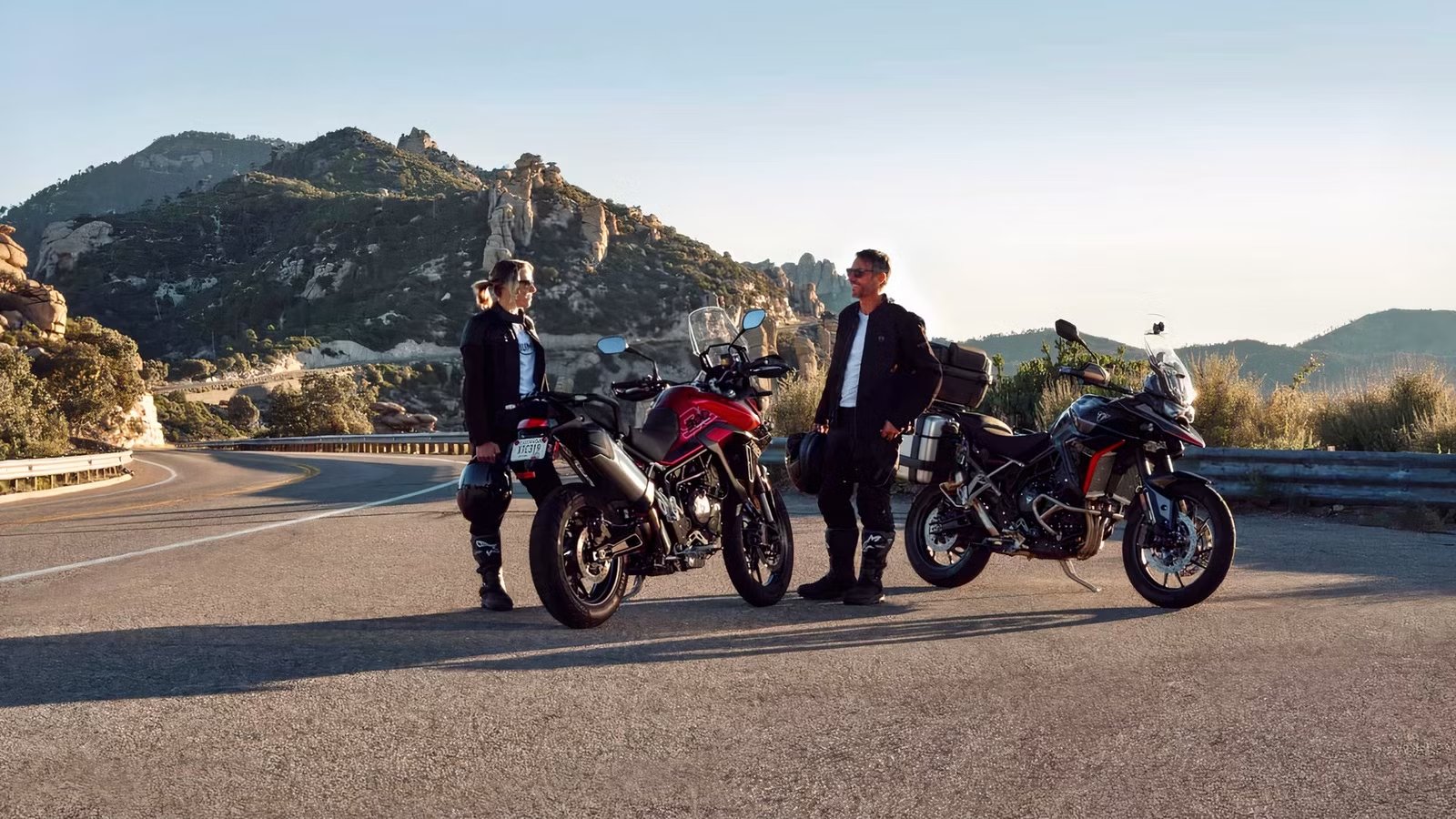
The Triumph Tiger 900 GT Pro sits right in that sweet spot. In the U.S., the MY25 GT Pro carries a $17,095 MSRP, above the Tiger 900 GT and below the Rally Pro in the range, priced at $15,195 and $17,595, respectively. Triumph positions it as the road-focused, high-spec Tiger 900, with equipment aimed at long-distance travel rather than extreme off-road work. Its 888cc triple, 19-inch front wheel, cast wheels and road-focused suspension give it a clear pavement bias.
The 900 GT Pro is built on a chassis that uses a tubular steel trellis main frame and bolt-on aluminum rear subframe. For the money, the GT Pro throws in a two-way quick-shifter, heated grips and rider/passenger seats, an electronically adjustable rear shock, and a tire pressure monitoring system as standard, rather than a checkbox on an options list. It’s not a cheap bike, but it undercuts most liter-class competitors by several thousand dollars while still delivering a genuinely premium spec sheet.
An 888cc Triple Built For The Long Haul
Low-End Grunt Meets High-Rev Polish

The heart of the GT Pro is its 888cc inline-triple, and it’s a genuinely charismatic piece of engineering rather than a spec-sheet afterthought. Triumph’s 2024 update to the Tiger 900 lineup bumped output to a claimed 106.5 horsepower at 9,500 rpm and 66 pound-feet of torque at 6,850 rpm, a 13 percent jump over the previous-generation engine. What makes it interesting isn’t just the number, though.
The T-plane crank gives the triple an offbeat, almost lumpy firing order that sounds more like a V-twin with a grudge than a typical smooth-spinning three-cylinder motor. Power reaches the rear wheel through a six-speed gearbox with a slip-and-assist clutch, and Triumph fits its Shift Assist quick-shifter as standard, letting you bang through gears on the highway without touching the lever.
Fuel Range That Matches The Mission

None of that muscle comes at the expense of range, which matters more on a touring bike than almost anything else. Triumph claims roughly 45 mpg from the updated engine, itself about a nine percent improvement over the pre-2024 unit, and that efficiency pairs with a 5.28-gallon tank to deliver well over 200 miles between fuel stops in real-world riding. That’s the kind of number that actually matters on the remote stretches of highway where long-distance ADV riders spend most of their time, where the next gas station might be a genuine 100 miles down the road rather than a rounding error.
A Chassis That Doesn’t Feel Like A Full-Size ADV

Triumph lists the bike’s wet weight at 489 pounds, which sounds unremarkable until you set it next to the liter-class machines discussed earlier, where you’re routinely looking at 30 to 50 pounds more. The tubular steel trellis frame, with its bolt-on aluminum subframe, keeps mass centralized rather than stacked high. The GT Pro’s 19-inch front wheel, smaller than the 21-inch units on more off-road-biased adventure bikes, also sharpens steering response, making slow-speed balance noticeably less of a chore. Push it backward out of a garage or muscle it up onto a curb, and that difference stops being abstract — it just feels like the bike is cooperating with you instead of testing your grip strength.
Seat Height And Ergonomics For Real-World Riders

Seat height is adjustable between 32.28 and 33.07 inches, and Triumph offers lower accessory seats for riders who want to get both feet flatter on the ground at a stop. The handlebar mounting system uses damping to reduce vibration transmitted to your hands over a long day in the saddle, a small detail that matters enormously by hour six of an interstate slog. The whole riding position is tuned for road-biased touring comfort rather than the standing, attack-ready posture you’d want on a dedicated off-road machine.
Suspension And Brakes That Keep Composure Loaded Up

The GT Pro’s suspension setup reflects its road-touring mission without feeling underbuilt. Up front sits a Marzocchi 45mm upside-down fork with 180mm of travel and manually adjustable compression and rebound damping. Out back, Triumph fits an electronically adjustable Marzocchi shock with 170mm of travel, and the standout feature is this: preload and rebound presets are accessible directly from the TFT dash, so switching between solo riding, two-up, or a fully loaded touring setup takes a few button presses instead of a roadside toolkit. Stopping power comes from twin Brembo Stylema four-piston monobloc calipers biting on 320mm floating discs, backed by Optimized Cornering ABS that keeps working even when you’re leaned over.
Technology That Reduces Rider Fatigue On Long Days

A seven-inch full-color TFT comes with Triumph’s My Triumph connectivity system, supporting turn-by-turn navigation, phone and music functions through the bike’s controls. The standard comfort package is just as relevant, comprising heated rider and passenger seats, heated grips, cruise control, and a manually adjustable windscreen. Tire pressure monitoring, emergency deceleration warning lights, and five riding modes—Road, Rain, Sport, Off-Road, and Rider-configurable—round out the package. The modes alter throttle response and the behavior of ABS and traction control.
Put it all together, and the Tiger 900 GT Pro reads less like a compromise and more like a rebalancing of priorities. It doesn’t chase the horsepower or the size numbers that dominate flagship adventure-bike spec sheets, and it doesn’t need to. The touring gear is all there, the range is real, and the comfort tech does its job quietly in the background instead of demanding attention. For riders who actually rack up the miles, rather than just admire the spec sheet in a showroom, a bike that stays manageable at every fuel stop and every gas-station U-turn might be the smarter kind of big.
Source: Triumph

Related posts


Latest Post


No Comments