
10 Cheap Muscle Cars That Outran Their Pricier Rivals
Muscle cars were supposed to follow a fairly simple formula. Spend more money, get more car, and ideally go faster. But the formula was never quite that simple. Sometimes the cheaper model had less weight to drag around, less luxury equipment, shorter gearing, or simply the right engine in the right body. These ten factory muscle cars show how the cheaper option could give its more expensive brother a serious run for its money, and how the showroom sticker didn’t always predict what happened when the light turned green.
10
1968 Dodge Dart GTS vs. Dodge Charger R/T

The party trick of the 1968 Dodge Dart GTS was putting serious V8 performance into a comparatively small body. It was a strange combination for Dodge, a company that had no problem building cars that looked like they needed their own zip code, but the compact Dart came standard with a 340-cubic-inch V8 making factory rated 275 horsepower. Buyers could also step up to the 383 big-block, rated at 300 hp. The Charger R/T was a much larger and more expensive performance car, with its 440 Magnum making 375 hp. Yet the Dart’s smaller body gave it a significant weight advantage, and at $3,163 for the hardtop, it undercut the Charger R/T by roughly $340. Period testing showed what the compact Dodge could really do, with an automatic 340 GTS running the quarter-mile in 14.38 seconds at 97 mph.
9
1969 Oldsmobile Cutlass W-31 vs. Oldsmobile 4-4-2

The Oldsmobile Cutlass W-31 was the kind of car that could look almost completely ordinary until the driver decided otherwise. Its 350-cubic-inch V8 was rated at 325 hp, while the larger 4-4-2 used a 400-cubic-inch V8 and could make 360 hp in W-30 form. The W-31 was based on the F-85/Cutlass rather than being a 4-4-2, and that distinction matters because the smaller car was lighter and less expensive. Its high-revving 350, aggressive gearing, and performance hardware made it considerably more serious than its ordinary Cutlass appearance suggested.

8
1970 Oldsmobile Cutlass W-31 vs. Oldsmobile 4-4-2

Oldsmobile made the comparison even more lopsided on paper for 1970. The W-31 carried over its 325-hp 350, while the 4-4-2 moved to the much larger 455, with the standard engine rated at 365 hp and the W-30 version reaching 370 hp. That was a 105-cubic-inch deficit for the little Cutlass, which fought back with outside-air induction and performance-oriented hardware. The W-31 package added $368.62 to a Cutlass S that started at $2,970. Only 1,352 W-31s were produced in 1970, making this compact Oldsmobile a rare alternative to the much more famous 4-4-2.
7
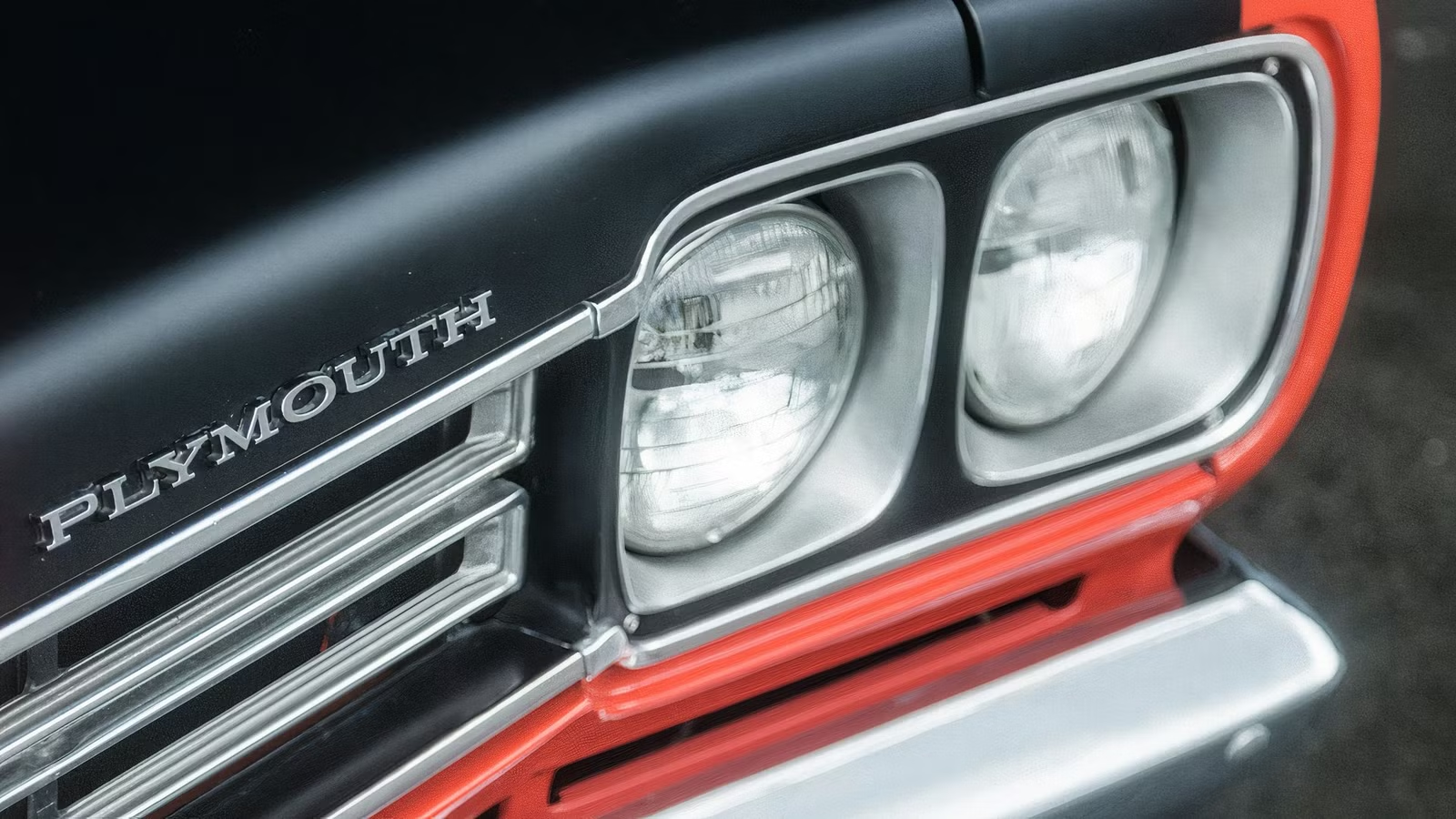
1968 Plymouth Road Runner vs. Plymouth GTX

Most muscle car fans know exactly what the Plymouth Road Runner was supposed to do. Plymouth stripped away much of the luxury equipment and built a relatively inexpensive performance car around a 335-hp 383 V8. The GTX took a very different approach, offering more equipment and a standard 375-hp 440. The difference was reflected in the price, with the Road Runner coupe starting at $2,870, while the GTX started at around $3,330. That did not automatically make the Road Runner faster in every configuration, but it showed how much performance Plymouth could deliver when it stopped spending money on everything except the parts that made the car go fast.
6
1969 Plymouth Road Runner vs. Plymouth GTX

The formula continued into 1969, and Plymouth gave buyers even more ways to turn the cheaper Road Runner into a serious performance car. The Road Runner started at $2,945 for the coupe and $3,083 for the hardtop, compared with $3,416 for a GTX hardtop. The Road Runner’s standard 383 made 335 horsepower, but buyers could move up to the 390-hp 440 Six Barrel or even the 425-hp 426 Hemi. The GTX started with the 375-hp 440 and offered the same Hemi at the top of the range. That meant the cheaper Plymouth could get extremely close to the GTX’s mechanical specification without requiring the buyer to spend GTX money.
5
1969 Ford Torino GT vs. Ford Fairlane Cobra

Ford’s 1969 Cobra took a relatively simple package and filled it with serious engine hardware. It came standard with the 335-hp 428 Cobra Jet and a four-speed manual, which is why the Cobra hardtop cost $3,208. The Torino GT hardtop started at $2,848 with a 302 V8, but the plot twist is that GT buyers could also tick the box for the same 428 Cobra Jet. That gave Ford buyers two routes to the same big-block punch. The Cobra bundled the performance hardware, while the cheaper GT let buyers pick the engine and skip the extras they didn’t care about.
4
1970 Buick GS 455 vs. Buick GSX

The GSX took the already serious GS 455 and piled on even more performance equipment and visual drama. The 455 made 350 hp and 510 lb-ft in standard GS form, while the Stage 1 package raised the factory rating to 360 hp. The GSX added a hood-mounted tachometer, upgraded suspension, a limited-slip rear end, front and rear spoilers, and other hardware, and that package alone cost $1,196. The strange part is that none of it touched the engine. A GS 455 buyer could skip the GSX package, order the Stage 1, and still get the same Stage 1 engine that ran 13.38 seconds at 105.5 mph in period testing.
3
1969 Dodge Super Bee vs. Dodge Charger R/T

The Dodge Super Bee might be one of the clearest examples of the cheaper-car philosophy working exactly as intended. Dodge positioned the Super Bee below the Charger R/T, with the Super Bee coupe starting at $3,076, but that did not stop it from receiving some expensive-looking hardware. The mid-year 440 Six-Pack produced 390 hp and 490 lb-ft, while the Super Bee’s stripped-down character kept the car focused on performance rather than luxury. The Six-Pack cars also came with aggressive 4.10 gearing, heavy-duty equipment, a lift-off fiberglass hood held down by pins, and plain black steel wheels with no hubcaps at all. That left the cheaper Dodge with 15 more rated hp than the 375-hp 440 Magnum in the pricier Charger R/T.
2
1970 Ford Torino GT vs. Ford Torino Cobra

The 1970 Torino lineup makes the relationship between price, equipment and performance particularly complicated. The Torino GT was the more style-focused, less expensive model at around $3,100, while the $3,270 Cobra was Ford’s harder-edged performance version. The Cobra came standard with a 360-hp 429, but both cars could be ordered with the 370-hp 429 Cobra Jet, so the exact specifications mattered far more than the badge. The Cobra’s best-known period result came with the 429 Super Cobra Jet, four-speed and 3.91 gears, running 60 mph in 5.8 seconds and the quarter-mile in 13.99 seconds at 101 mph.
1
1969 Ford Fairlane Cobra 428 CJ vs. Ford Mustang Mach 1 428 Cobra Jet

Remember the Cobra playing big brother to the Torino GT? Against the Mustang Mach 1, it becomes the cheap one. The Cobra started at $3,189, while a Mach 1 started at $3,122 before the $357 Cobra Jet option pushed it to nearly $3,480. Both used the same 335-hp 428 Cobra Jet, but the stopwatch told a harsher story. The Mach 1 ran the quarter-mile in 13.90 seconds at 103.32 mph, while a period Cobra test car weighing 4,105 pounds as tested with a 3.50 rear axle managed 14.9 seconds at 95.2 mph. In that same test, though, the Cobra pulled a hole shot on a Road Runner carrying $500 worth of aftermarket upgrades in most runs, so the less expensive Ford could still throw a punch.
These cars prove that muscle-car performance was never reserved for the biggest, most expensive nameplate. The right engine, gearing, weight and factory options could turn a cheaper model into a serious threat. Sometimes, the smartest way to build a fast car was simply to spend less and choose the right parts.
Sources: Classic.com, Bring A Trailer, Mecum

Related posts



Latest Post


No Comments