
Lotus Emira: Inside the Last Combustion Lotus Sports Car
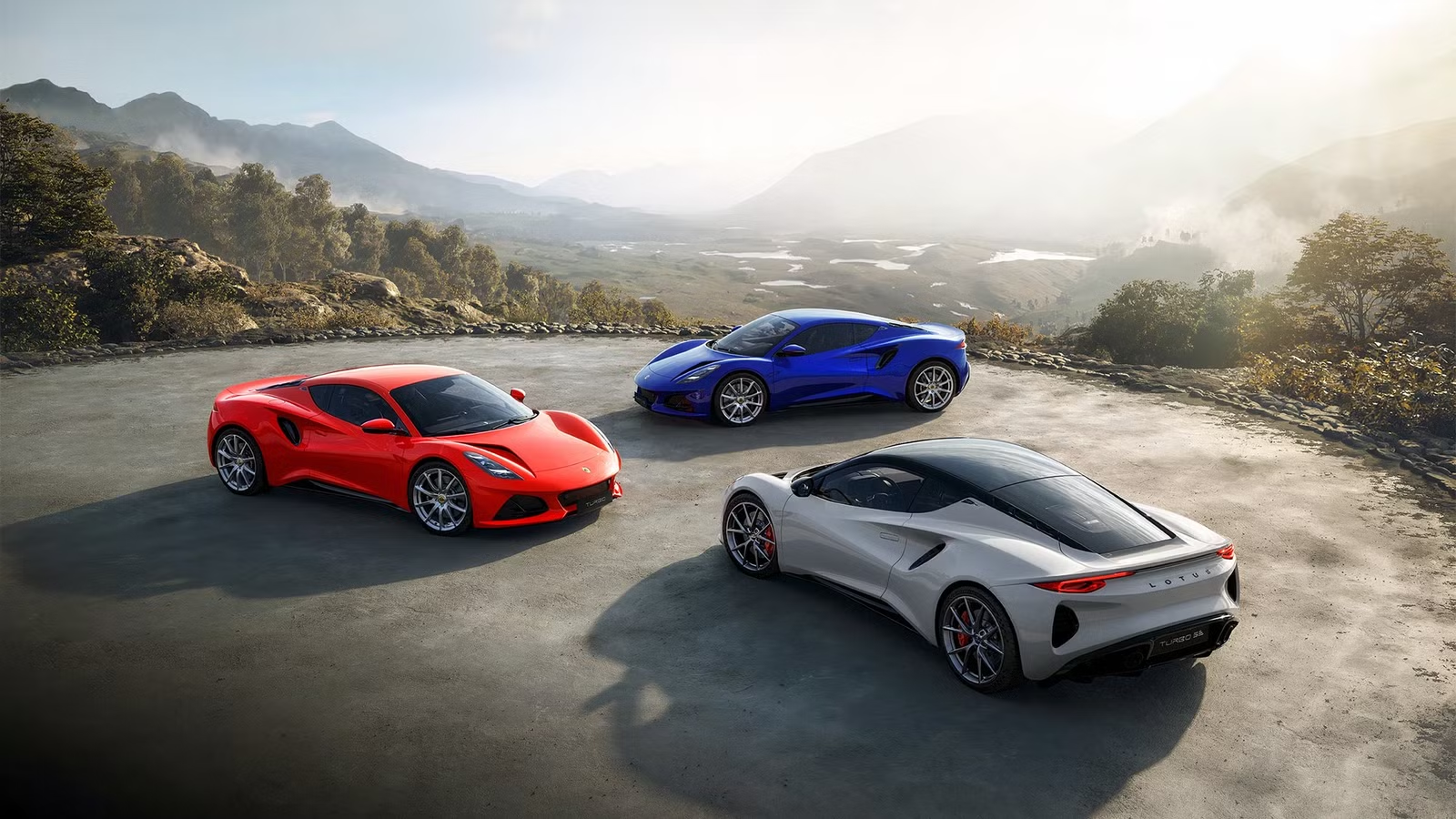
The Lotus Emira arrives at a pivotal moment in automotive history. As Lotus transitions toward an electric future, the Emira closes the book on more than seven decades of raw and analog cars built exclusively for driving pleasure. As far as we know, the Emira will be the last ‘pure’ Lotus sports car. That alone makes it noteworthy, but its appeal runs deeper than nostalgia and finality. Buyers can choose between a supercharged Toyota V-6 paired with a manual transmission or an AMG-sourced turbocharged four-cylinder with a dual-clutch automatic, giving the Emira two distinct personalities. Follow along as we break down the powertrains, driving dynamics, ownership experience, and how it stacks up against rivals like the Porsche Cayman to determine whether this final combustion Lotus deserves a place in your garage.
Two Engines, Two Personalities

Unlike most modern sports cars, the Emira wasn’t built around a single engine philosophy. Lotus engineered two completely different powertrains to appeal to different enthusiasts while navigating the realities of modern emissions regulations and limited production resources.
Toyota’s Supercharged V-6 Keeps The Analog Lotus Spirit Alive

Isn’t it embarrassing that a Toyota Sienna minivan and a hardcore British sports car share the same engine? Quite the contrary—we think it’s awesome. The Toyota-sourced 3.5-liter 2GR-FE is not your average V-6; it is among the most dominant and versatile six-cylinder platforms ever produced. In naturally aspirated form, it is a pleasure to experience with its smooth character and strong rev range. However, add a supercharger to this V-6 as found on the Emira, and you have an engine that provides exhilarating performance without sacrificing durability in the process. For 2026, the Emira V-6 SE produces 400 horsepower and 310 lb-ft of torque and is exclusively available with a six-speed manual transmission.
A six-speed automatic transmission was originally available with the V-6 model, but has now been dropped. If you crave the linear character of a naturally aspirated engine but don’t want to sacrifice performance in the process, the V-6 SE trim ticks all the right boxes. The 2GR-FE V-6 engine offers loads of emotional appeal with a delightful soundtrack throughout the entire rev range and begs you to stay on the throttle longer than you should. Despite its strong performance, the legendary reliability of this Toyota V-6 is still its strongest quality. If you want the quintessential modern analog Lotus experience, the V-6 SE trim should be the only option you consider.
AMG’s Turbo Four Brings Modern Performance


What if you want a completely different approach to power delivery but don’t want to lose the Lotus character that makes the Emira so special? The 2.0-liter Mercedes-AMG M139 turbocharged inline-four is a worthy alternative to the established supercharged V-6 formula. Found in the Turbo SE and upcoming 420 Sport model, this engine produces 400 horsepower and 354 lb-ft of torque in the Turbo SE and 416 horsepower and 369 lb-ft in the 420 Sport.
Both turbocharged trims are equipped with the eight-speed AMG dual-clutch transmission, making them both a few tenths of a second faster than the V-6 SE trim. The 420 Sport is particularly quick off the line, achieving 0-to-60 mph in 3.7 seconds compared to the V-6 SE’s 4.3-second 0-to-60 mph time. This performance improvement has just as much to do with the DCT’s blistering-fast shifting speed as it does with the added low-end torque of the turbo platform.

In terms of responsiveness, both powertrains are strong. Despite the turbo variants having more available torque across the entire rpm range, they still retain some of the desirable characteristics of analog engines. Peak torque doesn’t come on until 5,000 rpm, and peak power isn’t achieved until 6,750 rpm in the 420 Sport model. These turbocharged engines love to be revved out, and they reward you handsomely for doing so.
While this isn’t a make-or-break factor, the turbo variants are also significantly more fuel efficient, achieving 21 combined mpg, while the V-6 manual transmission model achieves 19 mpg combined. You can’t go wrong with either powertrain, but the manual-equipped model is clearly the winner in terms of experiencing the original Lotus performance formula that the brand has perfected over the last decade.
The Driving Experience That Defines A Lotus

The Emira’s engine choices may be critical differentiating factors, but its chassis is what truly defines the car. Lotus has spent decades perfecting the art of steering feel and balance, and the Emira serves as the culmination of that philosophy while incorporating the refinement expected from a modern premium sports car.
Steering, Chassis Balance, And The Lightweight Philosophy

While the Emira may offer two equally impressive powertrains, the real reason you are buying this particular sports car is the way it feels to drive. In an era dominated by sterilized electric steering racks, the Emira stays loyal to the tried-and-true visceral feedback that only a hydraulic steering rack can provide. In reality, there is nothing wrong with modern electric racks that are precise as a knife’s edge, but Lotus has spent countless hours refining the feel of a hydraulic system to dramatic effect.

The Emira has a curb weight of around 3,279 pounds, but it feels like a lot less than that. Part of this has to do with the Emira’s petite, yet muscular proportions, which have to be seen to be believed. For a car this light and nimble, 400 hp feels like a lot, because it is. Depending on the situation, you can opt for either Tour or Sport mode, the former designed for daily driving comfort and the latter for spirited driving. On the turbocharged models, an additional Track mode is also available for all-out attack with little to no electronic intervention. Regardless of what mode you select, it is clear the baseline steering response you get from the Emira’s hydraulic system remains the golden standard among modern sports cars.
Modern Comfort Meets Classic Lotus Dynamics

What may be even more impressive is how much more complete a sports car the Emira is when compared to its predecessors. The Elise, Exige, and Evora were always viewed as tools for hardcore track junkies who prioritized driving sensation over livability. However, the Emira manages to provide the same type of engagement that made previous Lotus sports cars outstanding while also introducing modern creature comforts. The fit and finish of the interior is superb. From the new digital instrument cluster to the look and feel of the buttons, dials, and trim, this interior immediately makes the Lotus look worthy of its price point.

The infotainment system has been completely overhauled when compared to the Evora and features wireless Apple CarPlay and Android Auto standard. The Emira is also the first modern Lotus sports car to offer a full suite of Advanced Driver Assistance Systems, as these features were never offered throughout the Evora’s entire production run from 2008 to 2021. Even more impressive is the optional Extended Co-Driver Pack, which unlocks additional desirable features such as Adaptive Cruise Control. Never before has there been a Lotus sports car more livable and daily drivable than the Emira. The British brand has discovered the perfect balance between creating a product that honors its racing heritage while focusing on everyday usability.
Lotus Emira Ownership And Cost Considerations

The Emira isn’t simply another exotic sports car—it might just be the last chapter of Lotus’ combustion-engine legacy. That distinction could influence depreciation, collectibility, and long-term ownership costs in ways few modern performance cars can match.
Average Prices, Service Networks, And Insurance

According to Kelley Blue Book, the fair purchase price for a 2024 Lotus Emira is between $85,000 and $87,900. Yet, Classic.com data tells us from 25 confirmed sales within the last year that the average price is $89,416. Among these 25 examples, the highest mileage model only had 6,000 miles. It is no surprise that these Emira models are all in excellent condition, given their mileages. On CarGurus, the average listing price of a Lotus Emira is $93,925, with prices rising roughly 1.2% in the last year.

When considering insurance premiums, the Lotus Emira is actually more expensive than a Porsche Cayman or BMW Z4. Much of that has to do with Lotus’ limited dealership network, relatively low production numbers, and limited parts availability. The Emira utilizes a bespoke fiberglass body that requires specialized parts and expertise during repair. Then there is the concern regarding availability and access. For a frame of reference, there are eight times as many BMW dealers in the U.S. when compared to Lotus dealers. Ultimately, your premiums will still vary significantly depending on factors like your age, driving record, and location.
Warranty Policies, Annual Costs, And Consumables

If you buy new, the Emira comes with a three-year/36,000-mile powertrain warranty. A three-year basic warranty is also included, which covers every component of the car, including exterior paint and interior materials, with no mileage limitation. As far as budgeting for annual maintenance costs goes, you should set aside at least $1,000 to $1,500 a year, which is reasonable for a car of this capability and price point. Routine service items like oil changes and cabin air filters are a bit trickier than a standard front-engine car. For example, the oil change requires the removal of the undertray, which is secured with 14 bolts, but the service should still cost less than $200 from a reputable shop.
A real consumable you should factor in on an annual basis is the cost of rear tires, especially on the performance models that come equipped with 295/35/20 Michelin Pilot Sport Cup 2s, which will cost around $500–$700 each. If you do take your Emira to the track, these grippy tires will see a large drop in optimal grip after only 20 or so heat cycles. Front tires should last considerably longer and are cheaper, but will also require semi-annual replacement if high-performance driving events are a monthly occurrence.
Choosing Between A Lotus Emira And A Porsche Cayman

Every premium mid-engine sports car inevitably gets compared to the Porsche Cayman, the segment’s longtime benchmark. The Emira doesn’t necessarily beat the Cayman in every measurable category, but it offers a compelling alternative for shoppers who want something intriguing and more adventurous than the conventional option.
Performance, Precision, And Everyday Livability Compared

When new, a 350-hp 2025 Porsche 718 Cayman S starts at $86,795 while a 394-hp 2025 GTS 4.0 model would run you $101,695. This is just within the price range of a Lotus Emira. As far as handling goes, both models excel in terms of outright grip, but the Cayman has more dynamic control than the Lotus when optioned with Porsche Active Suspension Management (PASM). The Lotus still wins in terms of outright steering feel with its exceptional hydraulic rack, although Porsche’s electric system is amazing in its own right.

If you are opting for a manual, the Emira wins hands-down with the exposed gear linkage mechanism, short-throw gear ratios, and loud, tactile engagement. Porsche’s manual is smooth as silk, but the long gear ratios of the Cayman mean less time engaging with the mechanical details of the car. Luckily, build quality on both models is second-to-none, each demonstrating some of the highest assembly standards of any vehicle on the market.
Determining Which Option Suits You Better
Choosing between a Cayman S, a Cayman GTS 4.0, and an Emira, can you really go wrong? Not really. Each of these cars will provide you with a tantalizing mid-engine driving experience and feel like a special occasion no matter the drive. If your preference is a visceral driving experience where connection to the road is everything, the Emira is the better choice, no question. Not only is it the more engaging option, but it offers more potential long-term collectibility due to its low production numbers. It is everything to love about Lotus, with a modern touch.

The Porsche Cayman S wins in terms of dealer support, resale consistency, and more everyday practicality. If you can opt for the rarer and more expensive GTS 4.0, the visceral nature of the driving experience is about equal with the manual V-6 Emira. Comparing them head-to-head, it will come down to looks and personal preference. We think the Emira is stunningly gorgeous and the more attractive of the two, while the GTS 4.0 is sleek but not quite as striking as its British counterpart. Whichever option you do end up choosing, pick with your heart first and use logic after. Happy hunting!
Sources: Lotus, Porsche, Classic.com, CarGurus, Edmunds, Kelley Blue Book

Related posts


Latest Post


No Comments