
The Ford Big-Block That Outlived Every FE Hero Engine
There’s no shortage of them, clearly, but the most interesting old Ford big-block may be sitting beneath a sun-baked motorhome, surrounded by weeds and one deeply suspicious wasp nest. It spent decades moving heavy machinery rather than building a reputation, which is why so many enthusiasts still walk past it.

That anonymity, however, is becoming an advantage. Ford’s celebrated performance engines have turned into collector-grade hardware, while this overlooked bruiser remains tied to work trucks and RVs. Under all that iron is a durable foundation with enough displacement to make serious power.
Ford’s Greatest Big-Blocks Were Built To Burn Bright
Ford’s big-block history is usually told through engines attached to famous badges. The 427 became a competition legend, while the 428 Cobra Jet brought big torque to showroom muscle. The 429 Cobra Jet and Boss 429 carried that reputation into the 385-series era.

Those engines earned their status in a concentrated burst. The 429 Cobra Jet and Super Cobra Jet lasted only through the 1970 and 1971 model years, while the Boss 429 Mustang existed mainly because Ford needed a street-going path to NASCAR homologation. Short production runs added to the mythology, and mythology has a habit of making old metal expensive.
By the late ’60s, Ford’s FE and MEL families were showing their age. Their replacement was the 385-series, named after the 3.85-inch stroke used by its largest member and also known as the Lima family after Ford’s Ohio plant. Thin-wall casting made the architecture lighter than the big-blocks it replaced, even though the largest version still weighed roughly 700 to 720 pounds.
The One That Lasted Was Sent To Work

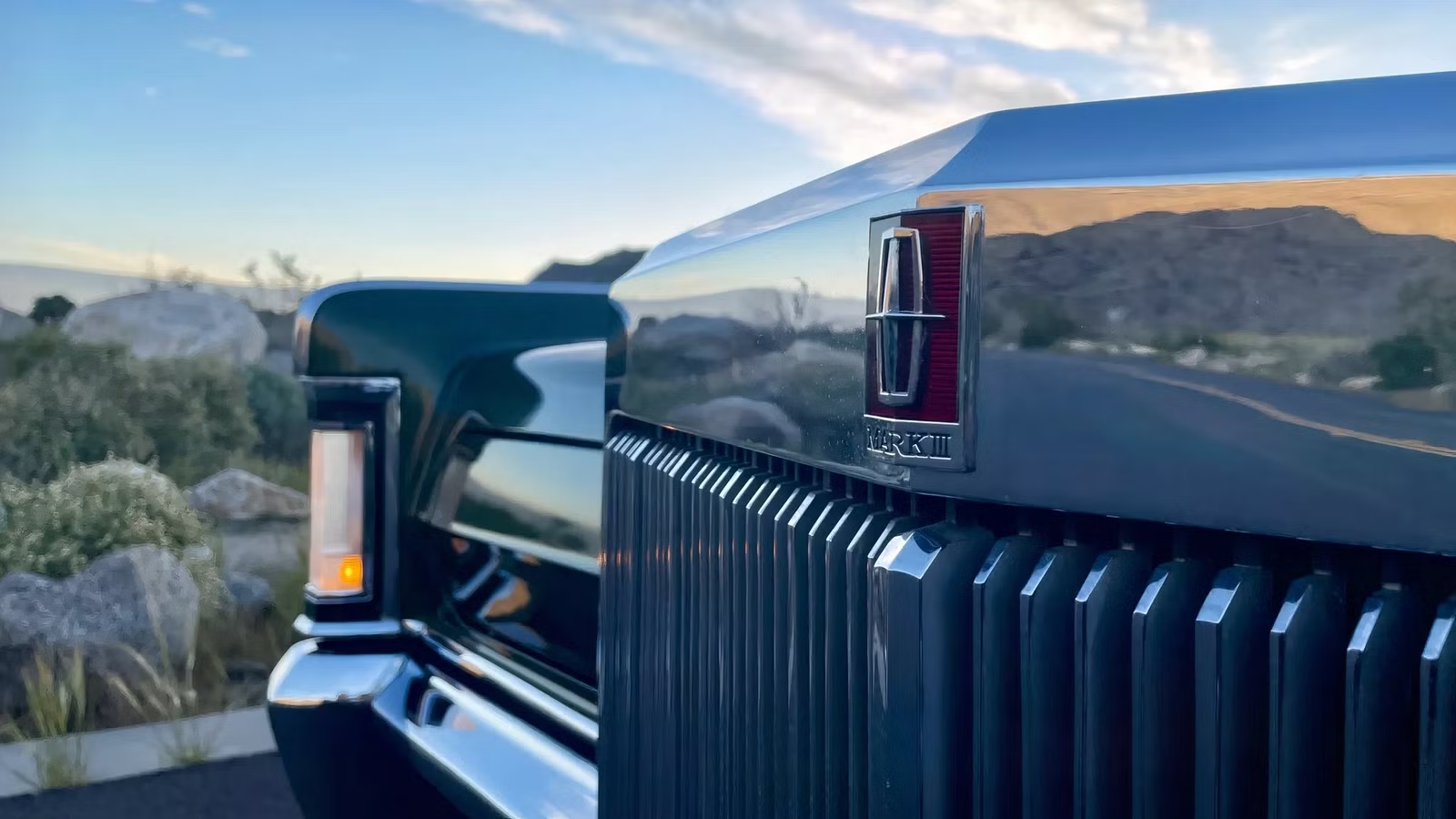
The largest 385-series V8 began life in Ford’s luxury division, where curb weight mattered less than effortless torque. It first powered the Lincoln Continental Mark III and Continental sedan, then spread into Mercury and Ford passenger cars during the ’70s. This was a big engine for big machinery, delivered when full-size American cars still needed their own ZIP codes.
Then the rules changed. Lower compression and emissions equipment drained the excitement from its specification sheet, while the switch from gross to SAE net ratings made the fall look even steeper. The 1972 cylinder-head design was especially troublesome because its poor quench area encouraged detonation, forcing Ford to revise the heads for 1973.
Alternate Uses

Ford removed it from passenger cars after ’78, which could’ve ended the story. Instead, it settled into the F-Series and E-Series, where low-speed pulling power mattered more than a road test. Motorhomes and industrial equipment also put it to work. Understandably, those applications rarely ended up on bedroom posters, unless the bedroom belonged to a very serious towing enthusiast.
That career change preserved the engine long after Ford’s FE heroes had left production. Trucks kept using it into the ’90s, supported by a broad supply of blocks and service parts. Survival came from usefulness rather than celebrity, which explains why this engine remained common while better-known Ford big-blocks became prizes.
The Ford 460 Was The Big-Block That Outlasted Them All

Let’s not beat around the bush any longer. The engine was the Ford 460, a 460ci V8 introduced for 1968 in the Lincoln Continental Mark III. With a 4.36-inch bore and 3.85-inch stroke, it was the largest production member of the 385-series family. Early versions were rated at 365 gross horsepower and 485 lb-ft of torque.
Sadly enough, its fall was nearly as dramatic as its debut. Compression dropped from 10.5:1 in the early years to 8.5:1 for much of the later production run. Depending on model year and application, late-’70s output bottomed out at roughly 197 to 202 hp, with torque around 348 lb-ft in one 1978 passenger-car specification. The change to net ratings makes a direct comparison with the 1968 figure misleading, but the decline was still painful.
Passenger car use ended in 1978, but the Ford 460 kept going in heavy-duty F-Series pickups and E-Series vans. Ford introduced electronic fuel injection in 1988, bringing output to about 235 hp and 395 lb-ft before later versions rose to 245 hp and as much as 410 lb-ft. It still wasn’t a muscle-era screamer, but it had regained the low-rpm punch its working customers needed.
Truck production continued through 1997, giving the Ford 460 a run of almost three decades. The engine that missed out on a defining muscle car had outlasted Ford’s celebrated FE big-blocks by becoming useful in places where durability mattered every day. It didn’t win a popularity contest, but it kept showing up for work.
The Bottom End Was Built For Way More Power

The 460’s modern appeal begins below the cylinder heads. Its cast-iron block uses massive 3.00-inch main journals, and estimates for a prepared stock block’s capacity range from around 700 to 900 hp. That doesn’t mean every junkyard short-block is ready for a heroic dyno pull after decades in a motorhome, but the basic structure gives builders plenty of room.
The factory heads are the bottleneck. Their oval intake ports support strong torque, while the restrictive exhaust side struggles once a larger camshaft asks for more airflow. Early C9VE and D0VE iron castings are favored for budget builds, although aftermarket aluminum heads improve breathing and remove roughly 60 pounds from the engine’s nose. The front springs may finally stop filing complaints.
A proven 466-cubic-inch, pump-gas build used aluminum heads and a streetable hydraulic cam to produce 503 hp at 5,200 rpm, backed by 555 lb-ft at 4,200 rpm. A header and intake-spacer change pushed the same combination to 514 hp and 565 lb-ft. Stroker crankshafts can take displacement to 502, 521, or 545 cubic inches, though higher-rpm builds also need oiling-system upgrades to protect the rear main and rods.
The Last Affordable Ford Big-Block Hiding In Plain Sight

The Ford 460’s biggest advantage is that many examples entered old age attached to ordinary equipment. A 427 or 428 Cobra Jet core carries a direct connection to Ford’s muscle car royalty, while a 460 may still be found beneath an F-350 hood or behind a motorhome grille. One comes with a story collectors already understand while the other may come with faded curtains and a family of mice.
In essence, nobody has to feel guilty about fitting aluminum heads or stroking a worn truck engine beyond 500 cubic inches. The platform also benefits from decades of aftermarket development, with replacement blocks and rotating assemblies available for anyone who would rather start fresh than scrape another donor vehicle out of a field.
Sleeper Build?

It isn’t a magic bargain. A proper rebuild still needs machine work, and its weight can complicate swaps into smaller cars. The worst factory heads can smother airflow, while high-rpm use demands oiling improvements. Yet those issues are known, the fixes are established, and the block’s dimensions reward sensible parts instead of requiring rare factory castings.
That makes the Ford 460 more interesting now than it was during the emissions era. It survived because Ford needed torque for trucks and motorhomes, then became plentiful enough for hot-rodders to rediscover. The famous FE engines will always own the trophies, but the 460 may be the big-block you can still build and enjoy before everyone else notices what has been hiding under those RV hoods.
Sources: Muscle Car Club, TopSpeed, Motor Trend, Driving Line, Repairpal.

Related posts



Latest Post



No Comments