
The Forgotten Muscle Car That Was Faster Than A Corvette
The late 1970s were a dustbowl, laying waste to any car that dared to call itself sporty or use the word “performance”. The 1973 oil embargo would cause a ripple effect, leading to an economic recession and rapid inflation, spurred on by political turmoil with the 1974 Watergate scandal and the end of the Vietnam War in 1975.

American highways were handicapped by the 1974 national 55 mph speed limit imposed under the Emergency Highway Energy Conservation Act. Mandated catalytic converters, lower engine compression, and smog devices choked the performance out of V8s to meet new, strict federal emission standards.
By 1978, the muscle cars that once ruled the streets were a shell of their former selves. Big block V8s were either extinct or wheezing, trying to get near 200 horsepower. Hood graphics, T-tops, and low-end torque were the new gimmicks to try and make muscle cars look faster than they were. But one unassuming vehicle would find a loophole in the system and exploit it to become the fastest American production vehicle that year.
A Low Point Of The Corvette’s Performance History

Before the 1984 C4 ignited the Chevrolet Corvette into a new digitalized, port fuel-injected era, the C3 was hanging on by a thread as a sports car. In 1978, if you walked into a Chevrolet dealer wanting to buy a new Corvette, you had a choice of two engines. By this time, gone were the days when you could get a fire breathing 427 or 454 big block V8 under the fiberglass hood. Now, all you had was a choice between the L48 350 and the L82 350 small block V8s, and neither one was particularly impressive.
The standard L48 small block V8 produced 185 hp and 280 lb-ft of torque in 1978. The higher-spec L82 variant produced 225 hp and 260 lb-ft of torque. The main difference between the two engines is that the L82 had larger heads and valves, an aluminum intake, and a forged steel crank with different sized pistons.
Even with the hotter L82 V8, a brand-new 1978 Corvette C3 would take 7.5 seconds to travel from zero to 60 mph. On a quarter mile, the L82 Corvette C3 would take 15.8 seconds to cross the finish line. Imagine that: going flat out in a lightweight V8-powered sports car and taking nearly 16 seconds to travel a quarter of a mile.
The Fastest Production Vehicle In America in 1978

The Corvette C3 was struggling to live up to its reputation in 1978. Meanwhile, Dodge was also struggling to deliver power on demand. The closest thing to a Mopar muscle car offered that year was the Magnum XE with the optional 400 V8 developing a lackluster 190 hp and taking 18.9 seconds to cross the quarter mile. Yet in 1978, Dodge built a vehicle that could beat a Corvette and nearly anything else with two doors — not a car, but a pickup truck.
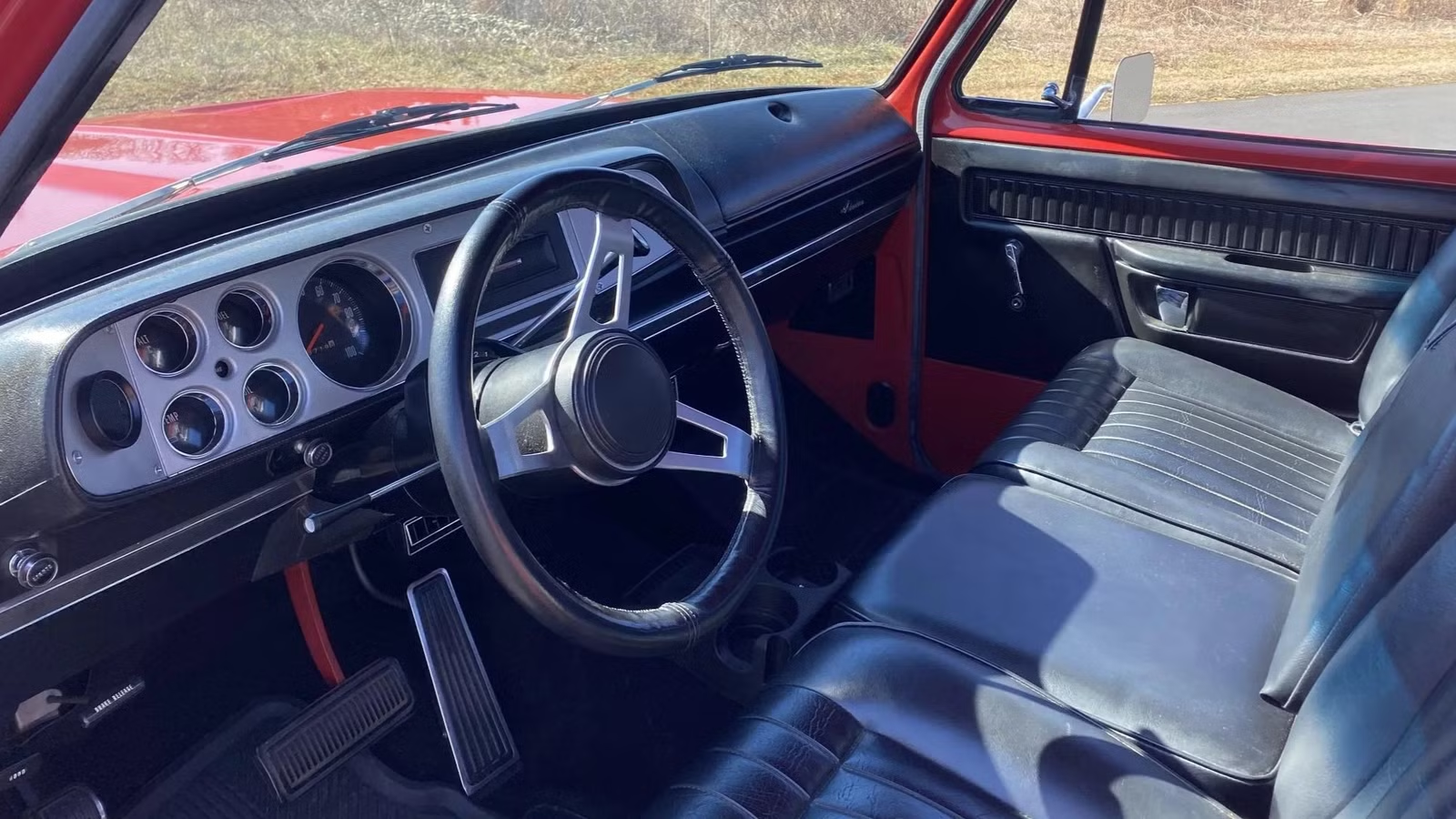
The 1978 Dodge Li’l Red Express pickup truck was the fastest production vehicle in America that year. This muscle truck debuted with a smoke stack exhaus’t, slotted chrome wheels, a step side truck bed lined with oak wood, bright Canyon Red paint with gold pinstriping, and western-style lettering on the doors bearing its name.

This truck became part of a limited-run series of branded “adult toys” offered by Dodge starting in 1976 with the Warlock pickup truck, followed by the Dodge Street Van, the Macho 4×4 Ramcharger, and the Macho Power Wagon. Each of these vehicles deserves its own story.
Under the hood, the Li’l Red Express featured a 360 V8 engine used by Chrysler police cars at the time. This engine was modified with a hotter camshaft, heavy valve springs, a cold-air intake, and a four-barrel 850cfm Carter Thermoquad carburetor. Its A-727 LoadFlite automatic transmission was also upgraded to send power to a 9.25-inch rear end with 3.55 gears. These mechanical upgrades resulted in 225 hp and 295 lb-ft, allowing the stepside pickup truck to reach 0-60 in about 6.6 seconds and run the quarter mile in 15.7 seconds.
The Loophole That Made The Li’l Red Express A Muscle Truck

The real question isn’t why Dodge built a muscle truck, but how they got away with it. In the midst of performance choking emission standards and smog control, how did Dodge sneak the Li’l Red Express under the nose of the federal government? By exploiting a legal loophole and playing the system.
In the late 1970s, passenger vehicles had to meet EPA (Environmental Protection Agency) and NHTSA (National Highway Traffic Safety Administration) standards requiring catalytic converters and lower compression to satisfy Uncle Sam’s smog check. However, light trucks with a gross weight over 6,000 pounds were considered “medium-duty” and didn’t need to meet the same emissions standards as passenger vehicles.

The Dodge D150, the truck on which the Li’l Red Express was based, has a gross weight of 6,100 pounds. So, basically, Dodge disguised a muscle car with a truck bed to exploit this emission regulation gap. But how fast was the 1978 Dodge Li’l Red Express compared to sports cars of the same year?
In 1978, a Li’l Red Express truck could outpace a Corvette C3 L82 in a straight sprint from zero to 100 mph. The truck’s reported 14.71-second quarter mile by Car and Driver magazine meant the little red Dodge was faster than a Porsche 928 (15.31 seconds), the Porsche 911/SC (14.81 seconds), and even a Ferrari 308 GTS (15.08 seconds). Not bad for a work truck with a bench seat and a column-shift automatic.
Dodge Li’l Red Express Inspired A Legacy Of Fast Ram Trucks

The 1978 Dodge Li’l Red Express held the heavyweight title of fastest production vehicle in America for only a brief time. By 1979, the feds had gotten wise to Dodge’s game and enforced catalytic converters, an 85-mph speedometer, and a mild camshaft for the 1979 model year of the Li’l Red Express.
Nevertheless, Dodge sold 2,188 Li’l Red Express pickup trucks in 1978 and another 5,188 units in 1979 before ending production. Today, these low-production numbers and its legend make this smoke-stacked muscle truck a collector’s item. According to Hagerty, at the time of this publication, prices for 1978 Li’l Red Express trucks have held steady, with prices ranging from $16,200 to $48,600. The highest selling price for a pristine example within the last three years was $58,300, according to Hagerty.
Something more valuable than this truck’s resale power is the legacy it created. A legacy that inspired a host of high-performance, muscle-infused Dodge Ram pickup trucks in the decades that followed. Trucks like the Viper V10-powered 2004–2006 Dodge Ram SRT-10, the high-flying supercharged Hemi Ram 1500 TRX, and the upcoming 2027 Ram SRT Rumble Bee street truck. All these Mopar muscle trucks owe their existence and their own legendary status to the little red truck.
Source: Hagerty, Hemmings, Dodge Connection, Corvette Action Center, Dodge, Chevrolet

Related posts

Latest Post



No Comments